A team-oriented plan is especially valuable because marketing work is rarely completed by one person. Content, design, search, paid media, email, social media, sales enablement, analytics, and management often depend on one another. A shared planning system makes those dependencies visible before they become execution problems.
Current marketing planning guidance commonly emphasizes elements such as the executive summary, situation analysis, target audience, objectives, strategy, tactics, budget, timeline, roles, and measurement. These components can be adapted to businesses of different sizes and industries rather than treated as a rigid checklist. :contentReference[oaicite:0]{index=0}
This guide explains how to design and use a team marketing plan template, how to choose between document and spreadsheet formats, how to structure responsibilities, how to connect activities with KPIs, and how to turn a static plan into a practical management system.
What Is a Team Marketing Plan Template?
A team marketing plan template is a reusable planning framework that organizes the decisions and information a marketing team needs to execute its strategy. It normally provides structured areas for goals, target markets, research, positioning, campaigns, channels, budgets, owners, dates, deliverables, and measurement.
The word “team” matters because the template is designed for coordination rather than individual note-taking. A solo marketer may only need a compact planning document, while a department needs clearer ownership, dependencies, approval stages, reporting responsibilities, and communication rules.
A useful template also separates strategic decisions from execution details. The strategy explains why the team is pursuing a particular market or objective. The action plan explains what will be produced, who will do it, when it will happen, how much it will cost, and what evidence will determine whether it worked.
Modern marketing project templates commonly include goals, target audiences, scope, deliverables, timelines, roles, budgets, channels, tactics, and metrics. The exact combination should change according to the size and complexity of the organization. :contentReference[oaicite:1]{index=1}
For that reason, the best template is not necessarily the longest one. It is the one that gives the team enough structure to make decisions and enough flexibility to reflect the way the business actually operates.
Why Teams Need a Shared Marketing Plan
Marketing teams can become inefficient when everyone understands the objective differently. A campaign may be considered a lead-generation initiative by one person, a brand-awareness project by another, and a sales-support activity by a third. The template creates a common definition of success.
Shared planning also reduces duplicated work. For example, a content strategist may schedule an article while the paid media specialist independently plans an advertisement around the same topic. A coordinated calendar can reveal opportunities to reuse research, creative assets, landing pages, and messaging.
Accountability is another major advantage. Assigning an owner to every significant deliverable makes it easier to identify who is responsible for moving work forward. Ownership should not imply that one person completes every part of a task; it means that someone is accountable for coordinating completion.
A shared plan can also make management conversations more objective. Instead of discussing whether the team “feels busy” or whether a campaign “seems to be working,” managers can review deadlines, spending, output, performance indicators, and unresolved dependencies.
Finally, a centralized plan makes adaptation easier. Marketing conditions change, campaigns are delayed, budgets move, and new opportunities emerge. A living plan allows the team to revise priorities without losing the strategic context behind those decisions.
Core Components of a Team Marketing Plan
1. Executive Summary
The executive summary should communicate the purpose of the plan quickly. It can identify the business objective, priority audience, major strategic approach, principal campaigns, expected outcomes, and the resources required to execute the plan.
Although it appears at the beginning, it is usually easier to write the executive summary after the rest of the plan has been developed. At that point, the writer can summarize actual decisions instead of making premature assumptions.
A strong summary is particularly important when the plan will be reviewed by executives or stakeholders who do not need every operational detail. They should be able to understand the direction, rationale, expected contribution, and major risks without reading every worksheet.
For example, a fictional software company might summarize its plan around increasing qualified pipeline from small and midsize businesses through search content, targeted email, partner campaigns, and product demonstrations.
The summary should avoid becoming a collection of vague statements such as “increase awareness” or “improve social media.” Each major objective should connect to an observable business result or a measurable marketing outcome.
2. Business and Market Context
The business overview explains what the organization sells, who it serves, how it creates value, and what business priorities marketing is expected to support. Without this context, marketers can optimize activities that have little connection to commercial priorities.
Market context should describe the relevant category, customer conditions, major trends, competitive environment, and known changes affecting demand. The goal is not to create an academic industry report but to establish enough evidence for strategic decisions.
Market research can combine customer interviews, surveys, website analytics, sales feedback, customer-support information, competitor reviews, search behavior, internal performance data, and credible secondary research.
A useful template should distinguish verified findings from assumptions. If the team believes customers care about faster implementation, for example, the plan should indicate whether that conclusion comes from customer research, sales conversations, support tickets, or an untested hypothesis.
This distinction makes later analysis more reliable. Teams can test assumptions instead of unconsciously treating them as facts, and they can revise the strategy when new evidence becomes available.
3. SWOT and Competitive Analysis
SWOT analysis can help the team organize internal strengths and weaknesses alongside external opportunities and threats. It becomes more useful when each item leads to a strategic implication rather than simply filling four boxes.
For example, a strength such as strong customer retention could support a referral strategy. A weakness such as limited creative production capacity might lead the team to prioritize fewer campaigns with stronger reuse of assets.
Competitive analysis should go beyond listing competitors. Teams can compare positioning, products, pricing, audience focus, content themes, distribution channels, offers, customer experience, and apparent strengths or weaknesses.
Competitive research should be based on observable information rather than speculation about another company’s internal results. Public websites, published offers, customer reviews, advertising libraries, product documentation, and other legitimate sources can provide useful evidence.
The outcome should be a set of decisions: where the business can compete effectively, where it should differentiate, which opportunities are underserved, and which competitive assumptions require additional research.
4. Target Audience and Customer Personas
A team marketing plan should define the audience at a useful level of specificity. Depending on the business model, this may involve demographic, geographic, behavioral, firmographic, psychographic, or purchase-stage information.
Personas can help translate research into practical messaging. A persona should explain what the customer is trying to accomplish, what problems create urgency, what objections slow the decision, what alternatives they consider, and what information helps them move forward.
A persona should not become a fictional biography filled with decorative details that do not affect marketing decisions. Every field should help the team choose a message, channel, offer, content format, or sales-support activity.
Audience segmentation also prevents the team from treating all customers as one group. Different segments may respond to different value propositions, content topics, purchase triggers, and channels.
The strongest audience section therefore connects directly to the strategy. If the plan identifies several customer segments but uses exactly the same message and tactics for all of them, the segmentation may not be doing meaningful work.
5. Marketing Goals and KPIs
Goals should translate business priorities into measurable marketing outcomes. Common categories include demand generation, revenue contribution, customer acquisition, retention, brand visibility, engagement, traffic, conversion, or expansion.
A practical objective can follow the SMART principle: specific, measurable, achievable, relevant, and time-bound. The point is not to make every goal complicated; it is to remove ambiguity about what success means.
Each goal should have one or more KPIs that provide evidence of progress. For example, a lead-generation objective might track qualified leads, conversion rate, cost per qualified lead, and pipeline value rather than relying only on website traffic.
Teams should distinguish leading indicators from lagging indicators. Traffic, content engagement, and form completion may provide early signals, while revenue, retained customers, or completed sales provide later evidence of commercial impact.
Measurement should also include a review cadence. A metric that is checked only at the end of the year cannot help a team correct a campaign that is underperforming in its second month.
Visual Example: Turning Goals Into an Actionable Work Plan
A marketing goal becomes easier to manage when it is broken into action steps, dates, expected outcomes, evidence sources, responsible owners, and notes. This structure prevents the plan from stopping at high-level strategy.
For example, a goal to improve organic lead generation could include technical SEO work, content production, internal linking, landing-page improvements, conversion testing, and reporting. Each activity should have a defined owner and a measurable completion condition.
The action plan should also identify dependencies. A landing page may depend on copy approval, design, development, analytics tagging, and legal review. If those dependencies remain invisible, a single delayed approval can disrupt an entire campaign.
A practical team work plan template can therefore sit beneath the strategic marketing plan. It translates the strategy into operational work without forcing the strategic document to contain every small task.
The following example shows how a structured work-plan layout can connect goals, action steps, timelines, expected outcomes, evaluation methods, responsible areas, and comments.
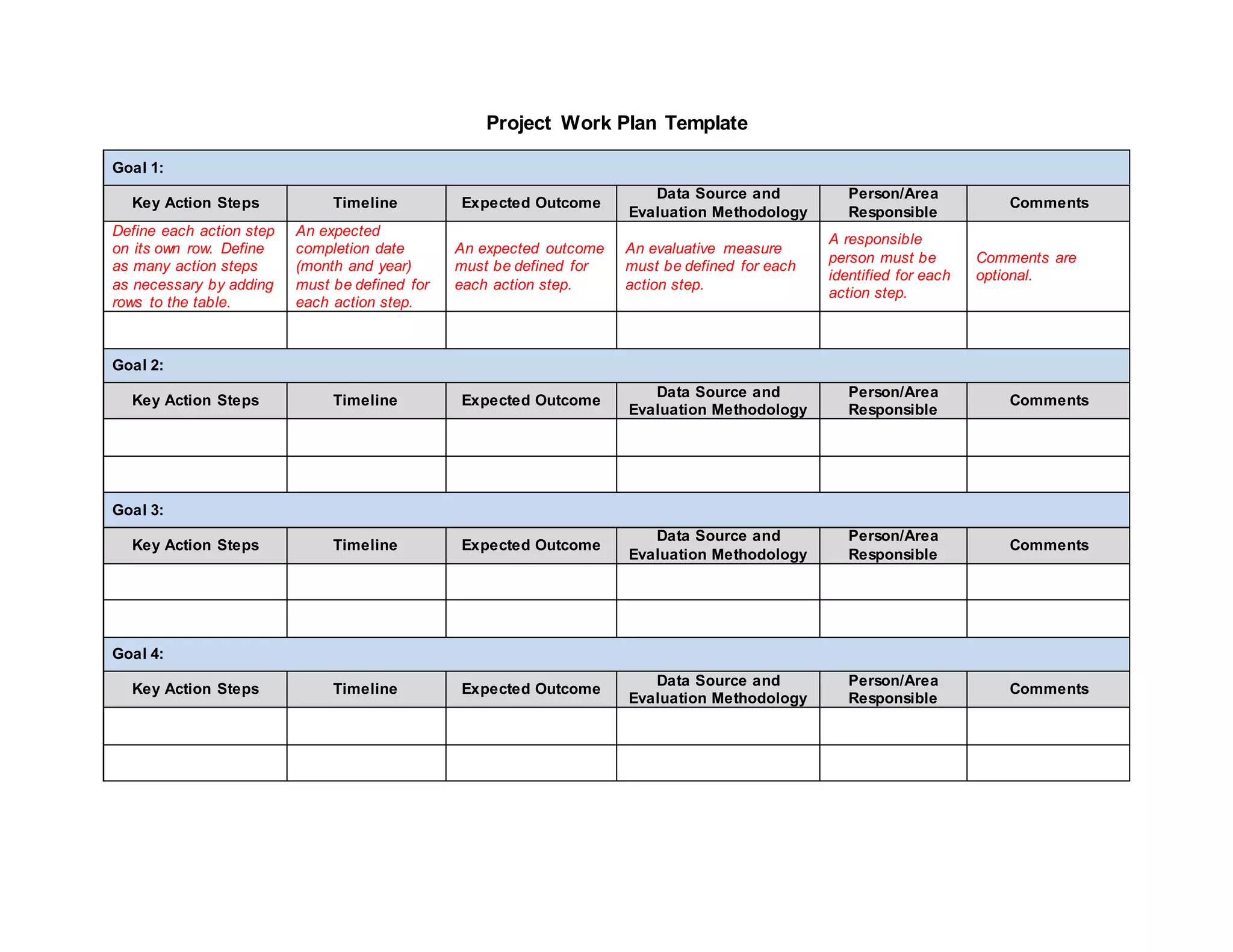
The value of this layout is its emphasis on accountability and evaluation. A task is stronger when the team can explain not only who will perform it and when, but also what result should follow and how that result will be evaluated.
Choosing the Right Template Format
Document-Based Templates
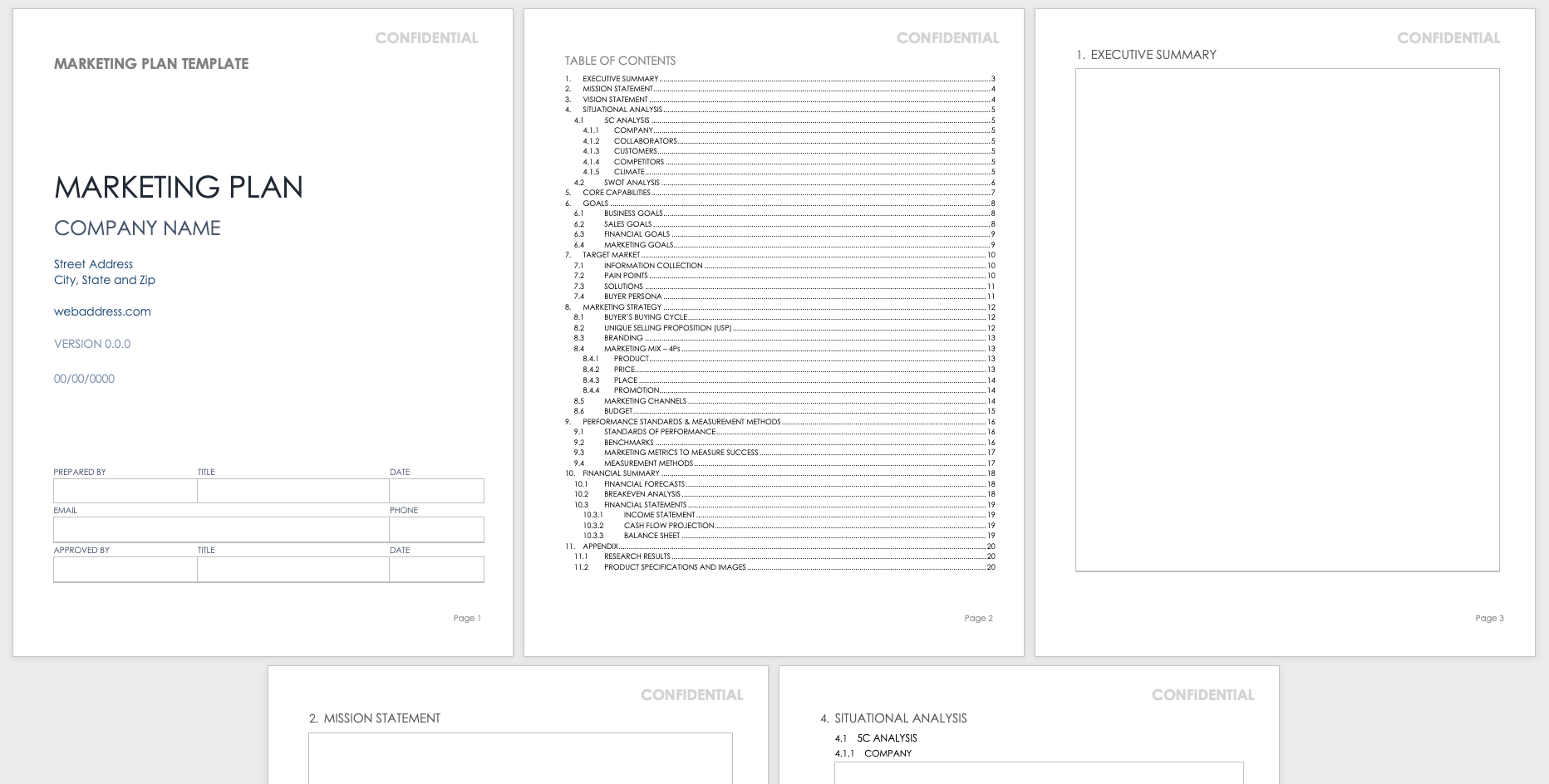
Document formats are useful when the marketing plan needs substantial narrative. They work well for executive reviews, annual strategy documents, business cases, detailed market analysis, and plans that require explanation around each decision.
A document can provide space for the reasoning behind a strategy, including research findings, competitive observations, positioning decisions, audience descriptions, and assumptions.
Microsoft Word is often convenient for formal documents because teams can use headings, tables, comments, version history, and standard organizational formatting. A team marketing plan template word format is especially useful when stakeholders expect a conventional business document.
PDF is generally better suited to distribution and presentation than ongoing collaborative editing. A team marketing plan template pdf can serve as a controlled final version after the working plan has been approved.
The key distinction is that a PDF should normally represent a finalized or review-ready plan, while the editable source should remain available for future revisions.
Spreadsheet Templates
Spreadsheets are particularly effective for budgets, timelines, campaign trackers, KPI dashboards, content calendars, ownership tables, and other structured information that changes frequently.
A team marketing plan template excel format can be useful when calculations, conditional formatting, filters, formulas, and structured tables are important to the workflow.
Google Sheets can be preferable when several contributors need simultaneous access, especially when the organization already works in a cloud-based productivity environment. A team marketing plan template google sheets approach can combine planning, ownership, budgets, and status tracking in one collaborative workbook.
The best spreadsheet plans avoid excessive complexity. A workbook containing dozens of tabs, inconsistent formulas, hidden assumptions, and unclear ownership can become harder to manage than a simple document.
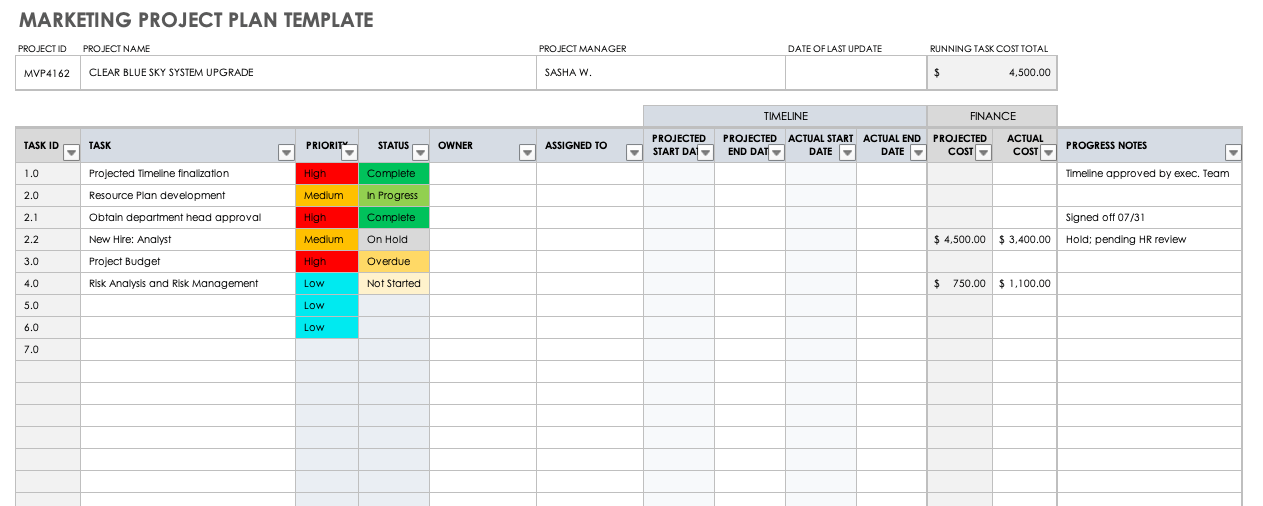
Whether the team uses Excel or Google Sheets, the structure should make the next action obvious. A useful row should answer what is being done, why it matters, who owns it, when it is due, what it costs, and how success will be assessed.
Presentation Templates
A presentation is useful when the marketing plan must be communicated rather than merely stored. A leadership presentation can summarize objectives, market findings, strategic choices, campaign priorities, budget allocation, milestones, and KPIs.
A team marketing plan template ppt format should prioritize visual hierarchy. Each slide should have one clear purpose rather than attempting to reproduce an entire spreadsheet on screen.
Presentations are especially useful for approval meetings. The detailed working plan can remain in a document or spreadsheet while the presentation communicates the decisions that require stakeholder understanding or approval.
Charts, timelines, simple matrices, and concise tables can help stakeholders understand the plan quickly. Detailed operational information should usually remain in the underlying working file.
The presentation should also state what decisions are needed from stakeholders. Asking for approval of a budget, campaign direction, audience priority, or launch date is more useful than simply displaying the plan and ending the meeting.
Visual Example: A Structured Marketing Plan
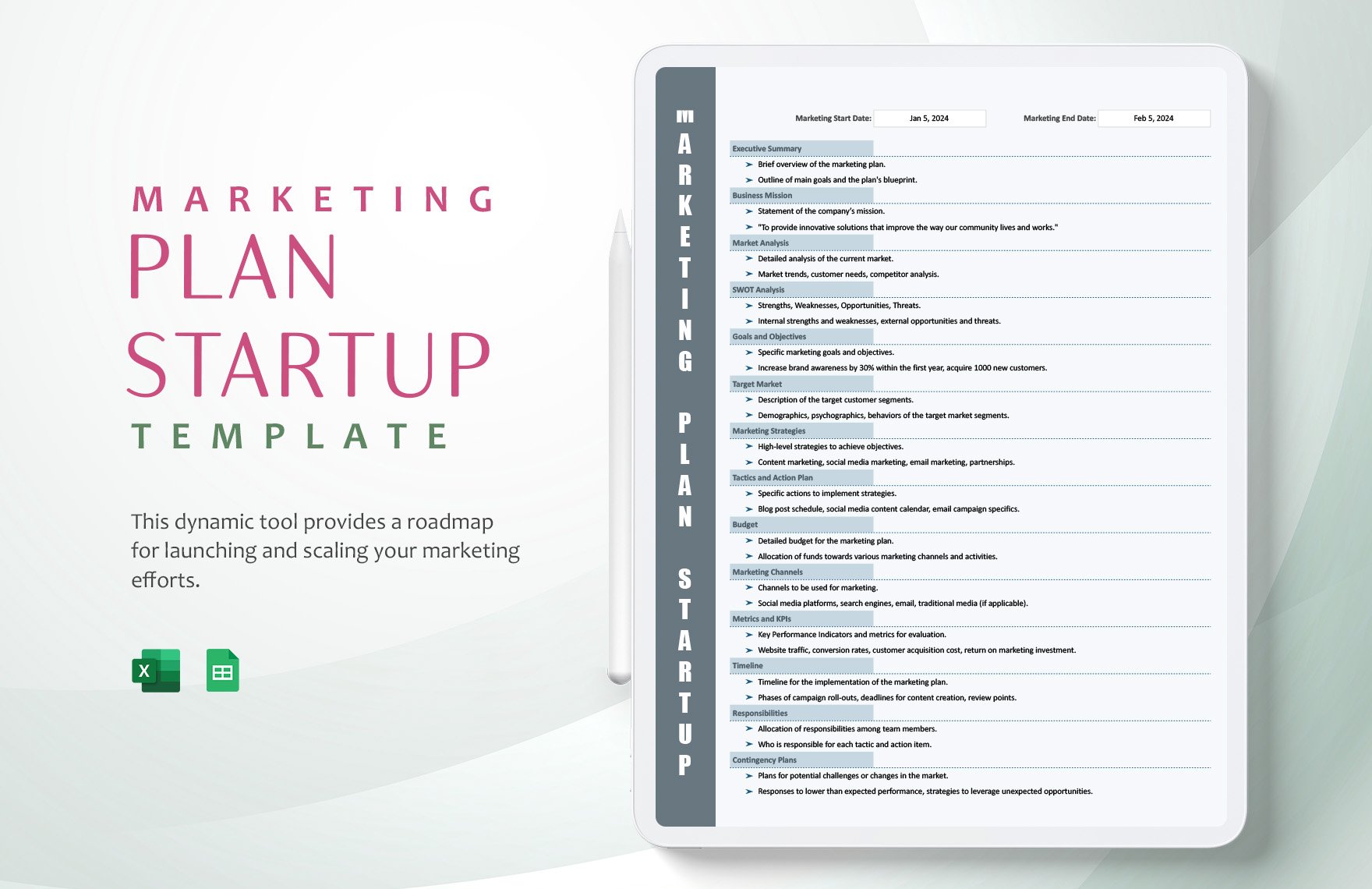
A good marketing plan document makes the relationship between sections easy to follow. Business context should lead to market analysis, market analysis should inform the target audience, and the audience definition should influence positioning and channel choices.
This logical progression helps prevent a common planning mistake: choosing tactics before deciding what the business is trying to accomplish. If a team starts with “we should post more on social media,” it may be solving an activity problem rather than a business problem.
A structured document can also make review easier. Managers can move directly from objectives to strategies, from strategies to tactics, and from tactics to measurement without hunting through unrelated files.
For smaller organizations, a one-page structure may be enough. Larger teams may need supporting documents for research, personas, competitive analysis, budgets, calendars, campaign briefs, and performance reporting.
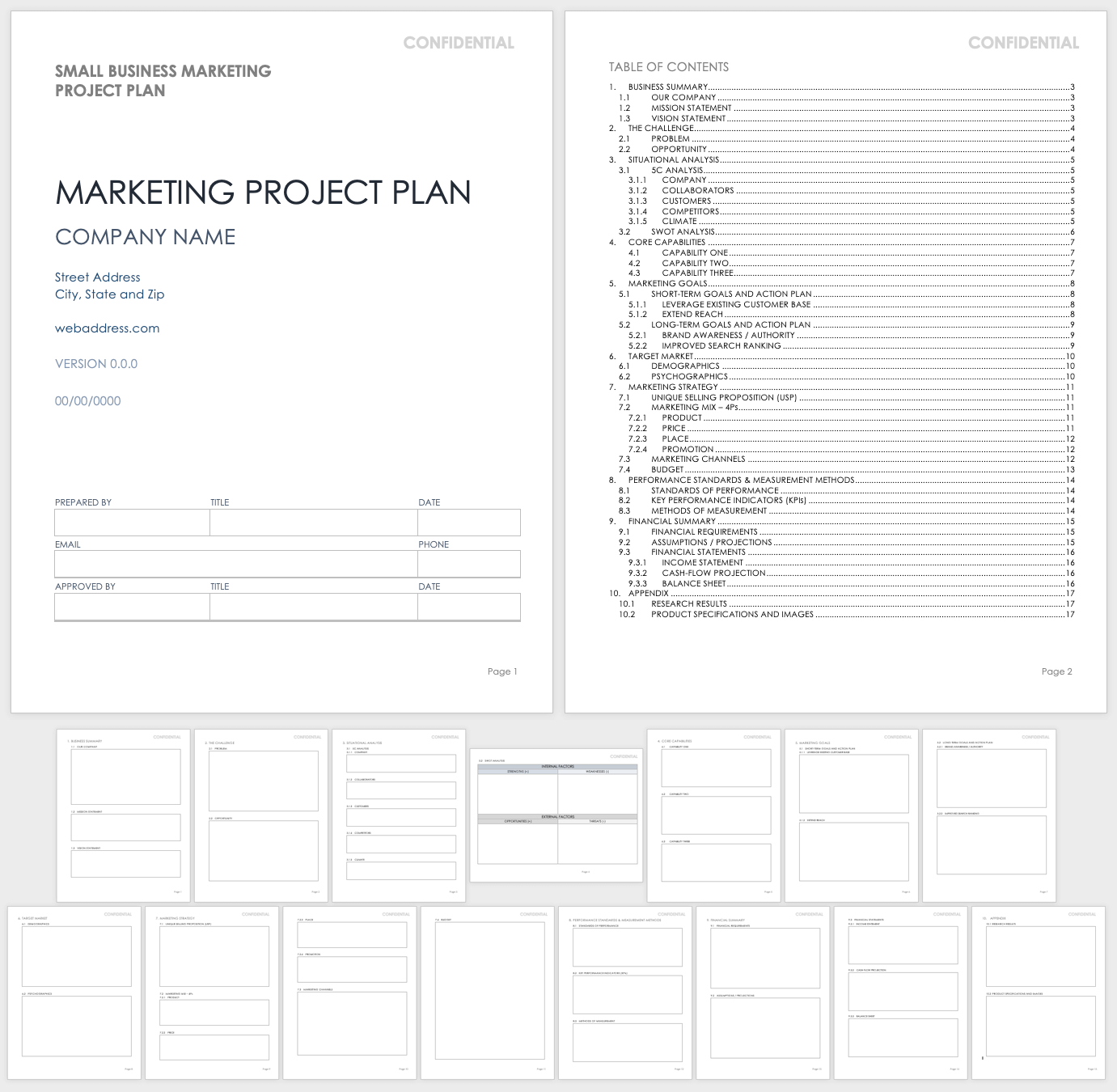
The visual below illustrates how a marketing plan can combine an executive summary, situation analysis, target market, and marketing strategy into a readable document structure.

This type of layout is useful as a starting point because it provides prompts rather than requiring the team to invent a structure from scratch. The prompts can then be customized to the organization’s industry, customer journey, and planning cycle.
How to Create a Team Marketing Plan Step by Step
Step 1: Define the Planning Period
Start by deciding what period the plan covers. An annual plan can provide strategic direction, while quarterly plans can translate that direction into more immediate priorities.
Do not confuse the planning period with the review period. A plan may cover twelve months while being reviewed monthly and formally recalibrated each quarter.
Define important business dates before creating the campaign calendar. Product launches, seasonal peaks, trade events, financial periods, renewals, promotions, and product releases can affect the timing of marketing activities.
Establishing these constraints early helps the team distinguish fixed dates from flexible activities. A campaign tied to a product launch may have little schedule flexibility, while an evergreen article may be moved without major consequences.
The final planning period should be visible throughout the template so contributors understand which dates and assumptions apply to their work.
Step 2: Gather Evidence
Collect the information required to make strategic decisions before assigning large numbers of tactics. Useful inputs can include customer research, website analytics, CRM data, campaign history, sales feedback, competitive observations, and internal business priorities.
A market research plan can help the team specify the questions it needs to answer, the data required, the collection method, the timetable, participants, analysis approach, and reporting format.
This prevents research from becoming an open-ended exercise. If the decision is whether to prioritize two customer segments, for example, the research should gather evidence that can actually inform that choice.
Research should also record its limitations. A small survey, a narrow customer sample, or incomplete analytics may provide useful directional information without proving a broad market conclusion.
The team can then classify findings as established evidence, working assumptions, open questions, or hypotheses that require testing.
Visual Example: Market Research Planning
A research plan should make the connection between questions and decisions visible. It should identify what the team wants to learn and why that information matters to the marketing strategy.
Research questions should be specific enough to answer. “Who are our customers?” is broad, while “Which onboarding barriers most often prevent small-business prospects from completing a trial?” provides a clearer direction.
The collection method should match the question. Interviews can reveal motivations and language, surveys can quantify responses, analytics can show behavior, and competitor research can reveal observable positioning patterns.
The plan should specify how results will be analyzed before data collection begins. Otherwise, teams can gather large amounts of information without knowing what decision criteria will determine the final recommendation.
A single-page research canvas can be useful when multiple contributors need to understand the objective, questions, data collection, analysis, timetable, participants, and reporting requirements.
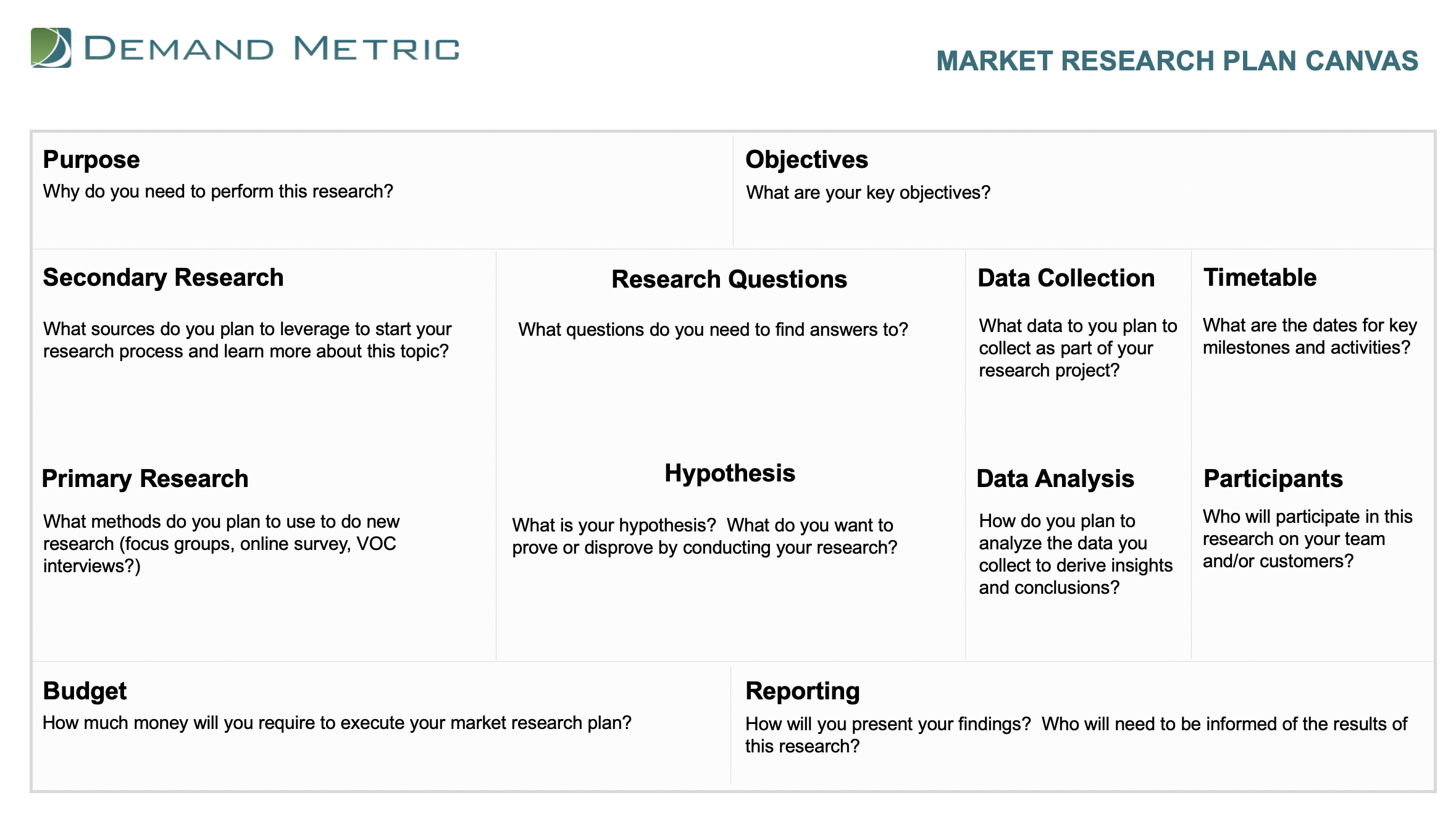
The important lesson is that research belongs inside the marketing planning process, not outside it. Findings should influence audience definitions, positioning, messaging, channel priorities, or resource allocation.
Step 3: Define Strategic Objectives
Once evidence has been gathered, define a small number of strategic objectives. Limiting the number of major objectives helps teams focus resources rather than distributing effort across too many competing priorities.
Each objective should describe an outcome rather than a task. “Publish twenty articles” is an output target; “increase qualified organic demand” describes the result the activity is intended to support.
Outputs still matter, but they should sit underneath outcomes. The content team can own article production while the broader marketing team monitors organic visibility, qualified traffic, conversions, and pipeline contribution.
Objectives should also have clear ownership. A team may collectively contribute to a goal, but one person should normally be accountable for coordinating progress and reporting.
Review objectives against available resources before final approval. A strategically attractive plan that requires more people, budget, or production capacity than the organization can provide is not an executable plan.
Step 4: Select Strategies and Channels
Strategy describes the broad approach the team will use to achieve its objectives. Channels are the environments or distribution methods through which that strategy will be delivered.
Potential channels include organic search, paid search, social media, email, partnerships, events, public relations, content marketing, communities, referral programs, and direct outreach. The appropriate mix depends on the audience and business model.
Channel selection should be evidence-based. A channel should have a defined audience role and a reason for inclusion rather than appearing because competitors use it or because it is currently popular.
Teams should also decide what each channel is expected to accomplish. Search might capture existing demand, while educational content builds consideration and email supports retention or conversion.
Clear channel roles make the overall plan more coherent and reduce the temptation to measure every platform using the same KPI.
Visual Example: Campaign Brief Structure
A campaign brief connects strategy to execution. It can define the campaign objective, audience, core message, creative requirements, channels, budget, KPIs, content plan, timeline, team responsibilities, and approval process.
Using a consistent brief prevents campaign teams from starting production with missing information. Designers know the intended audience and message, writers know the positioning, and analysts know what should be tracked.
The brief should state the campaign’s purpose in plain language. A campaign designed to generate qualified leads should not use the same success criteria as a campaign designed primarily to build awareness.
Creative requirements should also be specific enough to prevent unnecessary revision cycles. Define the required formats, core message, brand constraints, calls to action, and approval requirements before production begins.
A standardized brief can therefore become a bridge between the strategic marketing plan and individual campaigns.

The example illustrates why a campaign brief should include both strategic and operational information. The document is not merely a creative request; it establishes the conditions under which the campaign will be judged.
Step 5: Map Ownership and Responsibilities
Assigning responsibilities is one of the most important differences between an individual marketing plan and a team marketing plan. Every major deliverable should have an accountable owner and, where necessary, supporting contributors.
A RACI-style structure can clarify who is responsible, accountable, consulted, and informed. It is particularly useful when work crosses departments and approval responsibilities are otherwise unclear.
Responsibility should be assigned at the right level. Giving one person ownership of a complete campaign may make sense, while assigning separate owners for copy, design, media buying, analytics, and web development may be more practical for larger teams.
The plan should also distinguish ownership from approval. The person producing an asset may not be the person authorized to approve it, and that distinction should be visible before work begins.
Clear ownership reduces bottlenecks because team members know where questions should go, who makes decisions, and who must be consulted before a deliverable can move forward.
Visual Example: Responsibility Mapping
A responsibility matrix can turn an abstract team structure into an operational tool. Instead of listing job titles in a separate organization chart, the matrix connects roles directly to activities.
For example, the marketing manager might be accountable for campaign strategy, a content lead responsible for messaging, a designer responsible for creative assets, a media specialist responsible for paid distribution, and an analyst responsible for measurement.
Not every task needs a complicated matrix. Use one when multiple roles interact, approvals are sensitive, or missed ownership could create delays or duplicated work.
The matrix should be reviewed whenever team structure changes. A responsibility table that reflects last year’s organization can become actively misleading after hiring, restructuring, outsourcing, or role changes.
The following visual demonstrates how a team-oriented RACI structure can connect marketing activities with different responsibilities.
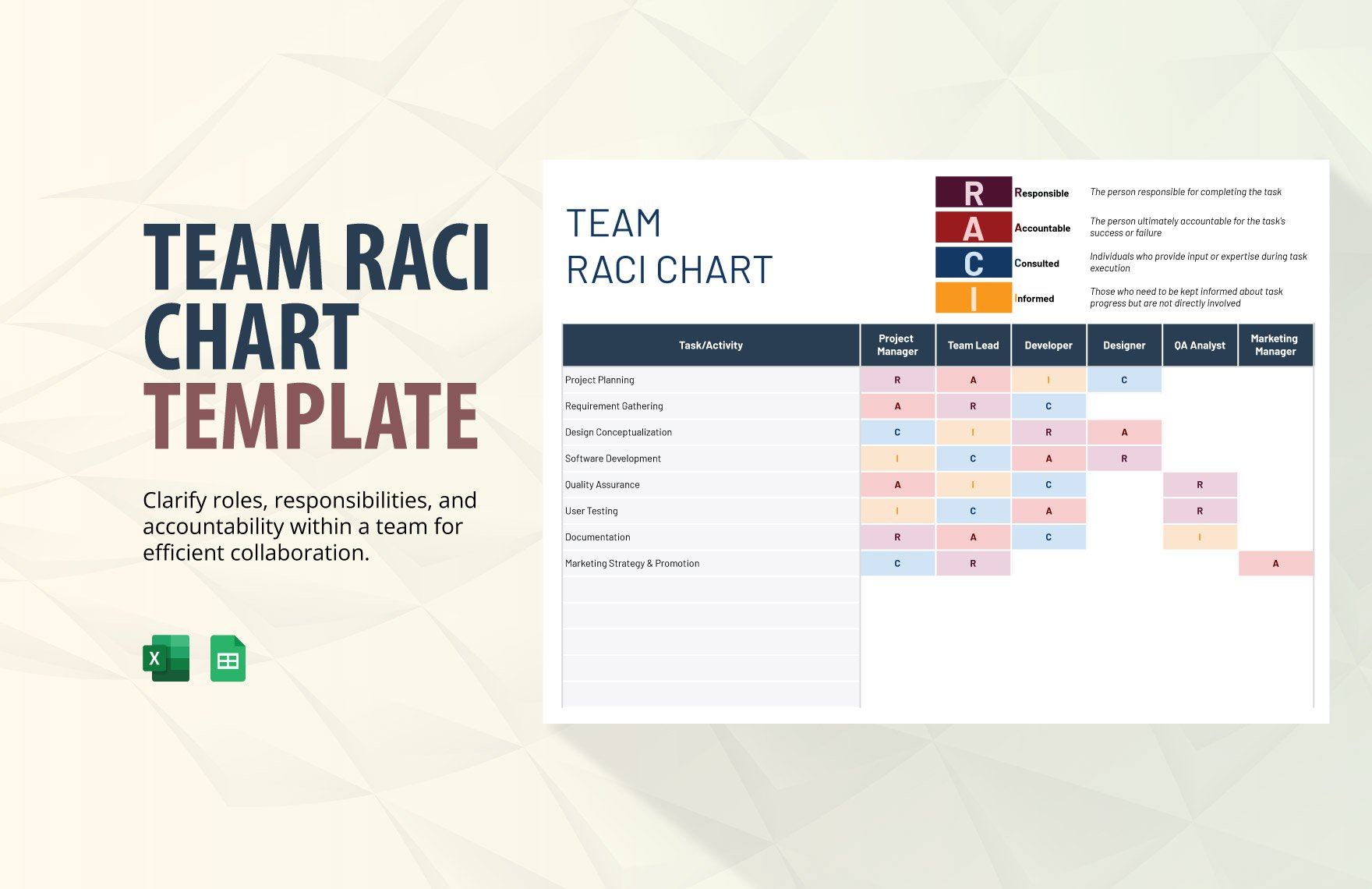
The visual approach is useful because responsibility becomes visible at a glance. In practice, the exact role labels should be adapted to the organization’s structure rather than copied without modification.
Step 6: Build the Budget
A marketing budget should connect spending with planned activities and expected outcomes. It can include media, creative production, software, agencies, research, events, sponsorships, content production, web development, and other relevant expenses.
Budgets can be organized annually, quarterly, monthly, by campaign, or by channel. The best structure depends on how the organization approves and controls spending.
Projected and actual costs should be separated. A plan that only records the approved budget cannot tell the team whether campaigns are overspending or whether unused resources are available for opportunities.
Budget owners should understand the difference between committed spend and estimated spend. This distinction becomes important when contracts, media reservations, or production costs create obligations before invoices arrive.
Do not treat a budget as a static number. It should be reviewed alongside performance, priorities, and changing market conditions so the team can shift resources toward higher-value opportunities when appropriate.
Visual Example: Marketing Budget Structure
A useful budget sheet separates campaign categories, quantities, projected cost per unit, projected subtotals, and comments or assumptions. This makes the calculation logic easier to inspect.
For example, a content campaign might include production costs, distribution costs, design support, landing-page development, and promotional spend. Grouping those costs under one campaign makes it easier to compare investment with results.
The team can also compare budget categories over time. If paid acquisition consumes more resources than planned while producing weaker results, management has evidence for reviewing the allocation.
Budget visibility is particularly important when several campaigns compete for the same resources. A central sheet can show whether new requests are genuinely incremental or simply move resources from another initiative.
A structured marketing budget therefore supports both financial control and strategic prioritization.
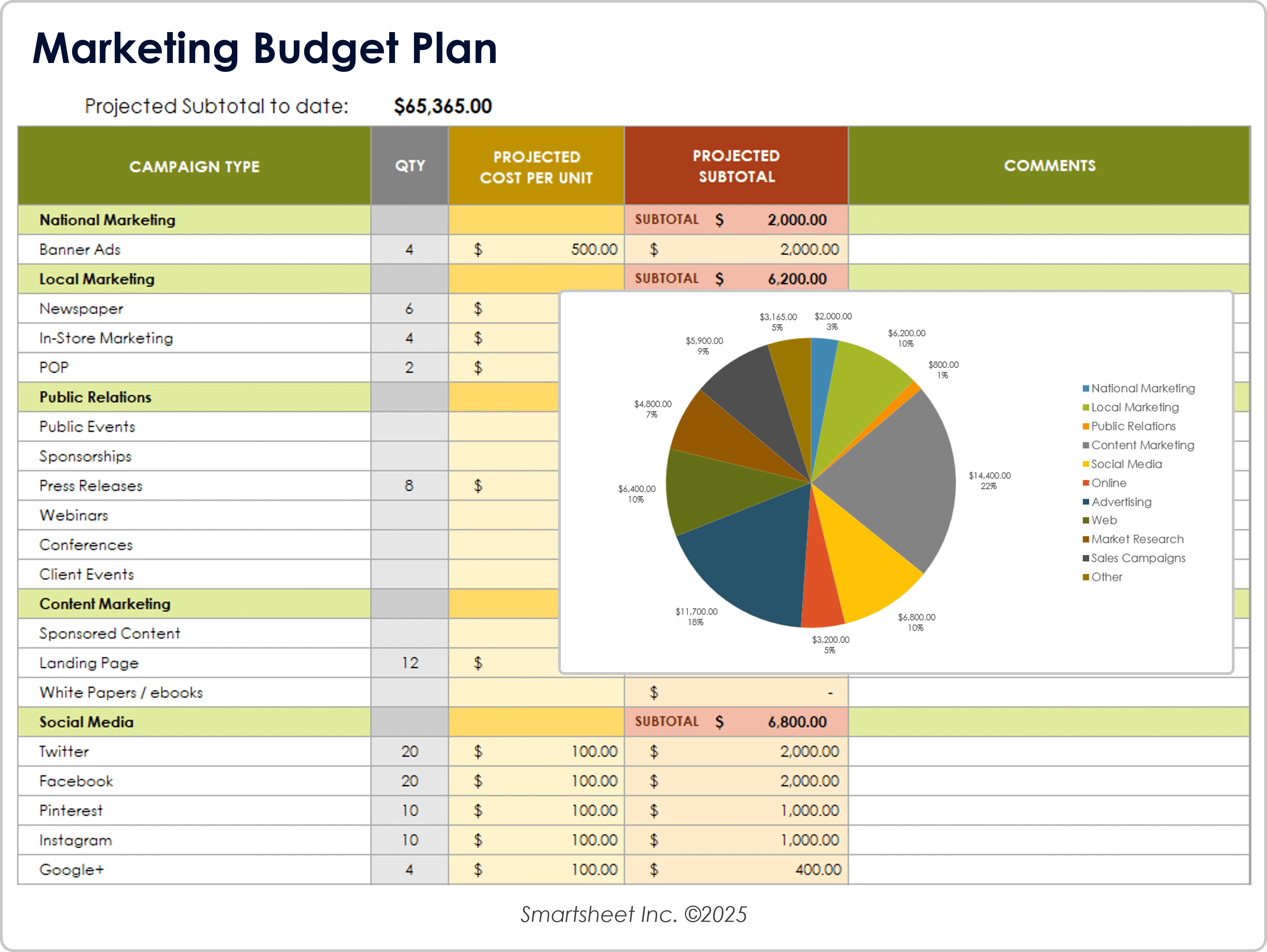
The example shows how a budget can combine detailed line items with a visual summary. The exact categories and figures should always be replaced with the organization’s own approved assumptions rather than copied from a sample.
Step 7: Create the Timeline
A marketing timeline translates strategy into sequence. It should show when campaigns begin, when major deliverables are due, when approvals happen, and when results will be reviewed.
Gantt-style planning is useful when tasks have dependencies. For example, research may precede messaging, messaging may precede creative production, creative production may precede media launch, and analytics setup must be complete before measurement begins.
A calendar view is often better for recurring work such as newsletters, social posts, content publication, events, or monthly reporting. Many teams use both a strategic timeline and a detailed calendar.
The timeline should include milestone dates, not only production tasks. Important milestones can include strategy approval, creative approval, campaign launch, optimization review, reporting, and retrospective analysis.
Keep enough flexibility for change. A useful timeline identifies critical dates while allowing lower-priority work to move when business conditions require it.
Visual Example: Marketing Timeline
A Gantt chart can show the relationship between marketing activities across a longer period. It is particularly useful when campaigns, content, public relations, search initiatives, and social activities overlap.
Grouping tasks by activity type makes the schedule easier to read. A team can see whether too many launches are concentrated in the same period or whether a critical channel has insufficient production time.
Dependencies are also easier to recognize visually. If a landing page is scheduled after the advertising launch, for example, the timeline exposes the problem before the campaign reaches production.
Teams can update the chart as dates change rather than rebuilding the plan from scratch. This makes the timeline useful as an operational document instead of a one-time planning artifact.
The following Gantt-style example demonstrates how marketing tasks can be organized across dates, categories, and campaign activities.
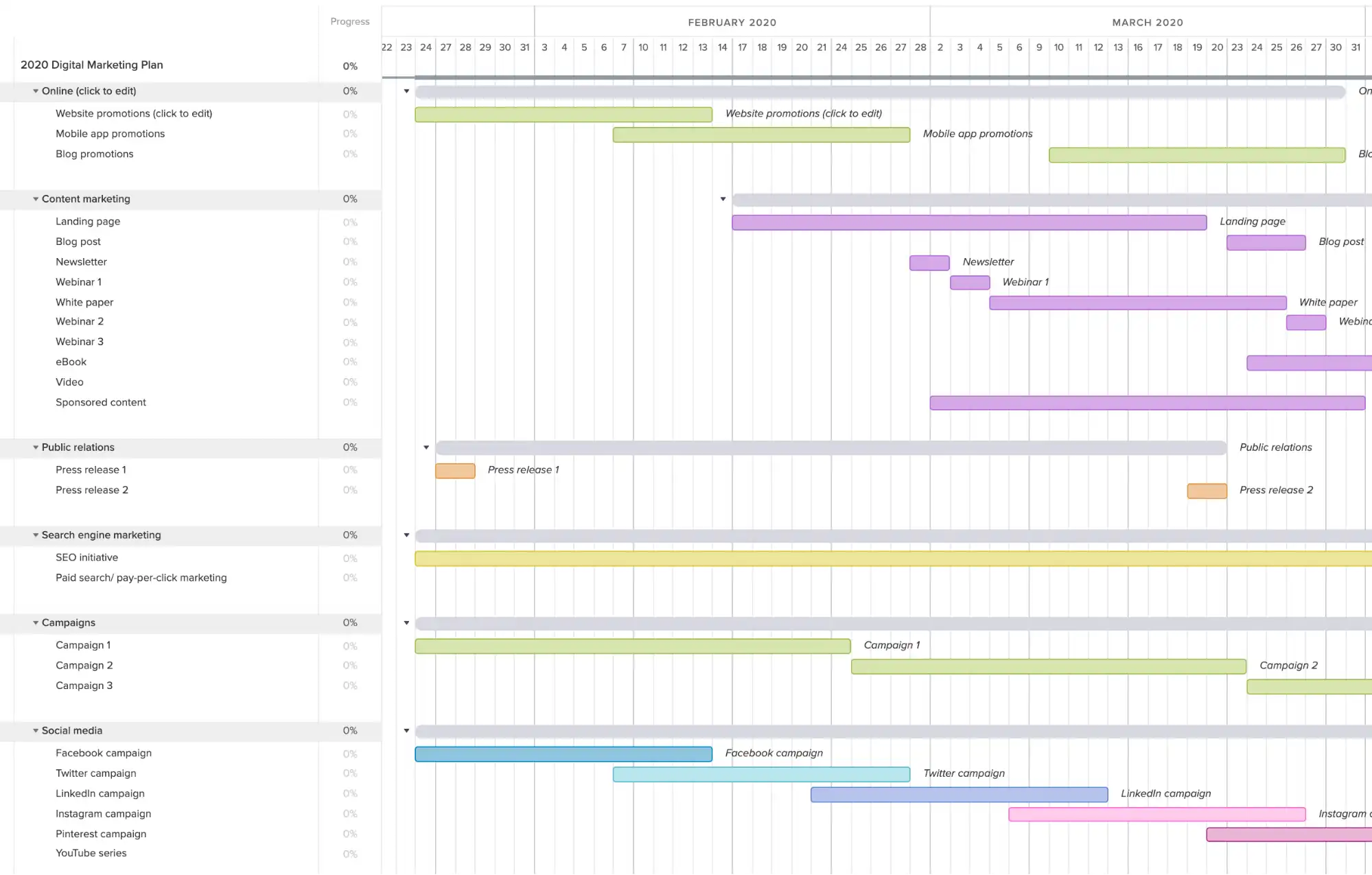
For a small team, a simpler timeline may be enough. The objective is not to produce an elaborate project-management chart but to make sequence, deadlines, dependencies, and ownership understandable.
Using Data and Dashboards to Manage the Plan
A marketing plan becomes more valuable when the team can monitor performance without manually rebuilding reports every time. A dashboard can provide a consistent view of the indicators most closely connected to the plan’s objectives.
Dashboard metrics should be selected based on decisions. If the team needs to decide whether to increase paid search spending, useful measures may include spend, clicks, conversion rate, cost per acquisition, qualified leads, revenue, and return on investment.
A dashboard should not become a dumping ground for every available metric. Too many numbers make it harder to identify what actually requires attention.
Teams should also document metric definitions. Terms such as “lead,” “qualified lead,” “conversion,” “customer,” and “revenue influenced” can mean different things across departments.
Consistent definitions are essential when marketing, sales, finance, and leadership review the same plan. Otherwise, teams may spend meetings debating numbers rather than deciding what to do next.
Visual Example: Marketing KPI Dashboard
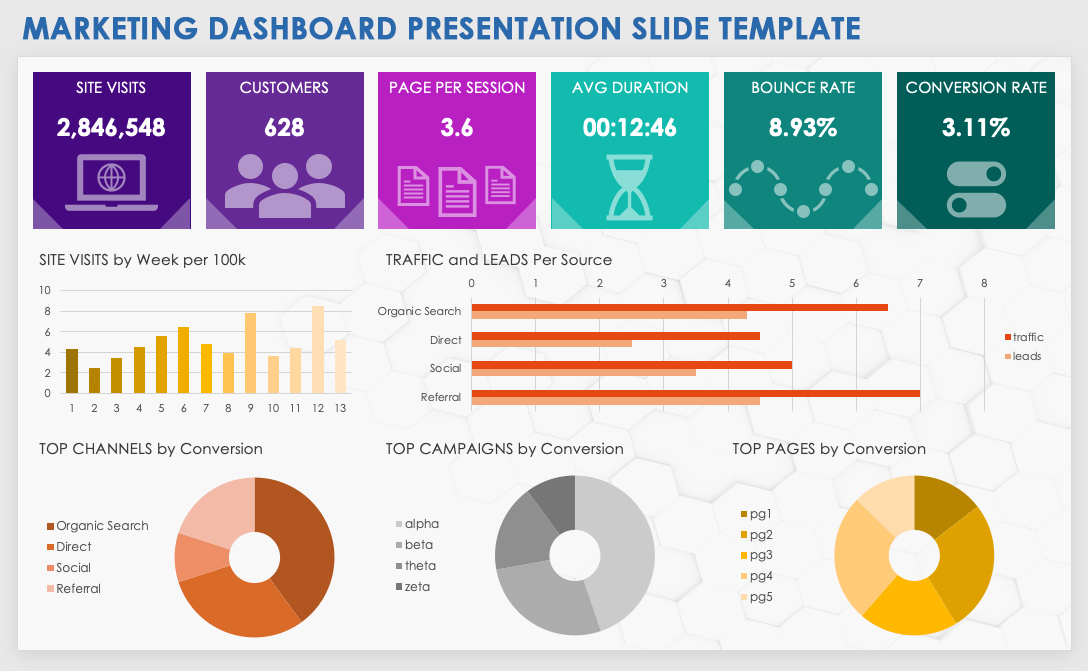
A KPI dashboard can combine headline indicators with charts that show trends over time. This format is useful for leadership because it provides a high-level view while still revealing changes in performance.
The dashboard should distinguish current performance from targets. A number without a benchmark does not necessarily indicate whether the team is performing well.
It is also useful to show changes over time rather than relying only on cumulative totals. Trend information can reveal deterioration or improvement before the annual result becomes obvious.
When possible, dashboards should connect metrics to campaign and channel dimensions. That enables the team to investigate why performance changed instead of merely observing that it changed.
A well-designed dashboard supports the marketing plan’s measurement section and provides a practical foundation for recurring performance reviews.
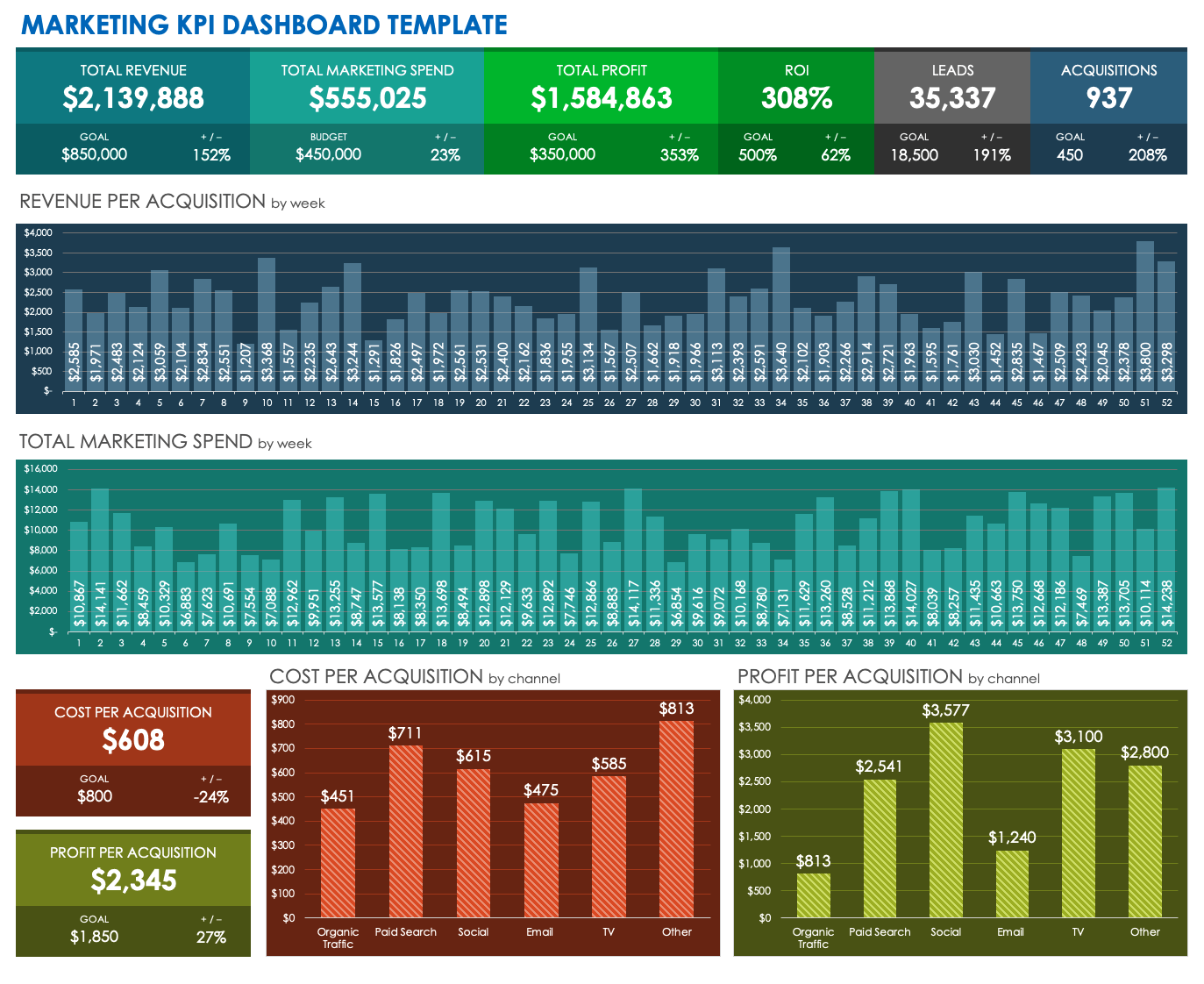
The displayed figures are illustrative template data rather than evidence about a real company. When implementing a dashboard, replace sample values with validated data from the organization’s analytics, advertising, CRM, and financial systems.
Visual Example: Campaign Performance Dashboard
Campaign dashboards can be more focused than executive dashboards. They can compare planned and actual budget, campaign outcomes, awareness indicators, perception measures, and other metrics tied to a specific initiative.
This makes them useful during campaign reviews. A team can see whether a campaign is on budget, whether its performance differs from expectations, and whether optimization or reallocation is required.
Performance dashboards should be linked to the original campaign objective. If the campaign’s purpose is lead generation, a dashboard dominated by impressions may provide an incomplete picture.
At the same time, awareness metrics can be valuable when they represent an intermediate stage of the customer journey. The correct KPI set depends on the role the campaign is supposed to play.
A campaign dashboard should therefore answer the management question, “What should we do next?” rather than simply presenting attractive charts.
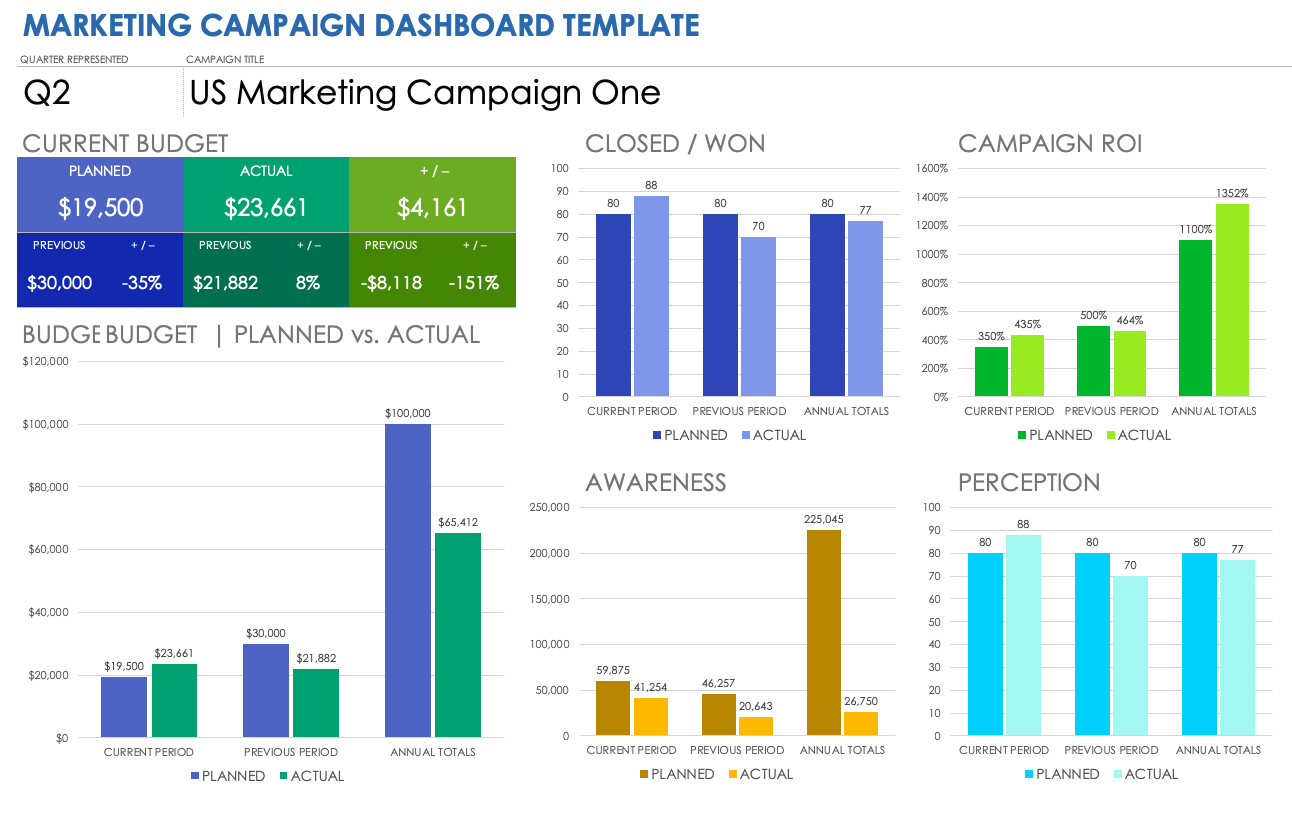
The visual structure provides a useful model for comparing planned and actual performance. A team can adapt the categories to match its own objectives, reporting definitions, and financial controls.
Visual Example: Funnel Measurement
Marketing funnels help teams understand how activity moves from initial attention toward deeper engagement and conversion. A funnel can organize metrics by stage rather than treating every interaction as equally valuable.
For example, a business might track visits at the top, leads or contacts in the middle, qualified opportunities later, and customers near the bottom. The exact stages should reflect the organization’s actual customer journey.
Funnel analysis can also reveal where performance is weakening. Strong traffic combined with weak lead conversion may suggest an offer or landing-page problem rather than a traffic problem.
Likewise, strong lead volume with weak sales acceptance may indicate audience quality, qualification, positioning, or sales-process issues.
Marketing teams should therefore treat funnel metrics as diagnostic tools, not simply scorecards.
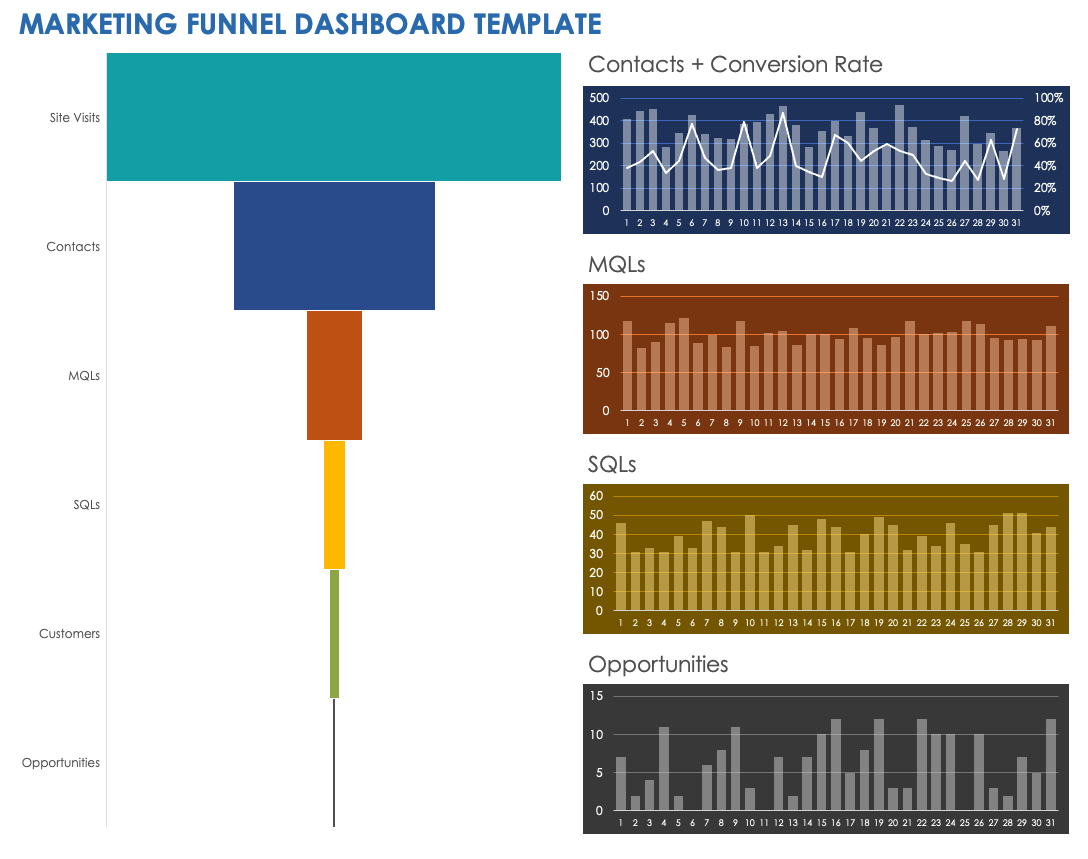
A funnel dashboard can make stage-to-stage movement easier to discuss. It should be combined with clearly documented definitions so everyone agrees on what each stage represents.
Visual Example: Sales and Marketing Alignment
Marketing plans are more effective when they define how marketing activity connects with sales outcomes. This is especially important for organizations where marketing generates leads that sales must qualify and convert.
Shared reporting can include visitors, new leads, qualified leads, opportunities, deals, revenue, and conversion rates. The team can then identify whether performance problems originate in acquisition, qualification, conversion, or another stage.
Marketing and sales should also agree on ownership rules. A lead may be generated by marketing but become a sales responsibility after meeting defined qualification criteria.
These agreements belong in the planning process because unclear handoffs can undermine otherwise strong campaigns.
The objective is not to make marketing responsible for every sales outcome, but to create a transparent connection between marketing activity and the business results it is intended to influence.
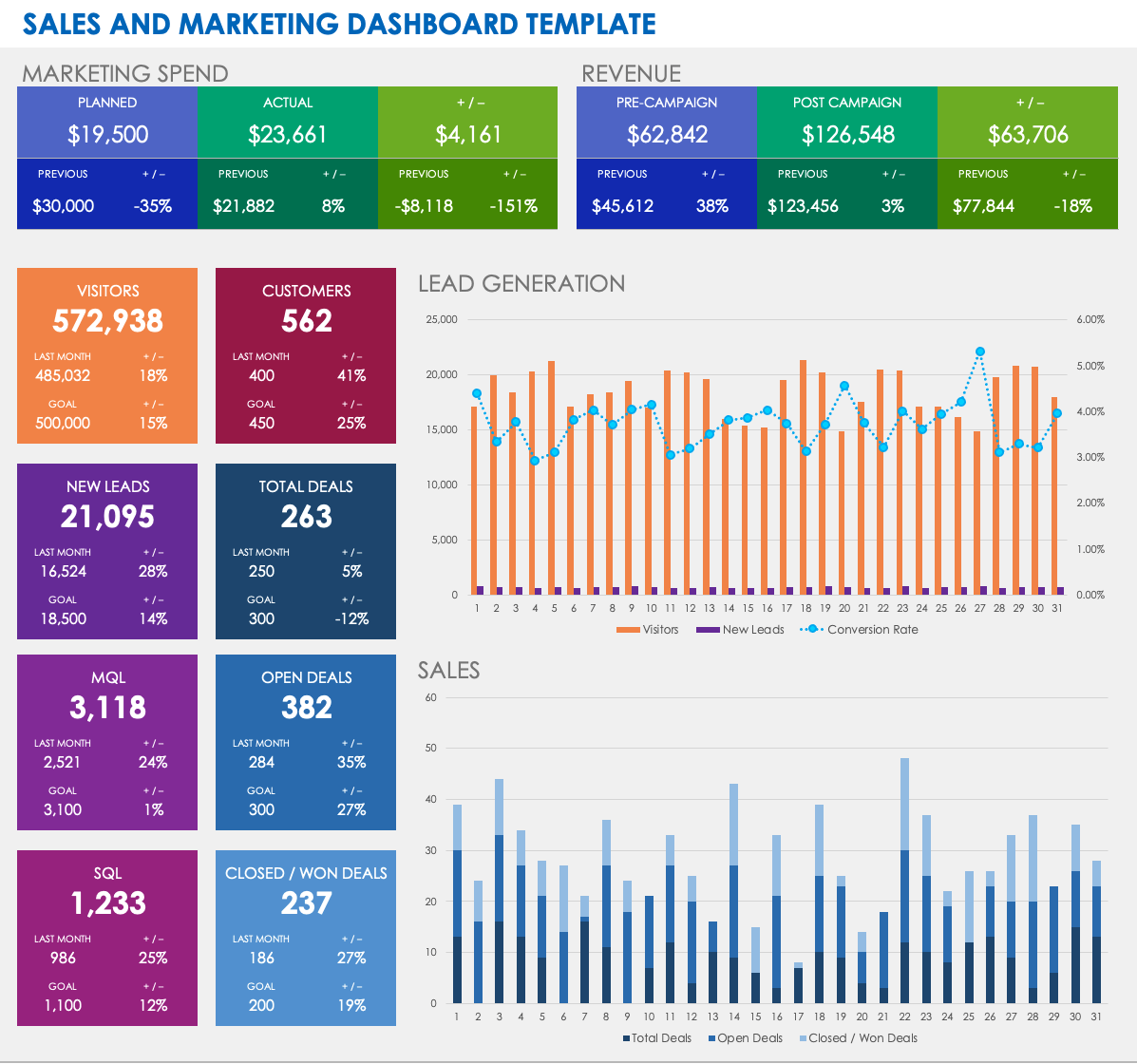
A shared dashboard can help both functions discuss the same funnel rather than relying on separate reports. It also provides a practical basis for identifying handoff problems and deciding where additional analysis is needed.
How to Build a Marketing Plan Example Template
A marketing plan example template should demonstrate structure without pretending that sample information applies universally. The strongest examples show how objectives, audiences, tactics, owners, costs, and metrics fit together.
Consider a fictional subscription business that wants to increase qualified trial users. Its plan might define small-business owners as a priority audience, position the product around faster setup, and prioritize educational search content, comparison pages, email nurturing, and targeted paid campaigns.
The plan could then assign content production to a content lead, landing-page work to the web team, paid acquisition to a performance specialist, and measurement to an analyst.
Each campaign would receive a budget, launch window, KPI set, and review date. If paid acquisition produces traffic but not qualified trials, the team can investigate the landing page, audience targeting, offer, or message rather than automatically increasing spend.
This is the difference between a template that merely looks professional and one that supports actual decision-making.
Team Management and the Marketing Plan
A team management plan template can complement the marketing plan when the main challenge is coordination. It may define team structure, responsibilities, communication rules, decision rights, approval processes, meeting cadence, escalation paths, and resource requirements.
The marketing plan should remain focused on marketing objectives and execution, while the management layer explains how the team will work together to deliver it.
This distinction is useful because a team can have an excellent marketing strategy but still fail through unclear ownership, slow approvals, overloaded specialists, or inconsistent communication.
Managers should therefore review capacity alongside campaign priorities. If the plan contains more deliverables than the team can realistically produce, reducing scope may be more effective than simply asking employees to work faster.
Team management should support the plan rather than create another disconnected document. Where possible, responsibilities and review processes should link directly to campaign milestones and deliverables.
How to Use a Template for Marketing Plan Reviews
A template for marketing plan development should not be treated as a document that is completed once and archived. The team should establish a recurring review process that keeps the plan connected to current performance and business conditions.
Weekly reviews can focus on immediate execution: overdue tasks, upcoming launches, blocked approvals, production status, and urgent performance signals.
Monthly reviews can examine campaign results, budget consumption, channel performance, lead quality, content output, and progress toward objectives.
Quarterly reviews should be more strategic. The team can revisit market conditions, audience assumptions, competitive changes, resource allocation, channel priorities, and whether the objectives themselves remain appropriate.
Each review should produce decisions, not just observations. If a channel is underperforming, the team should decide whether to optimize, pause, reduce investment, test a new approach, or gather more evidence.
Practical Solution: A Simple Workflow for Building and Running the Plan
The practical solution is to treat the team marketing plan template as a lightweight operating system for marketing rather than a static report. Start with business objectives, gather evidence, define the audience, choose priorities, assign owners, allocate resources, and establish measurement.
Step 1: Start with three to five business-relevant outcomes. Avoid beginning with channels. Write what the organization needs marketing to accomplish and identify the measurable result associated with each outcome.
Step 2: Create an evidence page. Record the strongest customer, market, competitive, analytics, and sales findings. Separate verified evidence from assumptions and open questions.
Step 3: Define priority audiences. Identify the segments that matter most during the planning period and document their needs, objections, buying triggers, and information preferences.
Step 4: Choose the strategic approach. For each objective, identify the positioning, message, offer, channels, and tactics that are most likely to produce the desired outcome.
Step 5: Convert strategy into campaigns. Give each major campaign a purpose, audience, message, deliverables, owner, contributors, budget, timeline, and KPI set.
Step 6: Build the working calendar. Add campaign milestones, production deadlines, review points, launch dates, optimization checkpoints, and reporting dates. Identify dependencies before they cause delays.
Step 7: Connect the budget to activities. Every meaningful expense should have a category, owner, expected purpose, and method for tracking actual spend.
Step 8: Establish the measurement system. Define KPI formulas, data sources, owners, targets, review frequency, and the decisions that will be made when performance falls outside expectations.
Step 9: Create a management rhythm. Use weekly execution reviews, monthly performance reviews, and quarterly strategic reviews. Keep meetings focused on decisions and actions.
Step 10: Archive lessons. After significant campaigns, record what worked, what failed, what assumptions changed, and what should be repeated or avoided. These lessons improve the next planning cycle.
A free template can accelerate this process, but the structure should always be customized to the organization. Templates save time by providing architecture; they do not replace research, strategic judgment, or clear ownership.
Common Mistakes to Avoid
One common mistake is creating a plan that contains only tactics. A long list of social posts, articles, advertisements, webinars, and emails does not explain why those activities matter or how they contribute to business goals.
Another mistake is setting too many objectives. When every department priority becomes a marketing priority, the team loses the ability to distinguish essential work from optional work.
Teams also make mistakes when they use vanity metrics as their primary evidence of success. Large numbers of impressions or page views can be useful, but they do not automatically demonstrate commercial value.
Unclear ownership is another frequent failure point. If a deliverable has three contributors but no accountable owner, everyone may assume someone else is responsible for moving it forward.
Finally, plans can become obsolete when they are never updated. A marketing plan should reflect current information and decisions, not simply preserve what the team expected several months earlier.
Best Practices for Maintaining the Template
Keep the core template stable enough that the team recognizes it from one planning cycle to the next. Changing the structure constantly makes historical comparisons difficult and increases the learning burden.
At the same time, allow controlled customization. Different campaigns may require different supporting fields, and different business units may need specialized sections.
Use clear naming conventions for campaigns, owners, channels, and reporting periods. Consistency becomes increasingly important when data is combined across multiple teams or systems.
Separate working information from final reporting where appropriate. A detailed operational sheet can contain task-level information, while a concise management view can summarize the most important decisions and results.
Finally, review the template itself at the end of each planning cycle. Remove fields that nobody uses, improve fields that repeatedly cause confusion, and add information that would have made previous decisions easier.
Reference Examples
The following references illustrate different document, spreadsheet, presentation, and team-planning formats that can inform the design of a team marketing plan template. They are examples of layouts and resource types, not universal requirements.
team marketing plan template free

Source: HubSpot
team marketing plan template pdf

Source: Smartsheet
team marketing plan template excel
Source: Template.net
team marketing plan template free download
Source: Smartsheet
team marketing plan template word
Source: Smartsheet
team marketing plan template google sheets

Source: Smartsheet
team marketing plan template ppt
Source: Smartsheet
team management plan template
Source: Template.net
template for marketing plan
Source: TemplateRadar
marketing plan example template

Source: Smartsheet
team work plan template
Source: SlideShare
business marketing plan template sample
Source: Smartsheet
Frequently Asked Questions
What should a team marketing plan template include?
It should normally include business context, market analysis, target audiences, objectives, strategy, channels, campaigns, owners, timelines, budgets, KPIs, reporting methods, and review procedures. The exact structure should reflect the team’s size and operating model.
How often should a marketing plan be updated?
Review execution frequently and strategy periodically. Weekly or biweekly reviews can address tasks and blockers, monthly reviews can examine performance and spending, and quarterly reviews can reassess strategic priorities and assumptions.
Is a marketing plan the same as a marketing strategy?
No. Strategy defines the broader direction, positioning, audience, and competitive approach. The marketing plan translates that direction into objectives, campaigns, resources, schedules, responsibilities, and measurement.
Should a small business use a team marketing plan?
Yes. A small business can use a simplified version. Even when only a few people perform marketing work, documenting priorities, owners, costs, deadlines, and KPIs reduces confusion and makes limited resources easier to manage.
Which format is best: Word, Excel, Google Sheets, PDF, or PowerPoint?
Use Word or another document format for narrative strategy, spreadsheets for budgets and operational tracking, Google Sheets for collaborative editing, PDF for controlled distribution, and PowerPoint for stakeholder presentations. Many teams benefit from combining formats rather than forcing everything into one file.
How many KPIs should a marketing team track?
There is no universal number. A practical approach is to identify a small set of primary KPIs tied directly to each objective, then use supporting metrics for diagnosis. If every available metric is treated as a priority, the team may lose sight of the decisions that matter.
What makes a marketing plan actionable?
An actionable plan links every major initiative to an objective, owner, deadline, resource requirement, and measurement method. It also establishes a review rhythm so the team can make changes when evidence shows that assumptions or tactics are not working.
Can one template support different marketing channels?
Yes. The core structure can remain consistent while channel-specific details are added where necessary. Search, email, paid media, social media, events, content, and partnerships can use different KPIs and workflows while still contributing to the same strategic objectives.
Conclusion
A strong team marketing plan template does more than make a marketing document look organized. It creates a practical connection between business objectives, customer research, strategic choices, campaign execution, team responsibilities, budgets, timelines, and measurable outcomes. The most effective plans are clear enough for stakeholders to understand, detailed enough for teams to execute, and flexible enough to change when evidence or business priorities change.
