Effective employee performance management is essential for real estate companies that want to build productive teams, improve client satisfaction, and achieve consistent business growth. Real estate professionals work in a competitive environment where sales results, customer relationships, market knowledge, communication, and time management can directly affect company performance.
A structured real estate employee performance management guide gives managers a practical framework for setting expectations, tracking key performance indicators, reviewing employee progress, and identifying development opportunities. Instead of relying only on annual reviews, managers can use regular performance discussions to recognize achievements and address challenges early.
This guide explains how to create an effective performance management process for real estate employees, including goal setting, KPI tracking, competency assessment, performance reviews, and employee development planning.
What Is Real Estate Employee Performance Management?
Real estate employee performance management is an ongoing process used to align employee activities with company goals. It involves establishing clear objectives, measuring results, providing feedback, evaluating competencies, and supporting professional development.
Unlike a simple annual performance appraisal, performance management should happen throughout the review period. Managers can set goals at the beginning of a quarter or year, monitor progress regularly, and make adjustments when market conditions or business priorities change.
For real estate businesses, this approach is particularly useful because employee performance can involve both measurable results and professional behaviors. For example, an agent may be evaluated on property sales while also being assessed on client communication and relationship management.
Why Performance Management Matters in Real Estate
A well-designed performance management system can help real estate companies create greater clarity and accountability. Employees know what is expected, while managers have a consistent way to evaluate progress.
- Clear expectations: Employees understand their responsibilities, targets, and priorities.
- Measurable performance: Managers can evaluate results using relevant KPIs and objectives.
- Better feedback: Regular conversations make it easier to recognize strengths and address performance gaps.
- Employee development: Performance reviews can identify training and career development opportunities.
- Improved client service: Consistent evaluation can encourage stronger communication and customer relationship practices.
- Business alignment: Individual goals can be connected directly to broader company objectives.
As a result, performance management becomes more than an administrative task. It becomes a practical tool for developing employees and supporting business performance.
Key Components of a Real Estate Employee Performance Management Guide
1. Employee Information and Role Expectations
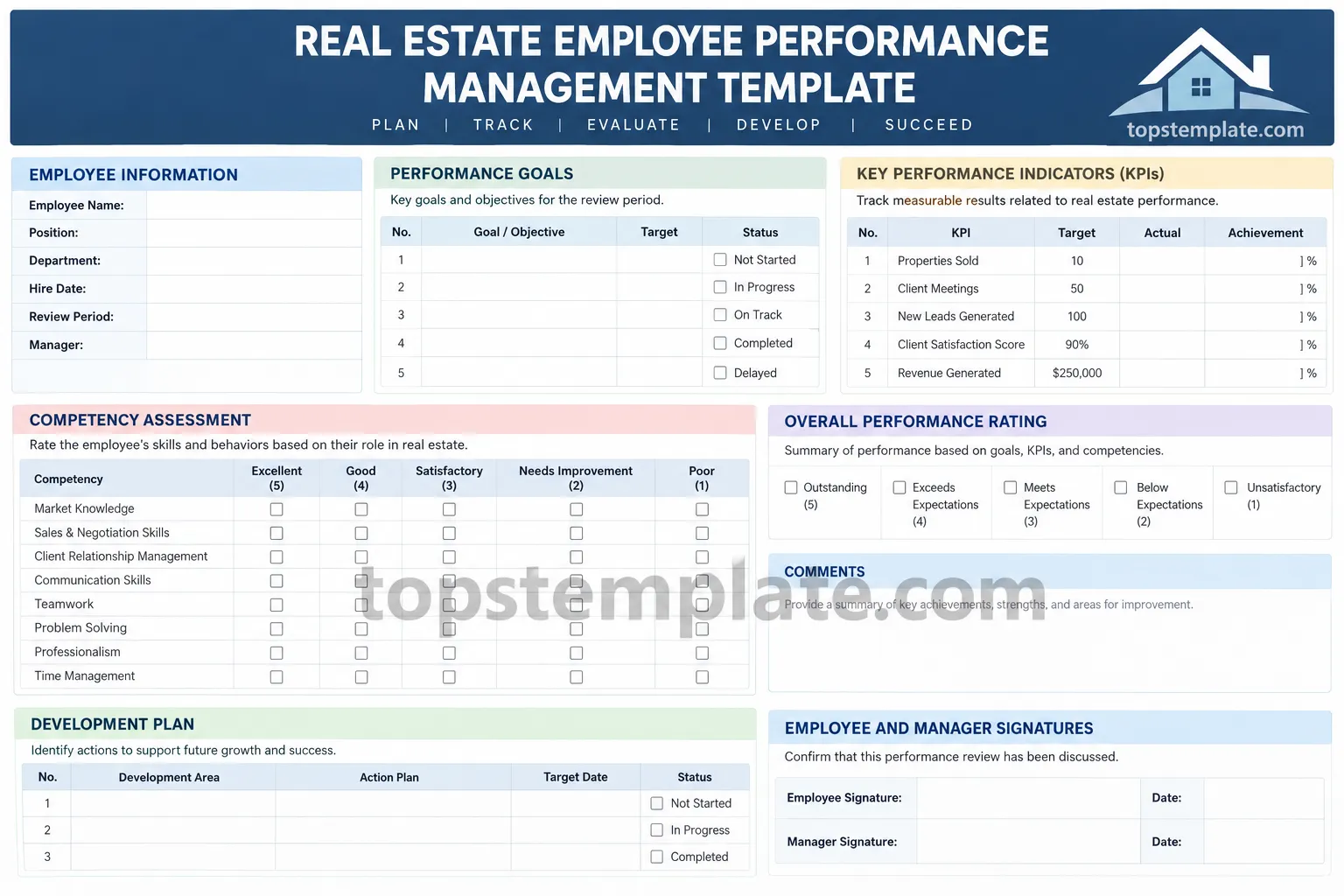
Start each performance review by documenting basic employee information, including the employee’s position, department, manager, hire date, and review period.
Next, clarify the employee’s primary responsibilities. A property agent, leasing consultant, property manager, marketing specialist, and administrative employee will naturally have different performance expectations.
Clear role expectations create a useful foundation because performance should always be evaluated against responsibilities that are relevant to the employee’s position.
2. Performance Goals and Objectives
Performance goals should be specific, measurable, and connected to business priorities. Instead of using a vague objective such as “increase sales,” create a target that defines the expected result and review period.
Examples of real estate employee performance goals include:
- Increase qualified property leads during the quarter.
- Complete a specific number of client consultations each month.
- Improve property showing activity.
- Increase successful property transactions.
- Maintain a defined customer satisfaction target.
- Improve response times for prospective clients.
Managers should also discuss how each goal will be measured. This prevents confusion when the performance review takes place.
3. Key Performance Indicators (KPIs)
KPIs provide measurable evidence of employee performance. However, the right KPIs depend on the employee’s role and responsibilities.
Common real estate performance indicators may include:
- Number of properties sold or leased
- Qualified leads generated
- Client meetings completed
- Property viewings conducted
- Conversion rate
- Revenue generated
- Average response time
- Client satisfaction score
- Repeat business or referral activity
- Pipeline value
KPIs should be used carefully. A high sales volume, for example, does not necessarily provide a complete picture of an employee’s performance. Managers should consider both measurable outcomes and the behaviors that contribute to sustainable results.
How to Evaluate Real Estate Employee Competencies
Performance results are only one part of employee evaluation. Competency assessments help managers understand how employees perform their responsibilities and interact with clients and colleagues.
Important Competencies to Assess
- Market knowledge: Understanding local property trends, pricing, neighborhoods, and market conditions.
- Sales and negotiation skills: Ability to communicate value, handle objections, and negotiate professionally.
- Client relationship management: Ability to build trust and maintain professional client relationships.
- Communication: Clear, timely, and professional communication with clients and team members.
- Teamwork: Ability to collaborate with colleagues, brokers, property managers, and other stakeholders.
- Problem solving: Ability to identify issues and develop practical solutions.
- Professionalism: Reliability, ethical conduct, organization, and appropriate workplace behavior.
- Time management: Ability to prioritize appointments, follow-ups, administrative work, and sales activities.
A simple rating scale can make competency assessment easier. For example, managers can use a five-level scale ranging from excellent to needs improvement. The most important point is to define what each rating means so that evaluations remain consistent.
How to Conduct an Effective Real Estate Performance Review
A performance review should be a structured conversation rather than a one-sided judgment. Employees should have an opportunity to discuss their achievements, challenges, resources, and development goals.
Step 1: Review Previous Goals
Begin by reviewing the goals established at the start of the performance period. Compare actual results with the agreed targets and identify which objectives were completed, exceeded, delayed, or remain in progress.
Step 2: Discuss Achievements
Recognize specific accomplishments rather than giving only general praise. For example, mention successful client relationships, improved conversion rates, successful transactions, process improvements, or contributions to team performance.
Step 3: Identify Performance Gaps
If results are below expectations, focus on the underlying issue. The cause may involve training needs, unclear expectations, insufficient resources, workload challenges, market conditions, or process problems.
This approach makes the discussion more constructive because the goal is to understand what can be improved rather than simply assigning blame.
Step 4: Create an Action Plan
Every important development area should have a practical next step. For example, an employee who needs to improve negotiation skills could participate in sales training, shadow an experienced colleague, or practice structured negotiation scenarios.
Step 5: Set the Next Review Milestone
Performance management works best when follow-up is built into the process. Set a date for checking progress and determine which metrics or behaviors will be reviewed next.
Tips for Setting Better Real Estate Performance Goals
Strong goals make performance management more useful. Managers should avoid creating too many objectives because excessive targets can make priorities unclear.
- Connect individual goals to company objectives.
- Use measurable targets whenever possible.
- Make goals realistic for the employee’s role.
- Include both short-term and long-term objectives.
- Define deadlines and review dates.
- Explain how success will be measured.
- Review goals when business priorities change.
It is also helpful to distinguish between outcome goals and development goals. An outcome goal could focus on sales or revenue, while a development goal could focus on improving negotiation, market analysis, customer service, or leadership skills.
Using Performance Reviews for Employee Development
An effective performance management system should not end with a rating. The review should help employees understand how they can grow within the organization.
A development plan can include training courses, mentoring, coaching, new responsibilities, professional certifications, or opportunities to lead specific projects.
For example, a junior real estate employee who demonstrates strong client communication but limited market knowledge could receive additional market analysis training. Over time, progress can be reviewed using both competency ratings and practical work results.
Development planning also supports employee engagement because team members can see how current performance connects with future opportunities.
Common Mistakes in Real Estate Performance Management
Only Reviewing Employees Once a Year
Annual reviews can be useful, but relying entirely on them can delay important feedback. Regular check-ins allow managers and employees to address issues while they are still manageable.
Focusing Only on Sales Numbers
Sales results are important in many real estate roles, but they should not always be the only measure. Customer service, communication, teamwork, compliance, and professional behavior can also affect long-term business performance.
Using Unclear Evaluation Criteria
Employees may struggle to understand a rating such as “average performance” if the organization has not defined what average means. Use clear criteria and provide examples where appropriate.
Ignoring Employee Feedback
Performance management should be a two-way conversation. Employees may have useful information about market conditions, operational problems, client expectations, or resources that affect their performance.
Failing to Follow Up
A performance review has limited value if agreed actions are never revisited. Schedule follow-up conversations and track progress against development goals.
How to Make Performance Management More Consistent
Consistency is important when multiple managers evaluate employees. A standardized performance management template can help ensure that everyone is assessed using similar categories and processes.
A useful template can include employee information, performance objectives, KPI tracking, competency ratings, manager comments, overall performance assessment, development actions, and employee acknowledgment.
Managers should still allow room for role-specific measurements. The framework can remain consistent while individual goals and KPIs are adapted to different positions.
Final Checklist for Real Estate Employee Performance Reviews
Before completing a performance review, managers can use the following checklist:
- Review the employee’s job responsibilities.
- Compare actual results with established goals.
- Review relevant real estate KPIs.
- Assess important job competencies.
- Document specific achievements.
- Identify areas that require improvement.
- Discuss the employee’s perspective.
- Create practical development actions.
- Set measurable future goals.
- Schedule the next performance follow-up.
Conclusion
A structured real estate employee performance management guide can help organizations move beyond basic annual evaluations and create a continuous process for improving employee performance. By combining clear goals, relevant KPIs, competency assessments, constructive feedback, and development planning, managers can create a more transparent and useful performance review system.
The most effective approach is one that connects employee expectations with measurable business objectives while still recognizing the human side of performance. Regular conversations, clear criteria, and practical development plans can help real estate employees understand where they stand, what they can improve, and how their work contributes to the organization.
Whether you manage real estate agents, property managers, leasing teams, administrative staff, or other real estate professionals, a structured performance management template can make the review process easier to organize and more consistent across your team.
