A sales price agreement rubric provides a structured way to evaluate whether a proposed sales price and its related terms are reasonable, competitive, and aligned with the value of the product, property, or service being sold. Instead of relying entirely on subjective judgment, a rubric gives buyers, sellers, managers, and sales teams clear criteria for reviewing an agreement.
Whether you are evaluating a real estate transaction, business sale, product contract, or negotiated sales proposal, a well-designed rubric can make the review process more consistent. It can also help stakeholders identify risks, compare offers, document their reasoning, and reach an informed decision.
This guide explains what a sales price agreement rubric is, what criteria to include, how to score an agreement, and how to use a template effectively.
What Is a Sales Price Agreement Rubric?
A sales price agreement rubric is an evaluation tool used to assess a proposed sales agreement against a predefined set of criteria. Each criterion can receive a score, weight, or written assessment depending on the needs of the transaction.
The goal is not simply to determine whether the price is high or low. A complete evaluation should consider factors such as market value, product or property condition, payment terms, contingencies, timing, and overall value.
For example, a buyer might receive a proposal with an attractive purchase price but unfavorable payment conditions. Another offer might have a slightly higher price but provide stronger terms and fewer contingencies. A rubric helps make these differences visible.
Why Use a Sales Price Agreement Rubric?
Sales negotiations often involve multiple variables. Without a consistent evaluation method, important details can be overlooked or different proposals may be judged inconsistently.
A sales price agreement rubric can help you:
- Evaluate sales proposals using consistent criteria.
- Compare multiple offers more objectively.
- Document why a particular agreement was accepted, revised, or rejected.
- Identify unfavorable payment terms or contractual conditions.
- Consider market value alongside the proposed sales price.
- Improve communication between buyers, sellers, managers, and stakeholders.
- Create a repeatable process for reviewing future sales agreements.
Using a standardized evaluation form can be particularly useful when several people participate in the approval process.
Key Criteria for a Sales Price Agreement Rubric
The most useful rubric criteria will depend on the type of transaction. However, several categories are broadly applicable to sales price evaluation.
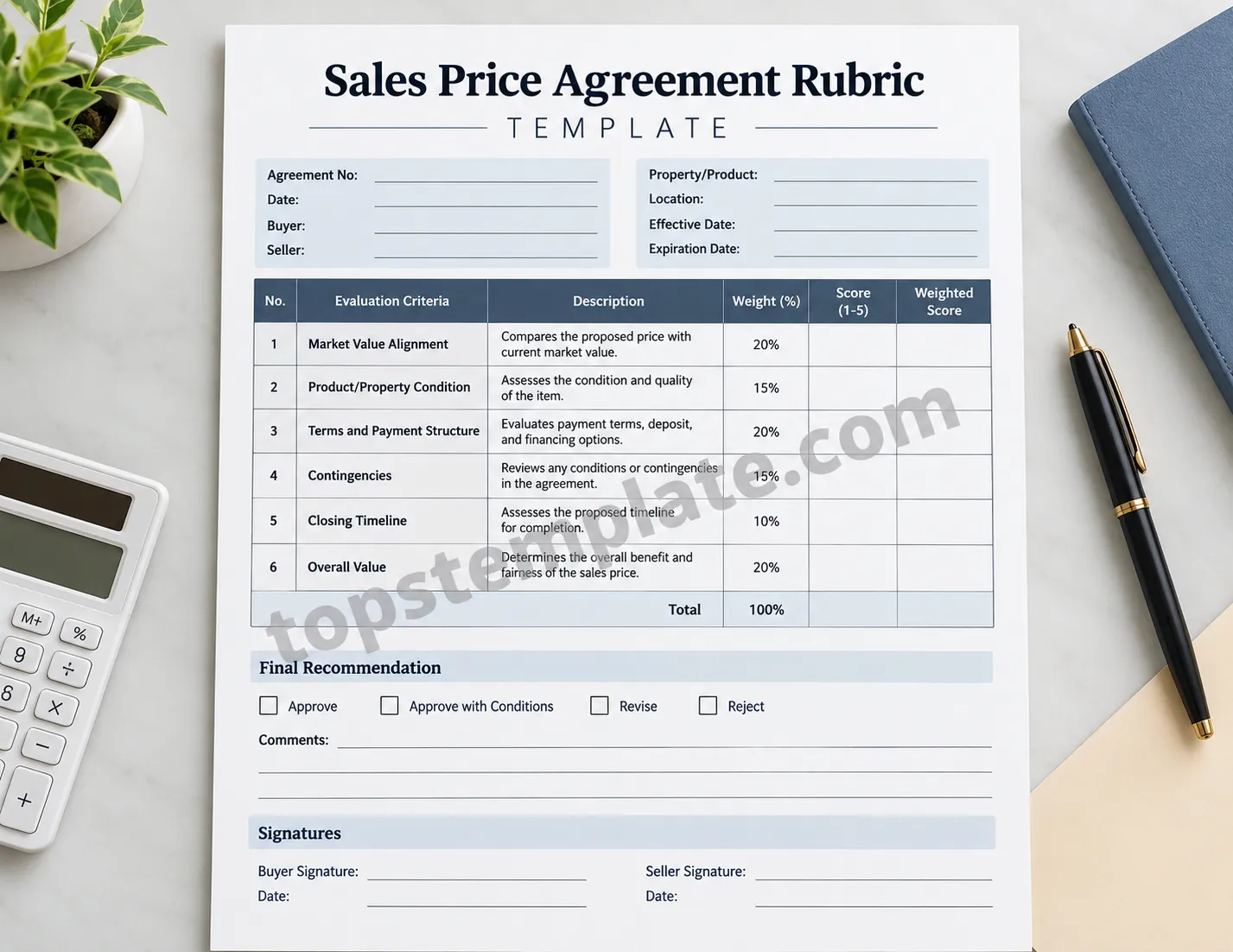
1. Market Value Alignment
The first consideration is whether the proposed sales price is consistent with current market conditions. Depending on the transaction, this may involve comparing the price with recent comparable sales, competitor pricing, market reports, appraisals, or other relevant benchmarks.
A strong rubric should provide space to record the evidence supporting the assessment rather than relying only on a personal opinion about whether the price appears reasonable.
2. Product or Property Condition
Condition can have a significant effect on value. For a property, factors may include age, maintenance, location, improvements, and required repairs. For products or equipment, the evaluation might consider quality, age, warranty coverage, specifications, and expected useful life.
Including condition as a separate criterion prevents the proposed price from being evaluated without considering what the buyer is actually receiving.
3. Terms and Payment Structure
The headline price is only one part of a sales agreement. Payment timing, deposits, financing arrangements, installment schedules, discounts, and other financial conditions can materially affect the value of the transaction.
A rubric can assign a separate score to the payment structure so that favorable or unfavorable terms are clearly reflected in the overall evaluation.
4. Contingencies and Conditions
Contingencies can protect one or both parties, but they can also introduce uncertainty into a transaction. Common examples include financing approval, inspection requirements, due diligence, regulatory approval, delivery conditions, or other prerequisites.
When reviewing an agreement, identify each significant contingency and consider how it could affect timing, cost, or the likelihood of completing the transaction.
5. Closing or Completion Timeline
Timing may be important when a transaction has a specific deadline. A buyer may value a quick completion, while a seller may need additional time to prepare the property, product, documentation, or inventory.
The rubric should therefore evaluate whether the proposed timeline is realistic and compatible with the needs of both parties.
6. Overall Value
The final category can provide a broader assessment of the complete proposal. This does not mean ignoring the individual scores. Instead, it allows the reviewer to consider how the price, terms, risks, timing, and other conditions work together.
This category can also be useful for documenting the reasoning behind a final recommendation.
How to Score a Sales Price Agreement
A weighted scoring system can make a rubric easier to use when some criteria are more important than others. For example, each category can receive a score from 1 to 5, while each category is assigned a percentage weight.
A simple weighted-score formula is:
Weighted Score = Rating × Criterion Weight
For example, if market value alignment has a weight of 20% and receives a rating of 4 out of 5, its weighted contribution can be calculated based on the scoring system used by the organization.
The important point is to define the scoring scale before evaluating the agreement. A consistent scale makes results easier to compare.
Example Rating Scale
- 5: Excellent alignment with the criterion.
- 4: Strong alignment with minor concerns.
- 3: Acceptable or average.
- 2: Significant concerns require review.
- 1: Poor alignment or substantial concerns.
The scoring descriptions should be customized to the type of transaction and the organization’s approval requirements.
How to Use a Sales Price Agreement Rubric Step by Step
Step 1: Enter the Agreement Details
Begin by recording essential information such as the agreement number, date, buyer, seller, product or property, location, and proposed effective dates.
Step 2: Define the Evaluation Criteria
List the criteria that matter most for the transaction. Keep the categories specific enough to support consistent scoring.
Step 3: Assign Weights
Assign a percentage weight to each criterion based on its importance. The total weight should equal 100%.
Step 4: Review Supporting Information
Gather relevant information before assigning scores. Depending on the transaction, this might include comparable prices, inspection reports, financial terms, market data, specifications, or contractual documents.
Step 5: Score Each Criterion
Apply the predefined rating scale consistently. Add short comments when a score requires explanation or supporting evidence.
Step 6: Calculate the Overall Result
Calculate the weighted scores and review the combined result. The numerical result should support the decision-making process rather than replace professional judgment.
Step 7: Record the Recommendation
Use the final section to document whether the proposal should be approved, approved with conditions, revised, or rejected according to the organization’s process.
Step 8: Obtain Required Signatures
When appropriate, have the relevant parties sign and date the completed evaluation or agreement documentation. Make sure the rubric is retained with the related transaction records.
Tips for Creating an Effective Sales Price Agreement Rubric
A good rubric should be detailed enough to support consistent evaluation without becoming unnecessarily complicated.
- Keep criteria measurable: Use evidence-based categories whenever possible.
- Define scoring standards: Explain what each rating means.
- Use appropriate weights: Give greater importance to factors that materially affect the transaction.
- Leave room for comments: Written explanations can provide valuable context behind a score.
- Review the rubric periodically: Market conditions and business requirements can change.
- Keep documentation together: Store supporting evidence with the completed evaluation.
- Avoid relying only on the final score: A high total can still contain an important individual risk that deserves attention.
Common Mistakes to Avoid
One common mistake is focusing exclusively on the proposed sales price. A transaction with a favorable headline price can still have problematic terms, significant contingencies, or costs that change its practical value.
Another mistake is changing the scoring criteria from one proposal to another. If different offers are evaluated using different standards, the resulting scores may not provide a meaningful comparison.
It is also important to avoid assigning scores without supporting information. A rubric works best when the reviewer can explain why a particular rating was selected.
When Should You Use a Sales Price Agreement Rubric?
A rubric can be useful whenever a sales decision involves multiple factors that need to be evaluated consistently. Potential applications include real estate transactions, equipment sales, business assets, vendor agreements, product purchases, and internal sales approvals.
It can also be adapted for team-based reviews. For example, several reviewers can independently assess the same proposal before discussing areas where their scores differ.
Final Thoughts
A sales price agreement rubric turns a potentially subjective sales review into a more structured evaluation process. By considering market value, condition, payment terms, contingencies, timing, and overall value, the reviewer can develop a clearer picture of the complete proposal.
The most effective rubric is one that matches the transaction, uses clearly defined scoring standards, and keeps supporting information alongside the evaluation. A printable template can make the process easier to repeat while providing a consistent record for future reference.
For important or legally binding transactions, the rubric should complement—not replace—appropriate financial, contractual, legal, or professional review.
