A property infringement questionnaire Template is best understood as a structured information-gathering document used to identify property issues that may affect ownership, use, sale, letting, development, boundaries, access, notices, alterations, or potential disputes. The phrase itself is not a universally standardized legal form name. In practice, people searching for it may be looking for a property information questionnaire, seller disclosure questionnaire, boundary questionnaire, infringement checklist, or a form for recording a notice or suspected breach.
That distinction matters because a questionnaire is normally an information-gathering tool rather than a legal determination. A well-designed form helps a seller, owner, agent, landlord, buyer, conveyancer, or property professional record what is known, identify documents that need checking, and flag matters requiring specialist review. It should not state that an infringement exists merely because someone has answered yes to a question.
Current UK property-information practice illustrates why careful wording matters. Propertymark describes its Property Information Questionnaire as a structure for gathering information from clients, while its lettings questionnaire is designed to help landlords and agents identify information that should be disclosed to prospective tenants. Propertymark also notes that the legal framework governing material information changed after the withdrawal of earlier guidance in May 2025. A template should therefore be treated as a working document that must be adapted to the transaction and current law.

What a property infringement questionnaire should actually do
The central purpose of the questionnaire is to turn scattered property knowledge into an organized record. Instead of relying on informal conversations about fences, extensions, rights of way, notices, planning work, neighbour disagreements, or restrictions, the form asks consistent questions and leaves space for explanations. That makes it easier to identify missing evidence and decide which matters should be referred to a solicitor, conveyancer, surveyor, planning professional, local authority, or other specialist.
A strong form also separates knowledge from verification. An owner may know that a neighbour has complained about a boundary, but that does not establish the legal position of the boundary. Similarly, an owner may know that an extension was built, but may not know whether planning permission, building regulations approval, a covenant consent, or another authorization was required. The questionnaire should record the known fact and then identify the evidence needed to verify it.
The document should therefore avoid questions that imply a legal conclusion. “Are you aware of any complaint concerning the boundary?” is generally more useful than “Has your property infringed the neighbour’s boundary?” The first question records knowledge. The second presupposes a conclusion that may require a title review, survey, measurements, planning records, correspondence, or legal analysis.

Key sections to include in the template
A practical questionnaire should begin with property identification. Include the property address, title or parcel reference where applicable, type of ownership or tenure, date of completion, name of the person completing the form, and the person’s relationship to the property. Where several owners exist, the form should make clear whether one person is answering for everyone or whether each owner must confirm the information.
The next section should establish the information source. A useful form can ask whether an answer is based on personal knowledge, an existing document, information supplied by a previous owner, a professional report, correspondence, or another source. This distinction is particularly valuable where a property has changed hands several times. A person should not unintentionally present something heard from a previous owner as though it were personally verified knowledge.
Supporting evidence should be identified alongside significant answers. A questionnaire can ask whether the respondent has a title plan, survey, planning consent, building-control certificate, party-wall correspondence, insurance document, guarantee, lease, deed, easement, covenant, notice, enforcement correspondence, or dispute correspondence. The form should provide a reference field so that each supporting document can be matched to the relevant answer.

Boundaries and encroachments
Boundary questions are often among the most important parts of a property questionnaire. The form can ask who is believed to maintain each boundary, whether any boundary has moved, whether any land has been transferred, whether structures cross a boundary, whether fences or walls are shared, and whether a boundary dispute has occurred. These questions should allow “not known” responses because an owner may not possess enough evidence to answer confidently.
An encroachment should be treated as a matter requiring investigation rather than as an automatic finding of wrongdoing. Examples can include a building extension crossing a boundary, a wall positioned on disputed land, foundations extending beneath adjoining land, eaves projecting over a boundary, a driveway occupying another person’s land, or a structure extending beneath a public area. The questionnaire should capture the physical circumstance without deciding the legal outcome.
Where an answer indicates a possible boundary issue, the next step is evidence gathering. Relevant material may include title documents, filed plans, historic conveyances, measured surveys, photographs, correspondence, agreements, neighbour statements, or records of previous works. A questionnaire becomes substantially more useful when it asks not only whether an issue exists but also when it arose, who was involved, what documents exist, and whether the matter remains unresolved.
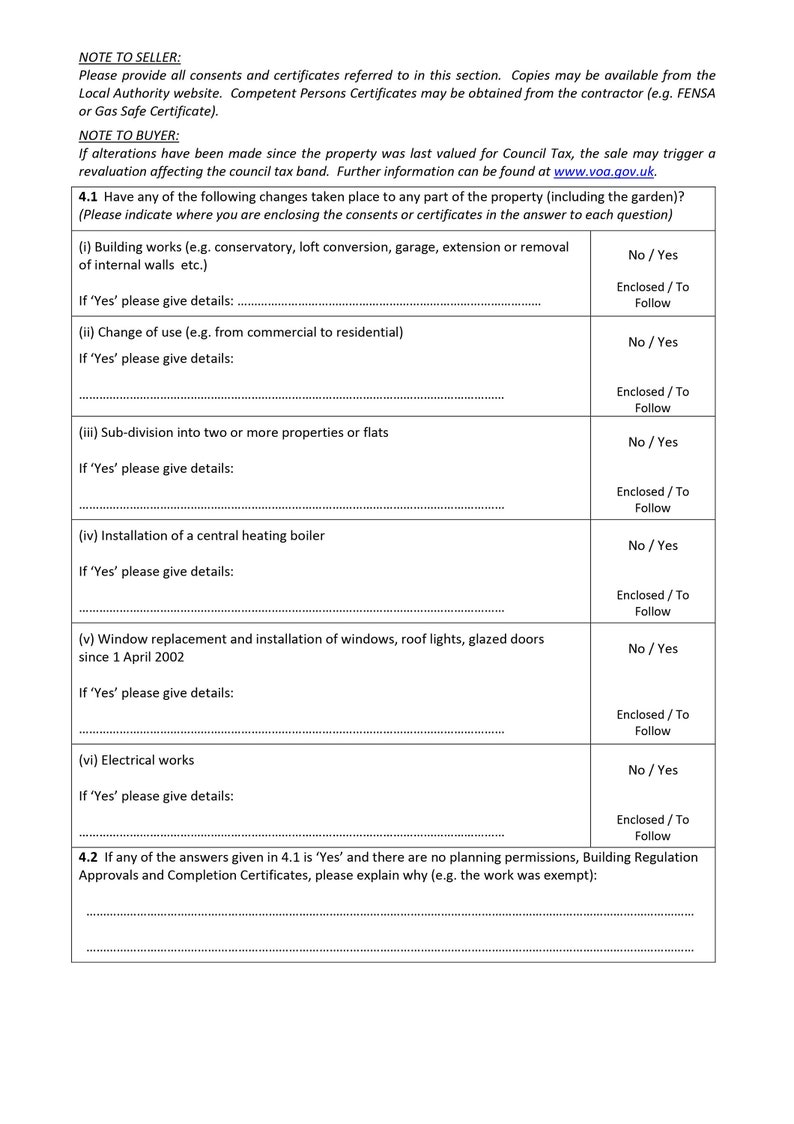
Alterations, planning and building work
Alterations should be recorded separately from boundary matters because an alteration can create several different information issues at once. A questionnaire may ask about extensions, loft conversions, internal structural changes, new garages, replacement windows, electrical work, heating installations, changes of use, subdivision, solar equipment, drainage work, or other material changes.
The form should then ask whether the respondent holds relevant approvals or certificates. A “yes” answer to an alteration question does not necessarily mean that a problem exists. Conversely, a “no” answer to a question about permissions does not necessarily establish that consent was required. The purpose is to identify work that should be checked against planning, building-control, title, lease, covenant, conservation, or other requirements.
For older properties, records may be incomplete. The questionnaire should therefore include an explanation field rather than forcing the respondent into a simple yes-or-no answer. A useful answer might say that an extension was present when the property was purchased, that no paperwork was found among the seller’s records, and that the respondent does not know when it was constructed. That is materially different from asserting that the extension was constructed without authorization.

Notices, complaints and possible infringement issues
A questionnaire aimed at infringement-related concerns should contain a dedicated notices and complaints section. Questions can cover letters from neighbours, local authorities, planning bodies, landlords, management companies, homeowners associations, environmental authorities, utilities, or other relevant bodies. The form should record the date of the notice, sender, recipient, subject, response deadline, and whether the notice has been resolved.
The word “infringement” can cover very different concepts depending on jurisdiction and context. It might refer to a planning breach, an alleged boundary encroachment, a lease breach, a covenant issue, an unauthorized alteration, a trespass allegation, a parking or access issue, or a regulatory infringement. Because these matters can follow different procedures, the questionnaire should identify the nature of the allegation instead of placing everything into one generic category.
It is also useful to ask whether the respondent has received an actual formal notice or merely an informal complaint. A neighbour saying that a fence is in the wrong place is not the same thing as a formal enforcement notice. Likewise, a local authority notice may have a specific statutory meaning and deadline. The form should preserve the original wording where possible and attach or reference the relevant document rather than paraphrasing it inaccurately.
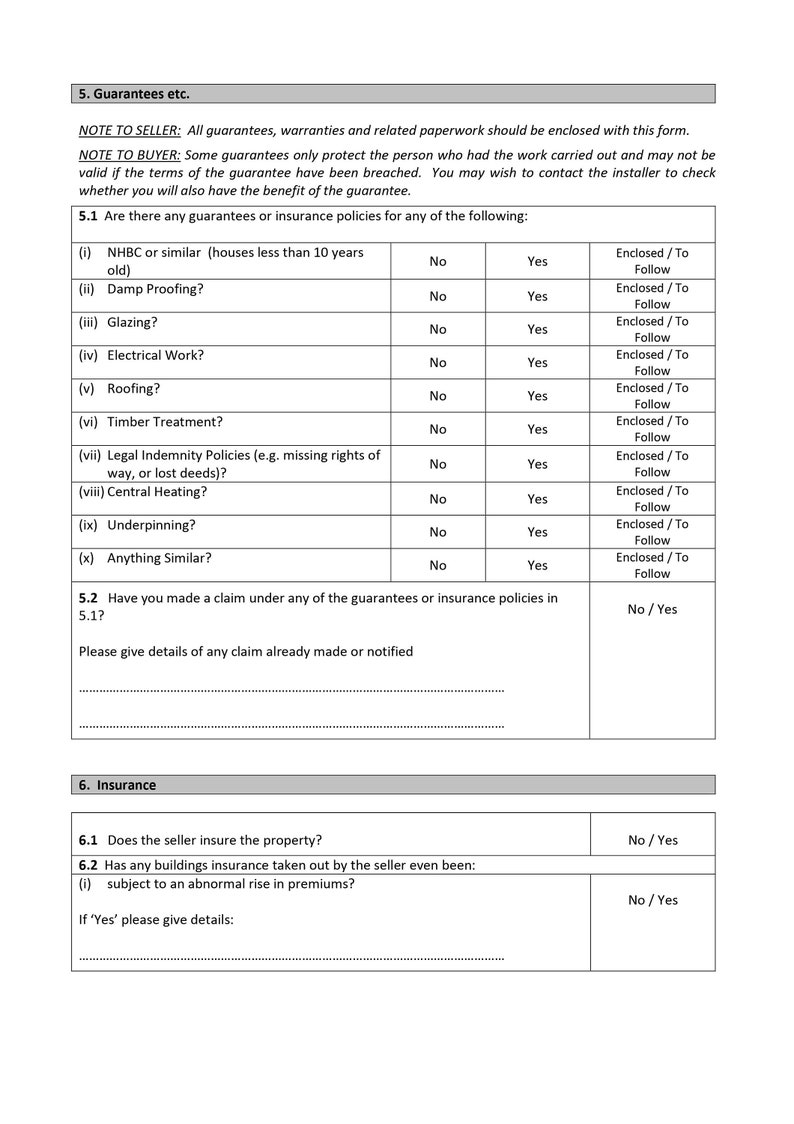
How to structure yes, no and not-known answers
A simple three-option response system can make a questionnaire easier to complete, but it should not be the only mechanism. “Yes,” “No,” and “Not known” are useful for initial screening, while significant matters should trigger an explanation field. This prevents a questionnaire from creating a misleading impression of certainty where the respondent genuinely lacks information.
For each “yes” answer, the template can request five basic details: what happened, when it happened, who was involved, what evidence exists, and whether the matter is resolved. These prompts encourage useful factual answers without requiring the person completing the form to provide a legal opinion. They also make later review more efficient because the professional handling the transaction can see immediately which issues need further investigation.
A good questionnaire should also distinguish between “not known” and “not applicable.” For example, a lease-related question may not apply to a freehold property, while a boundary question may apply but the owner may not know the answer. Treating both situations as blank fields can create unnecessary follow-up questions and may make an incomplete form appear more complete than it really is.
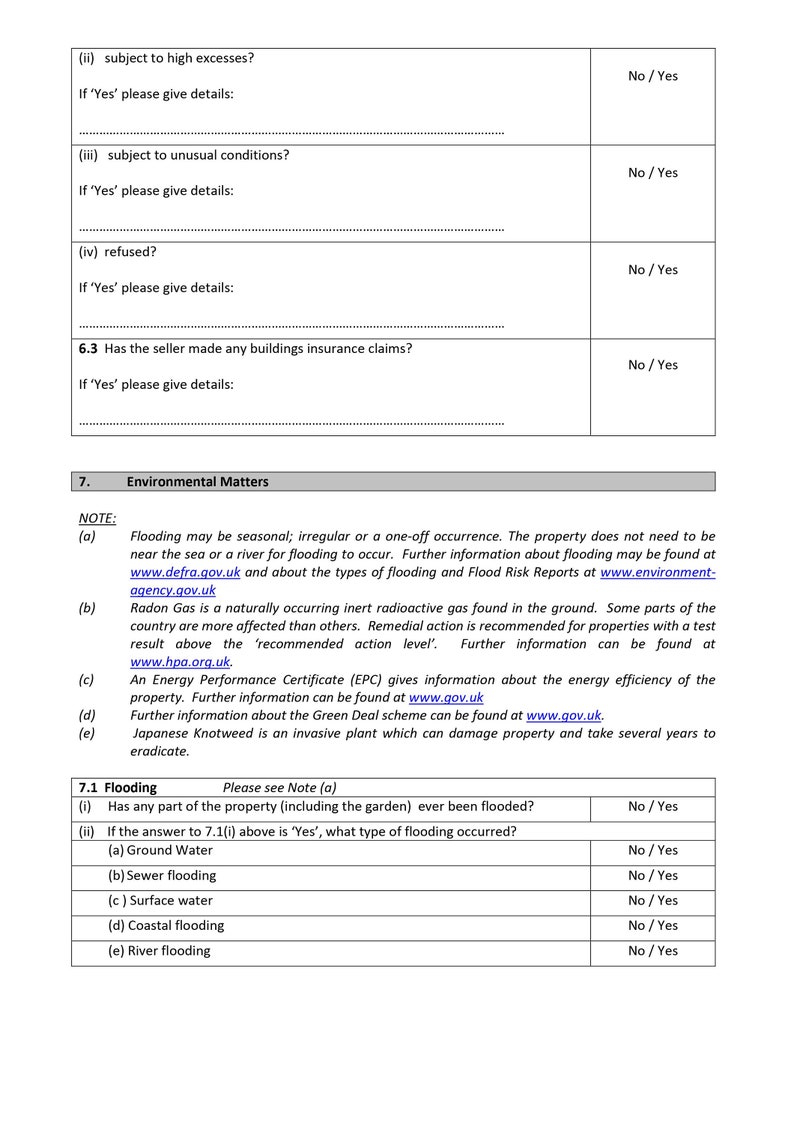
UK terminology: property information questionnaires and letting forms
The phrase property information questionnaire uk commonly points toward seller or landlord information-gathering documents used in UK property transactions. Propertymark publishes separate questionnaires for sales and lettings, and its current material explains that property professionals need to consider information that may affect a consumer’s transactional decision. A general template should therefore be regarded as a framework rather than a substitute for the form or instructions supplied by the relevant conveyancer or property professional.
The phrase property information questionnaire letting is especially relevant to rental transactions. A letting-focused questionnaire can ask about tenure, landlord details, restrictions, utilities, access, environmental matters, services, parking, known defects, shared facilities, and other information that may materially affect a prospective tenant’s decision. The scope should be adapted to the property and the current regulatory framework rather than copied mechanically from a sales questionnaire.
Propertymark’s current guidance is particularly important because its letting questionnaire notes that material information obligations continue even though earlier National Trading Standards guidance was withdrawn in May 2025. This demonstrates why templates need periodic review. A form that accurately reflected an earlier regulatory framework may still be useful as a checklist, but it should not automatically be described as the current official legal form.

How state-specific wording changes the questionnaire
Search phrases such as property infringement questionnaire template california, property infringement questionnaire template florida, property infringement questionnaire template texas, and property infringement questionnaire template virginia should not be treated as evidence that one identical questionnaire applies across all four states. Real-estate disclosure practices, statutory forms, contract language, title procedures, local government processes, and professional requirements can vary by jurisdiction.
California provides a useful illustration. The California Seller Property Questionnaire is designed to supplement other disclosure documentation and asks sellers about matters such as repairs, structural systems, water issues, boundaries, access, title, liens, neighbourhood issues, governmental matters, and other material information. It also makes clear that seller responses are not a substitute for inspections or independent investigation. That approach is a useful model for designing questions, but the actual form and its legal use should not simply be transplanted into another state.
For a jurisdiction-specific version, the safest structure is to keep a general factual core and then add a clearly labelled local section. The local section can identify the relevant statutory disclosures, customary transaction forms, notice terminology, title practices, or professional review requirements after they have been verified. This is preferable to placing a state name into a generic template and implying that the resulting document has official status.

Choosing PDF and Word formats
The phrase property infringement questionnaire template pdf reflects a common preference for a fixed document layout. PDF is useful when the form needs to preserve its visual structure, be printed, reviewed, or retained as a record. However, a PDF should not be assumed to be an official legal form merely because it looks formal. The source, edition, jurisdiction, and intended use should always be checked.
The phrase property infringement questionnaire template word points toward an editable working document. Word-style formats can be convenient when a firm needs to adapt headings, add jurisdiction-specific questions, insert additional explanation fields, or maintain an internal version-controlled template. The disadvantage is that unrestricted editing can change wording, remove questions, or create inconsistent versions.
For either format, version control is important. A professional template should display the date of revision, jurisdiction, intended transaction type, and person or organization responsible for maintaining it. Where legal or regulatory language is included, the review date should be visible internally even if it is not presented to the person completing the questionnaire. This helps prevent an old version from quietly remaining in circulation.

What a strong template can look like
A practical template can start with a declaration explaining that the respondent should answer according to their knowledge, identify uncertainty, provide supporting evidence where available, and notify the relevant professional if circumstances change before completion. This type of instruction helps reduce the risk that a person treats the form as a technical survey or legal opinion.
The property section can then be divided into logical groups: identity and ownership, boundaries and access, alterations and permissions, notices and complaints, restrictions and covenants, services and utilities, insurance and guarantees, environmental matters, occupancy and letting, disputes, and additional information. Conditional questions can be used where appropriate, so that leasehold questions are not presented as though they automatically apply to every freehold property.
The final part should provide a document register and an explanation area. A document register can record the name of each supporting item, date, issuer, reference, and question to which it relates. The explanation area gives the respondent room to describe circumstances that do not fit neatly into a checkbox. This combination makes the questionnaire much more useful than a long list of isolated yes-or-no questions.
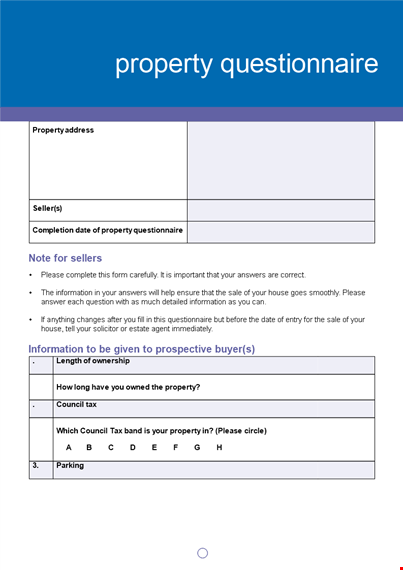
Questions worth including in an infringement-focused checklist
A carefully designed checklist should ask whether the respondent is aware of any dispute concerning ownership, boundaries, access, construction, use, planning, leasing, covenants, shared facilities, or neighbouring land. It should ask whether any formal or informal notice has been received, whether a response has been sent, and whether there is a pending deadline. It should also ask whether an issue has been resolved by agreement and whether evidence of that resolution exists.
Questions should cover both current and historical matters where the relevant transaction requires historical disclosure. For example, an owner might know that a previous extension was completed before they purchased the property. The questionnaire can ask when the respondent acquired the property and whether the issue was disclosed to them at that time. This creates a factual chronology without forcing the respondent to make assumptions about events outside their knowledge.
The form should also include an “other matter” question. No template can anticipate every property circumstance. A respondent may know about an unusual access arrangement, informal boundary agreement, unresolved complaint, historical notice, or other issue that does not match a predefined category. An open-ended final question reduces the risk that a person assumes they should remain silent simply because the form did not provide a matching checkbox.

Common mistakes when completing the questionnaire
One common mistake is answering from assumption rather than knowledge. A seller may assume that a neighbour owns a fence because the neighbour has maintained it for years, or assume that an extension was approved because it has existed for a long time. Those assumptions can be recorded as uncertainty, but they should not be presented as verified facts.
Another mistake is failing to update the form when circumstances change. A complaint that was not present when the questionnaire was first completed may arise before exchange or completion. A notice may arrive after the initial answers have been given. Where the transaction remains active, the person responsible for the form should know how changes are communicated to the conveyancer or other relevant professional.
A third mistake is treating the questionnaire as a substitute for independent investigation. Propertymark’s sales material describes the PIQ as a structure that supports information gathering, while the Law Society property information forms distinguish seller knowledge from matters that require searches, surveys, or professional investigation. The questionnaire is therefore most valuable as an early-warning and evidence-organizing tool.
Practical Solution
The most effective approach is to build the questionnaire in layers. Start with a universal factual section covering property identity, ownership, occupation, boundaries, access, alterations, notices, disputes, and supporting documents. Add conditional sections for leasehold ownership, letting, commercial use, development, shared facilities, or known regulatory issues. Finally, add a jurisdiction-specific review layer so the document can be checked against the requirements relevant to the transaction.
Before issuing the form, create a document checklist that sits alongside it. The checklist should identify title documents, plans, leases, consents, certificates, guarantees, insurance records, notices, correspondence, surveys, agreements, and other material records that may be relevant. Ask the person completing the questionnaire to identify whether each document is available, missing, attached, already held by a professional, or still being obtained. This turns the questionnaire into a practical case-management tool rather than merely a collection of answers.
When the completed form is returned, do not simply archive it. Review every “yes,” “not known,” or explanatory answer and classify it as resolved, evidence required, professional review required, or outside the scope of the current transaction. That triage process can highlight potential infringement issues early enough for a solicitor, conveyancer, surveyor, planning specialist, or relevant authority to investigate before the transaction reaches a critical stage.
For searches such as property infringement questionnaire template free, property infringement questionnaire template free download, or property infringement questionnaire template pdf, the practical question is not merely whether a document exists. Check who produced it, what jurisdiction it covers, when it was last reviewed, whether it is intended for sales or lettings, whether it is official or merely an example, and whether the wording matches the transaction. A professionally formatted document can still be unsuitable if its assumptions are wrong.
How to handle Queensland infringement notices
The phrase view infringement notice qld points to a different type of information problem. Queensland infringement notices are enforcement documents rather than property disclosure questionnaires. Queensland Government material explains that an infringement can be reviewed using the relevant reference information, and Brisbane City Council provides a process for reviewing a council-issued parking infringement, including details such as the offence location and photographs.
This distinction is important if the phrase “property infringement” appears in a search or document request. A questionnaire concerning property ownership or property conditions should not be confused with a government infringement notice. An infringement notice may have statutory deadlines and specific review, payment, transfer, or court procedures. Those procedures should be followed according to the issuing authority rather than copied into a generic property questionnaire.
If a property transaction involves an infringement notice, the questionnaire can still have a useful supporting question: ask whether any government or council notice affects the property, record the issuing authority and notice date, and identify whether the matter remains outstanding. The form should not attempt to determine whether the notice is legally valid. That determination belongs in the appropriate review or legal process.
Leasehold and management information
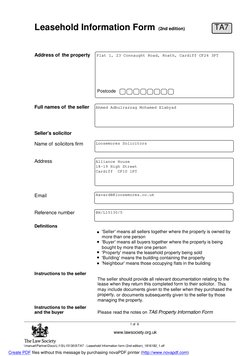
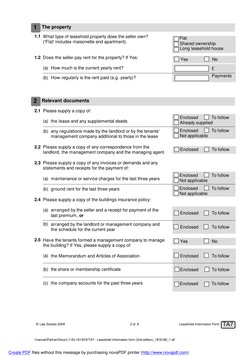
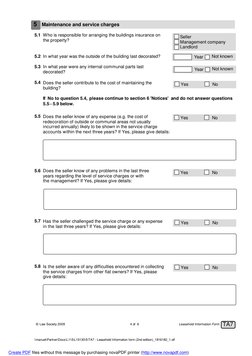
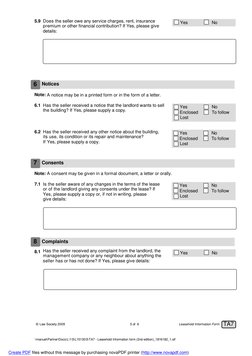
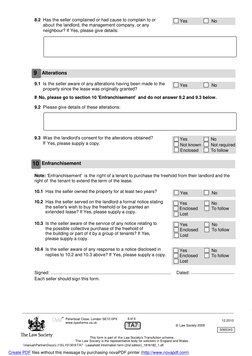
Leasehold properties require additional care because restrictions can arise from the lease itself, management arrangements, service charges, notices, consents, or alterations. A questionnaire should ask for the lease term, ground rent where relevant, service-charge information, managing agent details, notices, complaints, consents for alterations, and relevant correspondence. These questions should be adapted to the specific transaction rather than assumed to apply identically to every lease.
A leasehold information form can also identify possible conflicts between physical use and contractual rights. An owner may have carried out an alteration that appears physically harmless but required landlord consent under the lease. A questionnaire can flag the alteration and ask whether consent was obtained without declaring that the alteration is automatically a breach.
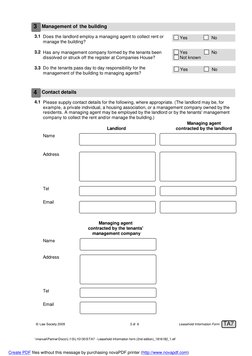
Management information can be equally important. Shared buildings may have responsibilities for insurance, repairs, common areas, access, service charges, and maintenance. Recording the responsible party and supporting documents helps distinguish a private property issue from an obligation arising through the building’s management structure.
Using the form for sales, purchases and letting
For a sale, the questionnaire is primarily a disclosure and preparation instrument. The seller should be encouraged to assemble information early, answer from actual knowledge, identify uncertainty, and supply relevant supporting documents. The aim is to reduce avoidable surprises during conveyancing while making clear that the questionnaire does not replace title investigation, searches, surveys, or legal advice.
For a purchase, the completed questionnaire should be treated as one information source among several. A buyer can use it to identify matters for further enquiry, compare answers with title documents and searches, and formulate questions for the conveyancer. A discrepancy between the questionnaire and another source should be investigated rather than automatically resolved in favour of either document.
For letting, the focus changes toward information that may affect a prospective tenant’s decision and the operation of the tenancy. Propertymark’s letting questionnaire is an example of a structured approach for collecting landlord and property information. A letting version can therefore emphasize occupancy, services, restrictions, material conditions, access, shared facilities, environmental factors, and other matters relevant to the proposed tenancy.
Quality-control checklist before the form is relied upon
Before the questionnaire is circulated, check that every question has a clear purpose. Remove questions that merely duplicate another section and add an explanation field wherever a simple answer could be misleading. Confirm that terminology is appropriate to the jurisdiction and transaction type. If the form uses terms such as infringement, enforcement, breach, consent, covenant, notice, or encroachment, make sure the terms are being used in their intended factual or legal context.
Next, test the form with a hypothetical property record. Imagine a property with a shared driveway, an extension of uncertain approval status, a historical neighbour complaint, a lease restriction, and a recent local authority letter. The questionnaire should allow every issue to be recorded, linked to evidence, and assigned for further review without forcing the person completing it to reach legal conclusions.
Finally, review the completed questionnaire against the source documents. Look for mismatched dates, inconsistent ownership names, unexplained “yes” answers, missing notices, missing attachments, and statements that appear more certain than the available evidence supports. This final review is where a well-designed template creates the greatest practical value: it exposes information gaps before those gaps become transaction problems.
Reference Examples
A useful property infringement questionnaire Template should be judged by the quality of the information it captures rather than by its appearance alone. Strong examples typically use clear sections, factual prompts, yes-or-no choices supported by uncertainty options, explanation fields, and references to supporting documents. Boundary, access, alterations, notices, disputes, insurance, environmental matters, services, and leasehold questions are recurring themes in property information forms because these areas can reveal matters that require additional investigation.
The following visual references show different ways property questionnaires and related information forms organize these topics. They include seller disclosure layouts, boundary questions, notices, alterations, environmental issues, access rights, leasehold management, service charges, and property identification fields. They are useful for understanding document structure and question design, but an example form should not automatically be treated as the legally prescribed document for a particular jurisdiction or transaction.
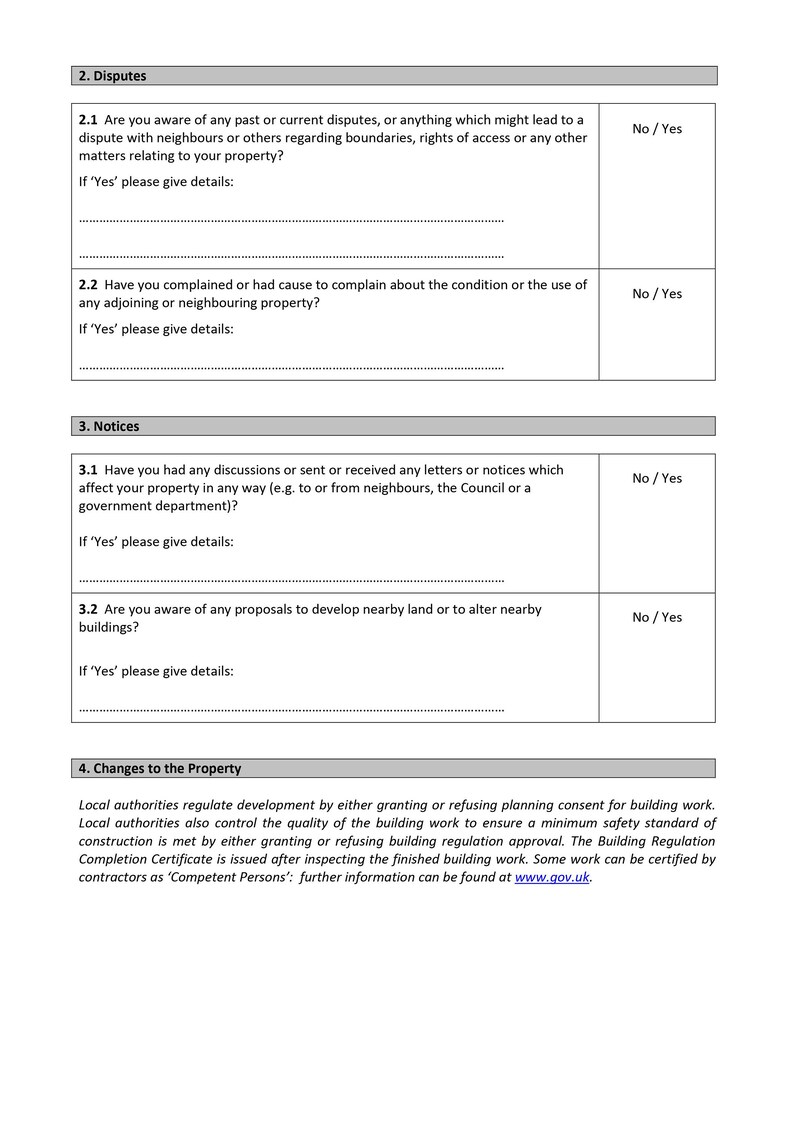
Seller Questionnaire: Disputes and Notices
Source: Etsy
Seller Questionnaire: Changes to the Property
Source: Etsy
Seller Questionnaire: Planning and Building Matters
Source: Etsy
Seller Questionnaire: Guarantees and Insurance
Source: Etsy
Seller Questionnaire: Environmental Matters
Source: Etsy
Seller Questionnaire: Rights and Informal Arrangements
Source: Etsy

Seller Questionnaire: Repairs and Contributions
Source: Etsy
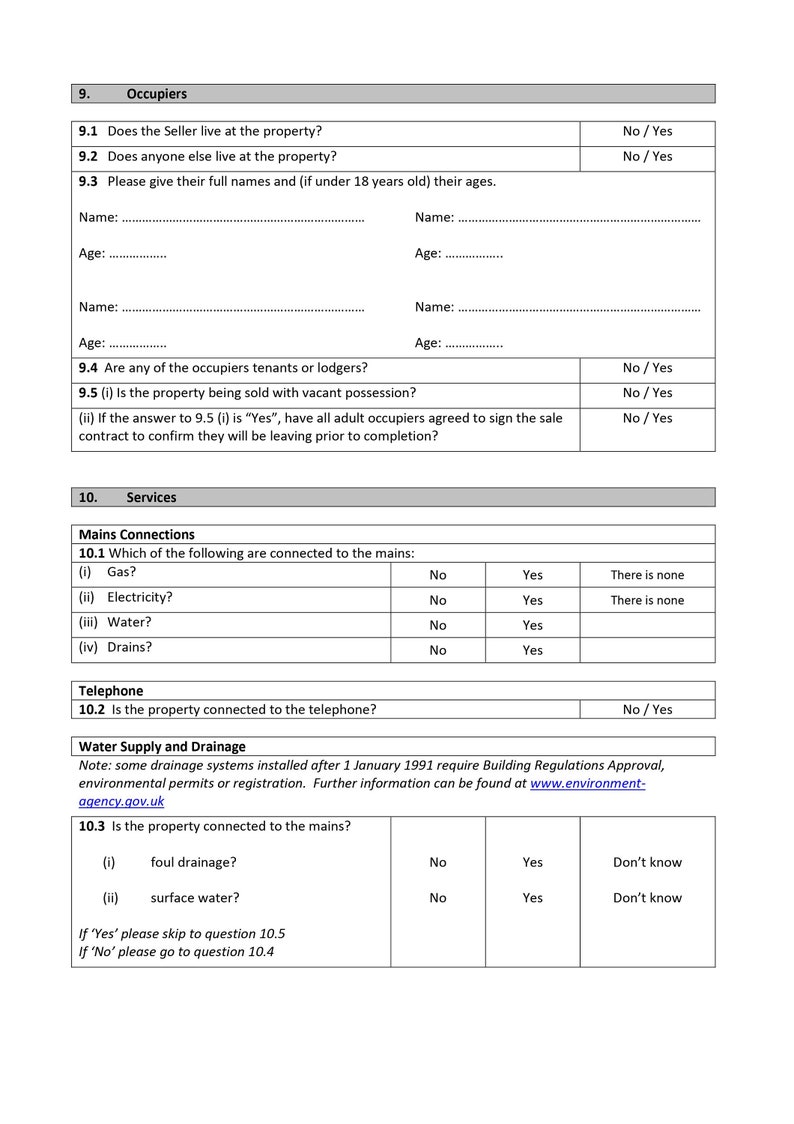
Seller Questionnaire: Occupiers and Services
Source: Etsy
Leasehold Information Form
Source: Scribd
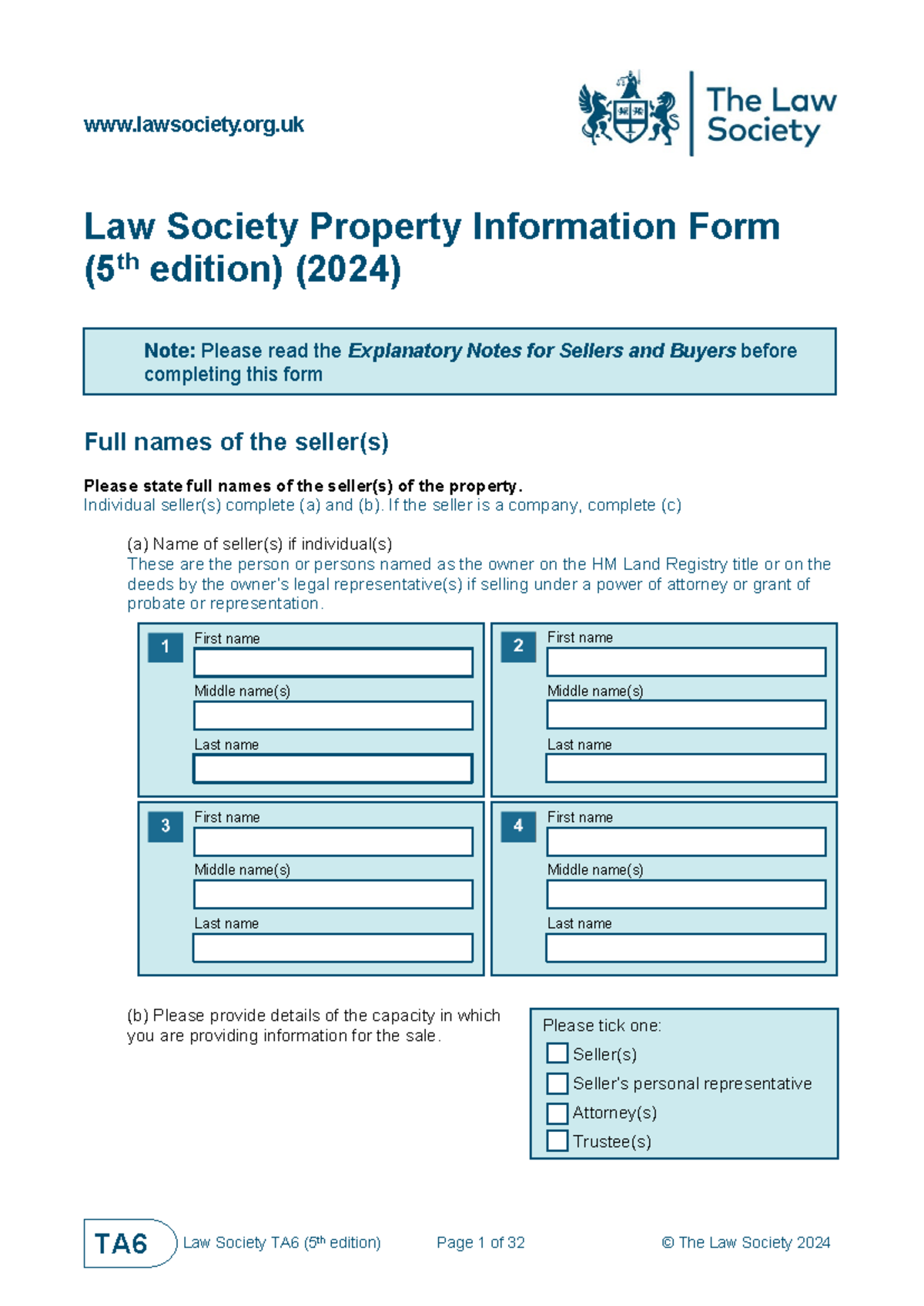
Law Society Property Information Form, 5th edition
Source: Studocu
