A grant funding award letter Template is most useful when it does more than announce that funding has been approved. A strong letter identifies the recipient, states the award clearly, explains the purpose of the funding, summarizes important conditions, and tells the recipient what happens next. The document should be easy to review, internally consistent, and appropriate for the relationship between the funder and recipient.
For a private foundation, nonprofit, educational institution, business, or public agency, the award letter can serve as an important communication record. It may sit alongside a grant agreement, budget, reporting schedule, or other award documents. It should therefore distinguish between the friendly announcement of an award and the binding terms contained in the governing agreement or official notice.
Federal awards require particular care. A federal award may be accompanied by a formal Notice of Award rather than an ordinary business letter. For example, NIH describes its Notice of Award as the official grant award document that notifies the recipient that an award has been made and contains or references applicable terms and conditions. A general letter should never be presented as a substitute for an agency’s official award document.

What a grant funding award letter should accomplish
The central purpose of an award letter is to communicate a funding decision accurately. The reader should be able to identify who is receiving the award, who is making the award, which project or program is being supported, how much funding has been approved, and what period the award covers. These details should be stated plainly rather than buried inside a long narrative.
A good letter also establishes a logical connection between the award and the original proposal. Instead of simply saying that funding has been approved, the funder can briefly identify the initiative being supported and explain why the project aligns with the funding program. This gives the recipient useful confirmation that the award relates to a particular purpose and reduces ambiguity when several projects are being discussed.
The final purpose is operational. A recipient needs to know whether a signature is required, whether an agreement accompanies the letter, when funds are expected to be released, who handles questions, and what reporting or documentation should be reviewed. These instructions should be accurate and should never imply that a payment is available before the relevant conditions have actually been satisfied.

Essential elements of a professional award letter
The opening portion normally identifies the funder and recipient. Include the date, recipient’s legal or organizational name, address when appropriate, and the name or title of the person responsible for issuing the award. If the funder uses an award number, reference number, project number, or other identifier, that information can be placed near the heading so it is easy to locate later.
The central section should state the decision. A useful structure is a direct sentence confirming that the proposal has been selected for funding, followed by the approved amount and the project or program name. If the amount differs from the amount originally requested, say so clearly. If funding is restricted to certain activities or costs, explain that restriction rather than leaving the recipient to infer it.
The final section should cover conditions and next steps. These may include execution of a grant agreement, submission of required documents, confirmation of banking information, reporting obligations, budget restrictions, or a specified start date. The letter should point to the controlling agreement or official award notice whenever those documents contain the complete terms.
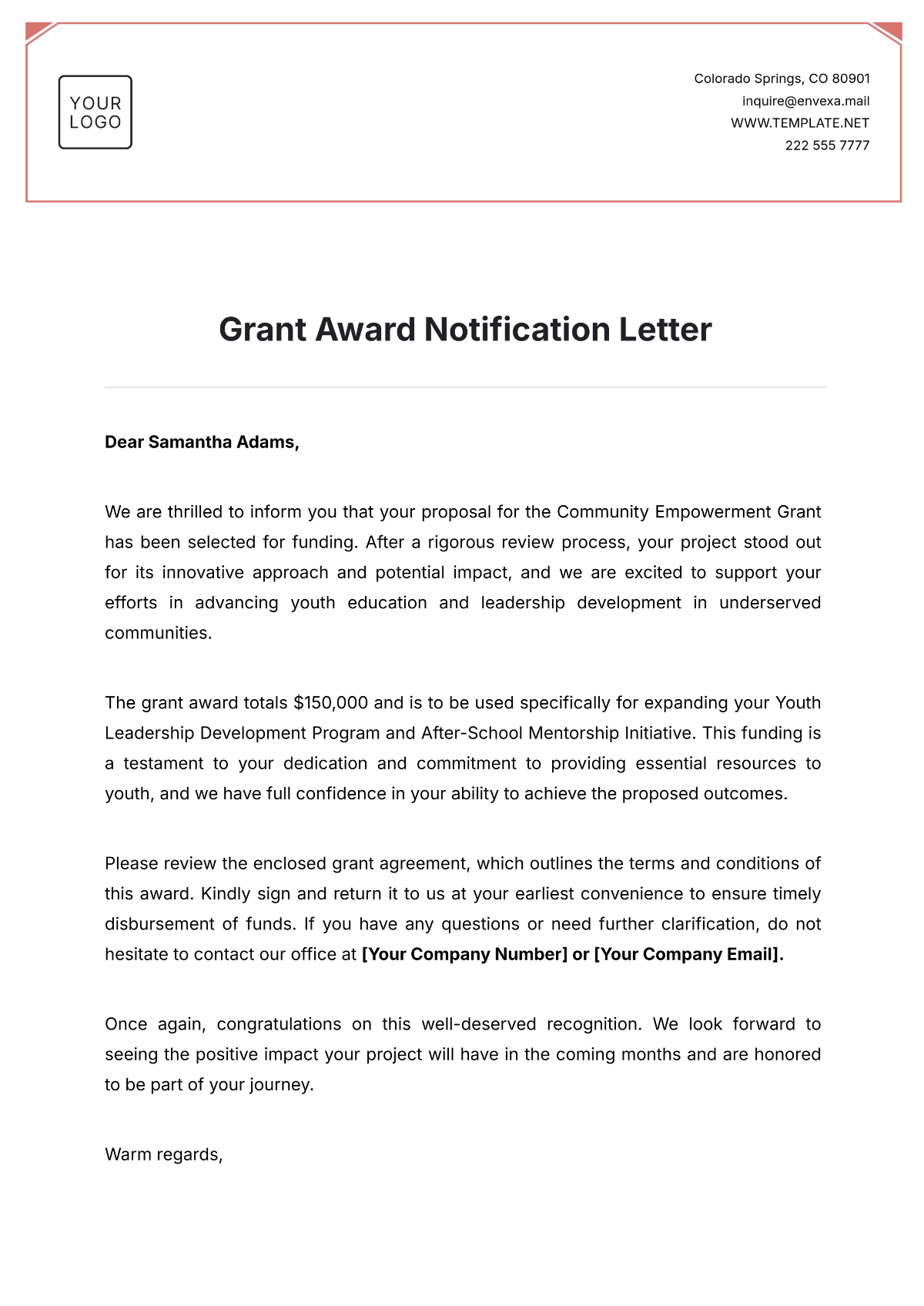
Recipient and funder information
Use names consistently throughout the letter. If the recipient is an organization, use the organization’s official name rather than an informal abbreviation unless the abbreviation is defined. The same principle applies to the funder. Consistent naming matters because grant records can later be reviewed by finance staff, auditors, board members, program managers, or external reviewers.
Contact details should be practical rather than excessive. A program officer, grants manager, or designated administrative contact is usually more useful than a generic list of departments. If the award has separate programmatic and financial contacts, identify both roles and explain which questions belong with each contact.
The letter should also use a professional document hierarchy. A recognizable heading, concise paragraphs, clear award details, and a formal signature block make the document easier to scan. Visual simplicity is usually more effective than decorative design because the primary job of the letter is to communicate an important funding decision.

How to state the award amount and funding period
The amount should be stated in both words and numerals when the organization’s normal document practice calls for that format. More importantly, the letter should clarify what the amount represents. It may be a total award ceiling, a particular budget period, a first installment, or a portion of a larger multi-period commitment. Avoid language that could make a partial commitment appear to be the entire award.
Dates deserve equal attention. A grant may have an award date, project start date, end date, budget period, and payment schedule, and these dates are not necessarily interchangeable. If the funder’s governing documents use defined terms, the letter should use those terms consistently. When future funding depends on additional approval, performance, or availability of funds, do not describe it as an unconditional commitment.
A useful award paragraph can therefore answer four questions: how much is being awarded, for what purpose, for which period, and under what conditions. That concise structure is often more valuable than several paragraphs of congratulatory language.

Grant agreements, conditions, and signatures
An award letter and a grant agreement serve related but different functions. The letter can announce the decision and summarize key information, while the agreement can establish detailed obligations, payment provisions, reporting requirements, intellectual property provisions, audit rights, termination provisions, and other conditions. The correct relationship depends on the funder’s governing documents.
Do not insert generic legal language simply because it appears in another organization’s letter. A clause that is suitable for one foundation may be inappropriate for another. Instead, identify the actual governing document and use language that accurately describes its role. If legal review is required by the organization’s internal process, the letter should be reviewed before it is issued.
Where acceptance requires a signature, provide a clear signature block and identify the deadline. If acceptance occurs through another mechanism, describe that mechanism accurately. For federal awards, recipients should rely on the relevant agency’s official award process rather than assuming that a conventional signature line has the same effect.

Grant award letter example: a practical structure
A useful grant award letter example can be built around a short sequence. Begin with the award date and recipient information. Follow with a direct statement of selection and the approved amount. Then identify the funded project, explain any important restrictions, reference the governing agreement, and finish with acceptance or next-step instructions.
For example, a hypothetical community foundation might write: “We are pleased to confirm an award of $75,000 to support the Community Learning Initiative for the period July 1 through June 30. The award is intended for the activities and budget categories described in the approved proposal and accompanying agreement.” The figures and project in this example are hypothetical and should be replaced with verified award information.
The next paragraph might explain that the recipient must review the accompanying terms, return a signed agreement by a specified date, and direct questions to the designated grants contact. This is a stronger structure than vague language such as “your funding has been approved,” because it gives the recipient concrete information without pretending that the letter contains every governing term.

How to adapt the format for nonprofits
A grant funding award letter template for nonprofits should recognize that nonprofit recipients may have several internal audiences for the same document. The executive director may need it for organizational records, finance staff may need the amount and restrictions, program staff may need the project period, and the board may need a concise record of the funding decision.
For that reason, nonprofit award letters benefit from precise financial language. State whether the amount is restricted, unrestricted, project-specific, multi-year, or subject to a separate budget. If the funder has approved a revised amount or budget, identify that fact clearly. The recipient should not have to compare multiple documents simply to discover whether the award differs from the submitted request.
A nonprofit may also want the letter to acknowledge the intended community benefit without turning the document into a promotional announcement. A short statement connecting the award to the organization’s mission can be helpful, but the operational details should remain prominent. This balance keeps the letter useful as both a communication and a record.

Federal grant award letter considerations
A federal grant award letter should be approached differently from a generic foundation letter. Grants.gov explains that a federal Notice of Award is the official, legally binding issuance of the award, and federal recipients are subject to the applicable terms and conditions. Agencies can use different systems and award documents, so the exact process must be confirmed with the awarding agency.
NIH is one example of why this distinction matters. Its current grants guidance describes the Notice of Award as the legal document that notifies the recipient that an award has been made and that funds may be requested through the designated payment system. The NoA also contains or references terms and conditions. A separate congratulatory letter may accompany that document, but it should not be represented as the official federal award instrument unless the agency expressly treats it that way.
When drafting a communication about federal funding, use the official award number, project period, budget period, funding amount, and agency terminology supplied by the award record. Avoid copying a private-foundation template and assuming it satisfies federal requirements. If the agency issues an amended or revised award, the recipient should use the latest official document when determining the current award status.

State-specific considerations and California examples
Someone searching for a grant funding award letter template california may be looking for a format suitable for a California public program, foundation, nonprofit, or local initiative. The key point is that California does not create one universal award-letter format for every grant. Individual agencies and programs can establish their own documents, instructions, agreements, and reporting procedures.
California agencies publish program-specific examples and award materials. CalRecycle, for example, provides resolution and letter examples for its grant and payment programs and advises users to consult the applicable program guidelines. The California Department of Public Health also publishes program-specific award-letter materials for certain funding programs. These examples show why a general template should be treated as a drafting aid rather than as an official state form.
For a California award, identify the specific awarding body and program first. Then compare the proposed letter against that program’s award notice, agreement, guidelines, and required terminology. If the program provides an official award letter, use that document rather than replacing it with a generic template. A general template can still help organize a separate cover communication when that communication is appropriate.

Choosing PDF, Word, and other document formats
People often search for a grant funding award letter template pdf because PDF is convenient for preserving the appearance of a finalized document. PDF is particularly useful when the letter has been approved internally and should be circulated without accidental formatting changes. It can also provide a stable record of what was issued at a particular time.
A grant funding award letter template word may be more convenient during drafting because staff can revise names, dates, amounts, project descriptions, and signature blocks. The important distinction is between an editable working document and the finalized record. Before issuing the final letter, check that the award amount, dates, recipient name, project name, and conditions are consistent throughout the document.
Searches for a grant funding award letter template free or grant funding award letter template free download should also be approached carefully. A no-cost template can be useful as a starting point, but the absence of a purchase price does not make its language suitable for every organization. The value of a template lies in its structure; the organization remains responsible for verifying the actual award terms and tailoring the document.

What to include in the body of the letter
A well-built letter usually starts with a concise congratulations or confirmation statement. The second paragraph can explain the project and award amount. The third can address conditions, reporting, agreement execution, payment timing, and contact information. This three-part structure is simple enough for quick review while still giving the recipient meaningful operational information.
For organizations that issue many awards, standardization can improve consistency. A central template can use fixed headings for award information, project period, approved amount, conditions, and next steps, while leaving variable fields for recipient-specific details. Staff should still review every completed letter individually because a standard structure cannot detect every project-specific restriction.
The closing should be professional and proportionate. Thanking the recipient for the work that led to the award can strengthen the relationship, but the closing should not introduce new obligations or financial promises. If the recipient needs to contact a grants manager, the relevant contact information should appear before or within the closing section.

Supporting letters versus award letters
A letter of support template for grant funding serves a different purpose from an award letter. A support letter generally comes from a partner, collaborator, community organization, institutional leader, or other stakeholder who is endorsing a proposed project. It can explain the relationship, the reason for support, and the value of the proposed work.
A support letter should not imply that funding has already been approved when the decision has not been made. This distinction is particularly important when the letter is submitted as part of a proposal. A supporter can describe intended collaboration, technical assistance, referrals, facilities, expertise, or other commitments, provided that those commitments are real and accurately represented.
Once funding is actually awarded, the award letter takes over a different communication role. It confirms the decision and records the principal award information. Keeping these documents distinct helps prevent a preliminary endorsement from being mistaken for a funding commitment.

Using request letters and award notifications correctly
A grant funding request letter sample is useful before an award has been made. It should explain the need, proposed project, amount being requested, expected outcomes, and relationship to the funder’s priorities. It should not be confused with an award letter, which communicates a funding decision after review.
Likewise, a sample letter for grant funding may refer to several stages of the funding process. Before using any example, identify whether it is a request, inquiry, support letter, award notice, acceptance letter, or closeout communication. Similar-looking documents can have very different purposes, and using the wrong structure can create confusion for the recipient.
A grant funding request letter sample can therefore be useful for studying tone and organization, while an award letter should be based on the actual decision record. The same organization may use several related letters over the life of one grant, but each should have a clearly defined purpose and should not make statements that belong in another stage of the process.
Grant award notification letter sample structure
A grant award notification letter sample normally places the funding decision near the beginning. A practical opening could state that the recipient’s proposal has been selected for funding, identify the approved amount, and name the project. The next section can explain the purpose of the award and identify any accompanying agreement or official notice.
The notification should then tell the recipient what action is required. For example, a hypothetical foundation could require the authorized representative to review an agreement and return it by a specified date. If no signature is required, the letter should not imply otherwise. If payment depends on documentation, the letter should describe that dependency accurately.
The final paragraph can provide a grants contact and express confidence in the project. This is a useful place to reinforce the relationship without making promises that have not been approved. A concise notification is often more effective than an elaborate letter that obscures the essential award details.
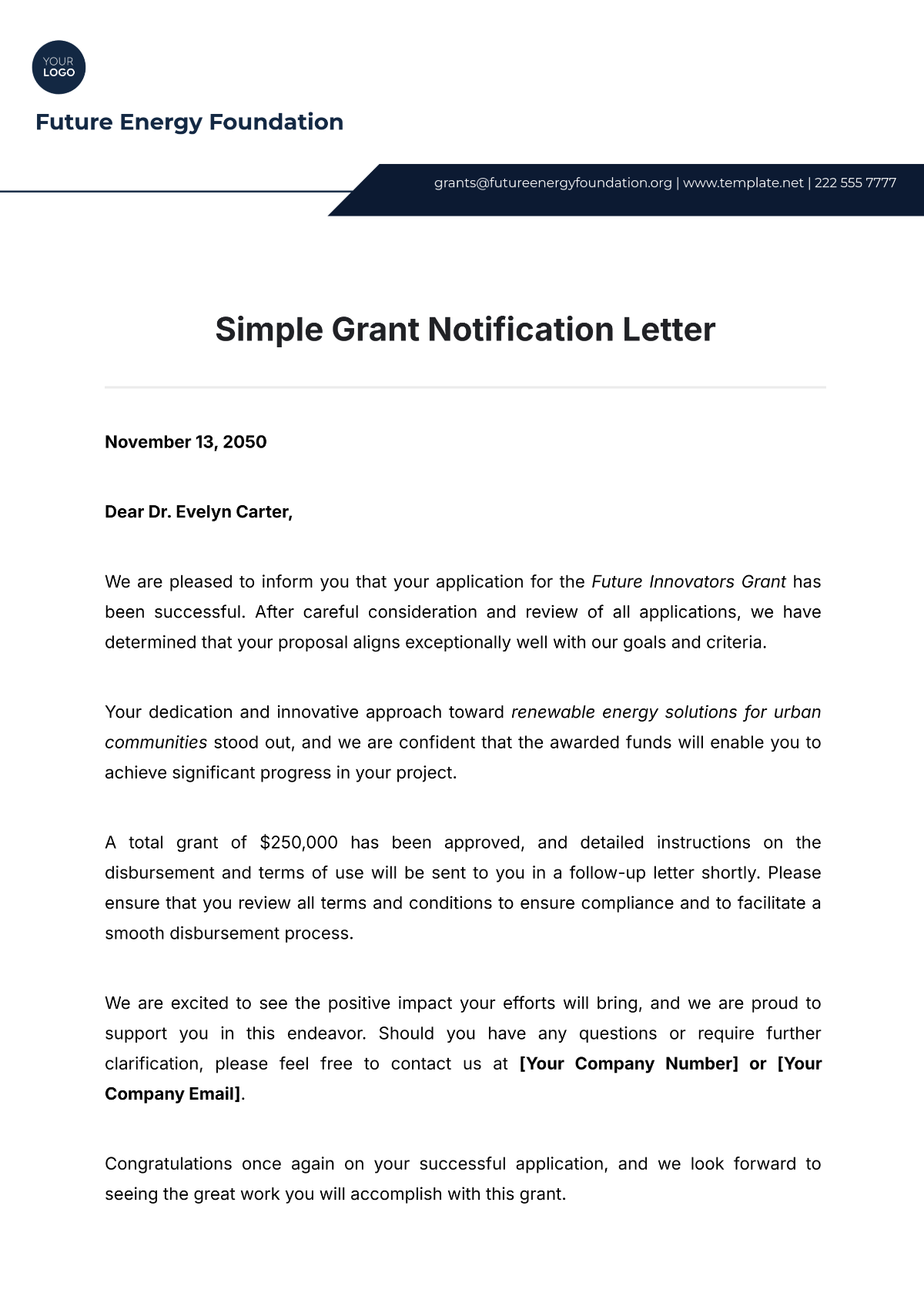
Practical Solution
Start by creating a master structure with five blocks: identifying information, award decision, financial details, conditions and next steps, and signature or contact information. Keep variable fields clearly marked during drafting. Before the letter is issued, compare every variable against the approved funding record rather than relying on memory or copying an older award.
Next, create a verification checklist. Confirm the recipient’s legal name, project title, award amount, currency, award date, project period, budget period if applicable, funding restrictions, agreement reference, reporting expectations, payment conditions, authorized signatory, and contact information. For government awards, add the relevant award number and agency-specific identifiers. This process catches errors that a simple spelling review will miss.
Finally, separate the drafting version from the issued record. A Word document may be useful while the letter is being prepared, while a finalized PDF may be appropriate for circulation or records. Store the issued version with the corresponding award documentation and make sure later amendments are clearly identified. If an official agency notice or agreement controls the award, retain that document as the authoritative record.

Common mistakes to avoid
One common mistake is treating the letter as a generic congratulatory note. An award letter should communicate information that the recipient can actually use. Leaving out the award amount, project period, required action, or governing agreement reference can create unnecessary follow-up questions.
Another mistake is copying language from an unrelated funding program. Different funders can use different definitions for award periods, eligible costs, matching requirements, reporting, payment, and amendments. A template should provide structure, not substitute for the actual terms of the award.
A third mistake is failing to distinguish examples from official requirements. A polished template may look authoritative even when it is merely a sample. Always verify the governing organization’s current instructions before representing any field, clause, signature, deadline, or reporting provision as mandatory.

Final quality check before issuing an award letter
Read the document once as a recipient would. Can the recipient identify the award amount in seconds? Is the funded project unmistakable? Are the dates understandable? Does the letter say exactly what the recipient must do next? If any answer is no, revise the structure before focusing on visual polish.
Then read it as a finance or grants administrator. Check whether the amount matches the approved record, whether restrictions are stated correctly, whether the payment language is accurate, and whether the letter conflicts with the governing agreement. A single incorrect amount or date can create more administrative work than a poorly designed page.
Finally, read it as an auditor or future records reviewer. The document should make sense months or years after it was issued. Use a clear date, identifiable recipient, identifiable funder, project reference, award amount, and relevant document references. When those elements are consistent, the letter becomes a useful part of the grant record rather than merely a congratulatory communication.

Reference Examples
The following visual references show different ways a grant funding award letter Template can be organized, from concise award notices to more detailed funding communications. They are useful for comparing hierarchy, placement of recipient information, treatment of award amounts, use of headings, and the balance between narrative language and operational instructions. Some examples are award-specific, while others represent closely related grant correspondence such as proposal letters, support letters, acknowledgment letters, and commitment letters. They should be viewed as visual references rather than universal official formats.
When reviewing these examples, pay particular attention to what makes an award letter easy to understand at a glance. A strong layout gives prominence to the decision, project, amount, and key dates while keeping secondary information organized. The references can also help distinguish documents that occur before funding is awarded from documents issued after a funding decision. That distinction is essential when adapting a grant funding award letter Template for a foundation, nonprofit, business, educational institution, or public-sector funding program.

Grant Award Letter
Source: Template.net

Grant Letter
Source: Template.net
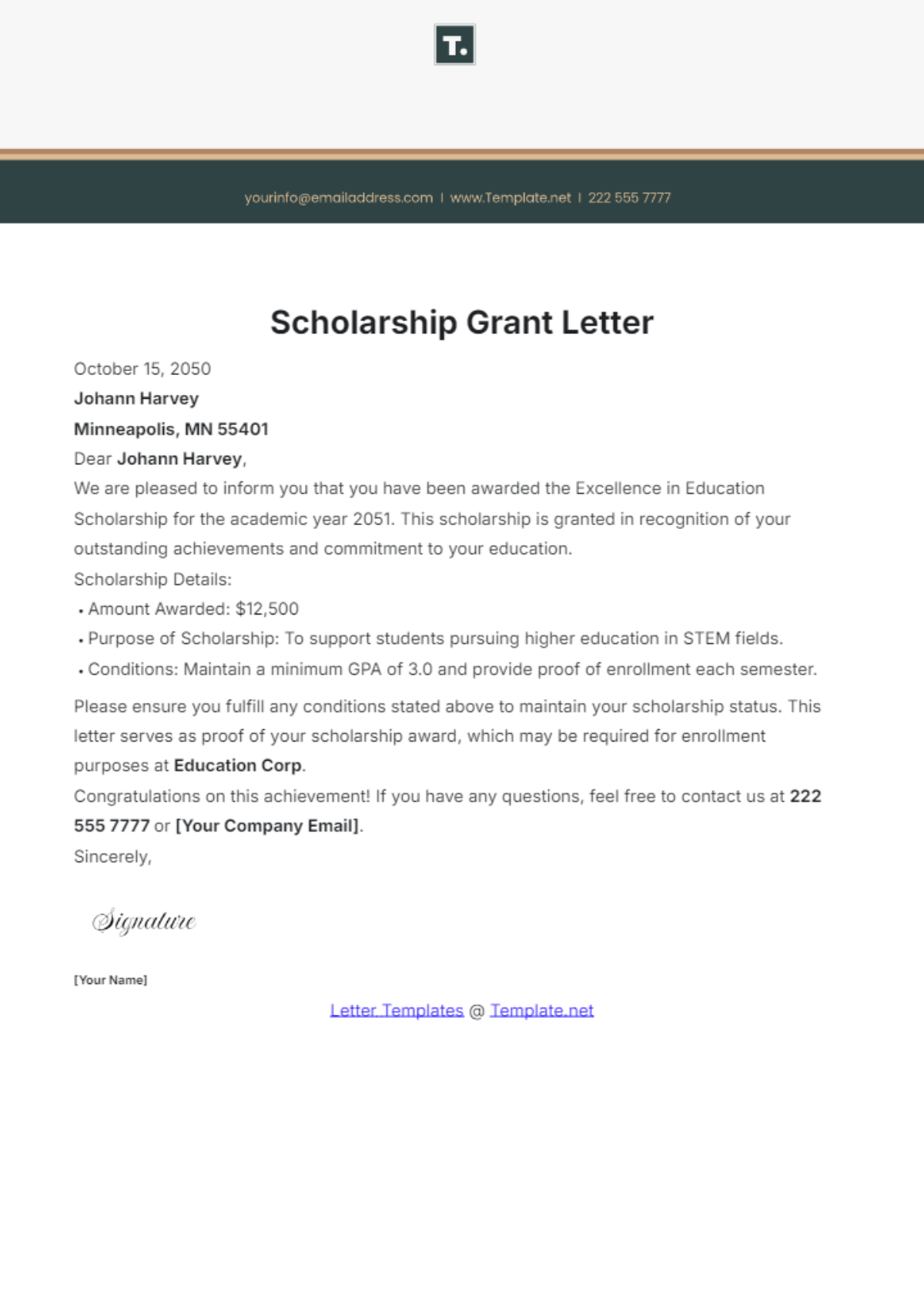
Scholarship Grant Letter
Source: Template.net

Grant Proposal Cover Letter
Source: Template.net

Energy Funding Service Letter
Source: Template.net

Grant Writer Cover Letter
Source: Template.net

Equity Grant Letter
Source: Template.net

Grant Thank You Letter
Source: Template.net

Grant Commitment Letter
Source: Template.net

Sample Grant Letter
Source: Template.net
