The best letter for investment property Template is not simply a page with blanks for names and addresses. It is a framework for presenting the property, the investment rationale, important assumptions, proposed terms, due-diligence expectations, and next steps in an organized way. A strong template reduces omissions while leaving enough flexibility to reflect the specific transaction.
Searchers often want a template in a particular format, such as Word, PDF, or Google Docs. Others need a short letter to a seller rather than a full investment proposal. Still others are looking for a document that can communicate projected cash flow, financing needs, or an investment partnership. Those are related uses, but they should not be treated as interchangeable documents.
This guide explains how to choose and customize the right format, what information belongs in an investment property letter, how to build a persuasive real estate proposal, how to present financial assumptions responsibly, and how to avoid common mistakes. The examples are illustrative, so hypothetical figures should be replaced with verified information before a letter is used in an actual transaction.
The central principle is simple: the letter should help the recipient understand what property is being discussed, why it may be attractive, what is being requested, what assumptions support the request, and what should happen next. Good structure creates clarity without making the letter sound like a sales brochure.

What Is an Investment Property Letter?
An investment property letter is a formal business communication concerning a property acquired, sold, financed, evaluated, or presented primarily for investment purposes. Depending on the situation, it may be addressed to a property owner, investor, lender, broker, partner, or other transaction participant.
The phrase what is an investment letter can therefore have several practical answers. In real estate, an investment letter may communicate interest in buying an income-producing property, propose an investment opportunity, request funding, summarize expected returns, or document an important part of an investment discussion.
The document is usually shorter than a complete business plan, underwriting package, purchase agreement, or private offering memorandum. Its purpose is often to start or advance a conversation. It should provide enough substance to make the recipient understand the opportunity without attempting to replace documents that require detailed legal, financial, or transactional treatment.
A useful investment property letter distinguishes facts from assumptions. The property address, asking price, current rent, and known physical characteristics should be identified as facts when they have been verified. Forecast rent, appreciation, renovation costs, or projected returns should be described as estimates or assumptions rather than guaranteed outcomes.
That distinction matters because a polished document can create false confidence if projections are presented as established results. A professional letter does not hide uncertainty. Instead, it identifies the information available, explains the assumptions used, and points the recipient toward the due diligence needed before making a decision.

When Should You Use an Investment Property Letter?
One common use is buyer outreach. An investor may write to a property owner to communicate serious interest, explain the intended investment strategy, and request a conversation about price or transaction terms. The letter can be particularly useful when the investor wants to make contact before presenting a complete offer.
Another use is investor communication. A property owner, developer, or sponsor may need a concise document explaining a potential acquisition to a prospective capital partner. In that context, the letter should focus less on emotional descriptions of the property and more on the investment thesis, capital requirement, structure, risks, and proposed next steps.
A financing letter is a different variation. An investor may need to communicate with a lender about the intended purchase, financing amount, property type, expected use, available funds, and supporting documentation. The lender may require its own forms, so a general-purpose letter should not be described as an official lender form.
Investment property letters can also support internal decision-making. An investment committee, business partner, or small real estate team may use a structured letter as a concise summary of a deal before deciding whether to spend more time on inspections, underwriting, financing, or negotiation.
The right document therefore depends on the recipient and objective. Before opening a template, write one sentence describing the desired outcome: obtain a meeting, express interest, propose an acquisition, request financing, attract an investor, summarize analysis, or move an existing discussion toward formal documentation.
Investment Property Letter vs. Letter of Intent vs. Proposal
These documents can look similar, but their roles differ. A general investment property letter may simply communicate interest or explain an opportunity. A letter of intent, often called an LOI, generally sets out preliminary business terms that the parties may later incorporate into a definitive agreement.
An investment proposal is more analytical. It usually explains why a particular investment may be attractive and provides supporting information about the property, market, financial assumptions, proposed capital, management plan, and expected outcomes. The proposal may be addressed to someone who is being asked to contribute capital.
A purchase offer is more transaction-focused. It may specify a proposed price, deposit, financing or cash structure, contingencies, closing expectations, and other terms. Whether an offer is binding depends on the document, transaction, jurisdiction, wording, and surrounding circumstances, so a generic template should never be assumed to create or avoid legal obligations.
The safest approach is to select a format based on function rather than appearance. If the objective is simply to open a conversation, use a concise letter. If the recipient must evaluate an investment opportunity, use a proposal structure. If the parties are negotiating defined deal terms, obtain appropriate professional guidance before relying on a generic LOI or offer format.
This distinction also improves search and document selection. Someone searching for a template in Word may actually need a purchase letter, while someone searching for a PDF may need a proposal. File format answers the question of how the document is delivered; document type answers the more important question of what the document is supposed to accomplish.
Core Components of a Strong Investment Property Letter
The opening should identify the sender and recipient clearly. Include the sender’s name or legal entity, mailing address when appropriate, email address, telephone number, date, recipient name, recipient organization if applicable, and property address. A clear header helps the recipient understand the context immediately.
The subject line should state the purpose in plain language. Examples include “Investment Interest in [Property Address],” “Proposal for Acquisition of [Property Address],” or “Investment Opportunity: [Property Name].” Avoid vague subjects such as “Real Estate Opportunity,” particularly when the recipient manages multiple properties or proposals.
The introduction should explain why the recipient is receiving the letter. A buyer can state that the property has been reviewed and that there is interest in discussing an acquisition. An investor seeking capital can identify the project and summarize the opportunity in one or two sentences.
The property overview should contain only information that helps the recipient evaluate the opportunity. Depending on the property, that might include property type, approximate size, number of units, location, occupancy, current use, asking price, existing lease status, or notable characteristics that are relevant to the investment thesis.
The financial section should then explain the economics. Instead of presenting a long spreadsheet inside the letter, summarize the most decision-relevant figures and identify where detailed calculations are available. For example, a rental-property proposal might summarize estimated income, operating expenses, debt service, projected cash flow, and the assumptions that drive those figures.

Property Identification
Property identification is more important than decorative formatting. Use the full street address when appropriate and add a parcel number or legal description only when the transaction context calls for it and the information has been verified. A property should be identifiable without forcing the recipient to guess which asset is being discussed.
For multifamily or commercial properties, identify the number and general type of units or spaces where that information is material. If occupancy is mentioned, state whether it is current occupancy, a historical figure, or a projection. This prevents a temporary leasing condition from being mistaken for a long-term operating result.
Location should also be specific enough to support the investment thesis. Instead of writing that a property is “in a great area,” explain the relevant characteristic, such as proximity to employment centers, transportation, educational institutions, retail, or another feature that has actually been researched.
Avoid unsupported claims about appreciation or rental demand. If a market observation comes from comparable properties, describe it as an observation from the available comparables rather than a universal market fact. If the data is preliminary, label it accordingly.
For an acquisition letter, the property description should support the proposed action rather than become a marketing brochure. The recipient already knows the asset better than a generic letter writer does in many cases. Specificity, accuracy, and restraint are more persuasive than exaggerated adjectives.
Investment Purpose and Strategy
A good investment letter explains what the buyer or sponsor intends to do with the property. Common strategies include long-term rental ownership, renovation and resale, redevelopment, value-add operations, commercial leasing, or acquisition for portfolio diversification. The strategy should match the financial analysis presented elsewhere in the document.
For a rental strategy, describe the intended operating model. Explain whether the plan is to retain existing tenants, renovate units between leases, improve management, reposition the property, or simply maintain current operations. The purpose is not to provide a full management manual but to show that the investment thesis has been considered.
For a value-add strategy, identify the improvement concept and explain why the proposed work may create value. A useful example would be a hypothetical plan to improve common areas, modernize selected units, improve operating efficiency, and reposition rents after the work is completed. The costs and expected results should remain clearly identified as estimates.
For a development opportunity, the letter should explain the development concept, site status, major funding needs, expected timeline, and principal uncertainties. Planning approvals, construction costs, financing availability, market demand, and timing can all materially affect the outcome.
The strategy section is strongest when it connects the property to the investor’s objective. A property is not attractive simply because it has a large building or a favorable location. The letter should explain why the specific asset fits the intended strategy and what evidence supports that conclusion.

How to Build the Financial Section
The financial section is often the most important part of an investment proposal because it translates the property story into an economic decision. Start with acquisition costs, including the proposed purchase price and any known transaction expenses. Then consider financing assumptions, operating income, operating expenses, reserves, and the expected investment period.
For a rental property, distinguish gross scheduled rent from effective rental income. Vacancy, concessions, bad debt, and other adjustments can affect the amount actually collected. If those items are estimated, state that they are assumptions rather than established operating results.
Operating expenses may include property taxes, insurance, management, maintenance, utilities paid by the owner, landscaping, administrative expenses, and reserves for capital expenditures. The precise categories vary by property and operating model. The purpose of the letter is to make the major assumptions visible.
Net operating income, commonly abbreviated NOI, is generally calculated by subtracting operating expenses from operating income before financing costs. It can be useful for evaluating a property’s operations independently of the specific mortgage structure. However, NOI is not the same as cash flow available to an investor after debt service and other cash requirements.
Cash-on-cash return is another commonly discussed measure. In a simplified example, if a hypothetical property produces $18,000 of annual pre-tax cash flow and the investor has $200,000 of cash invested, the resulting ratio would be 9%. This is only an illustration; actual calculations should use verified income, expenses, financing, reserves, and transaction costs.
Presenting Projections Responsibly
Projections should be traceable. If expected rent is based on comparable listings, document the source and date of the comparison in the underlying analysis. If renovation costs come from contractor estimates, retain the estimates. If an appreciation assumption is used, explain why that assumption was selected rather than presenting it as a certainty.
Scenario analysis is often more informative than one optimistic forecast. A basic model might include conservative, base, and stronger operating cases. The letter does not need to reproduce every spreadsheet calculation, but it can summarize the principal difference between the scenarios and identify which variables have the greatest effect on the result.
For example, a hypothetical rental property might be modeled with different rent levels, vacancy assumptions, renovation costs, and financing costs. If a modest change in rent or interest expense materially changes cash flow, the letter should not hide that sensitivity. A recipient needs to understand which assumptions deserve further verification.
Exit assumptions deserve similar care. If the investment thesis depends on selling after several years, the projected sale price, selling costs, remaining loan balance, and estimated holding period should be analyzed separately. A projected profit at exit is not equivalent to a guaranteed return.
Good financial writing is transparent rather than impressive. A proposal that clearly identifies uncertainty is more useful than one that relies on precise-looking numbers without explaining where those numbers came from.
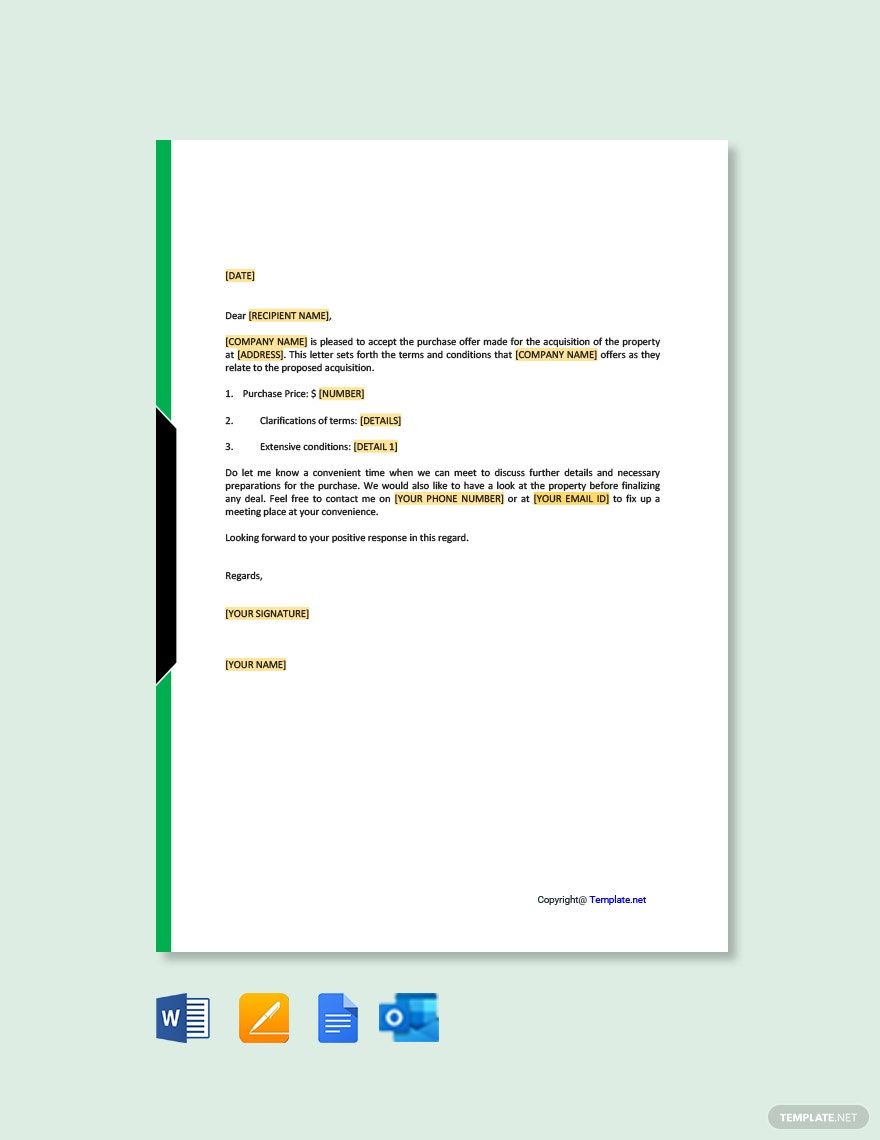
Writing the Investment Request
The request should be unmistakable. If you want to purchase the property, say so. If you want an investor to contribute capital, state the amount or the amount being sought, subject to final documentation. If you want a meeting, say what you would like to discuss and suggest a practical next step.
In an investor-facing document, explain how capital would be used. Examples might include acquisition, renovation, closing expenses, working capital, refinancing, or development costs. The description should be specific enough for the recipient to understand the purpose of the funds.
If the proposed structure includes equity, profit sharing, a preferred return, debt, or another arrangement, avoid presenting a generic template as a substitute for definitive legal documents. The letter can summarize the proposed concept while making clear that final terms are subject to negotiation and appropriate agreements.
A strong request also explains what information is available. You might identify an accompanying underwriting model, property inspection materials, rent roll, operating statement, comparable analysis, financing information, or other documentation. Only list materials that actually exist and are ready to be reviewed.
Finally, give the recipient a straightforward next action. A good closing might invite a call, request confirmation of interest, ask for permission to conduct due diligence, or propose a date for reviewing the transaction. Avoid ending with a vague statement that simply says you hope to hear back.

How to Create a Letter for Investment Property Template
Start with a clean business-letter layout. Use a readable font, consistent margins, a clear subject line, and enough white space to separate sections. A simple one- or two-page document is often easier to review than a visually complicated design with large graphics.
Create reusable placeholders for the sender, recipient, date, property address, property type, purchase price, proposed investment, and contact information. Keep placeholders visually distinct during drafting so they cannot accidentally remain in the final version.
Build the body around a predictable sequence: purpose, property overview, investment rationale, financial highlights, proposed terms or request, due diligence, next steps, and closing. Not every letter requires every section, but this structure gives the writer a reliable starting point.
Add a short assumptions section when projections are important. This can identify whether figures are based on current rents, estimates, broker information, preliminary contractor pricing, or another source. The assumptions section should not become a substitute for a complete underwriting file.
Before sending the document, remove irrelevant template text and verify every number. Check the recipient name, property address, proposed price, investment amount, dates, contact details, and references to attachments. A beautiful template with one incorrect figure can undermine confidence in the entire proposal.

Using a Word-Based Template
Word is useful when the document needs extensive editing, tracked changes, comments, or collaboration with advisers. It is also practical when a company already maintains letterhead or document standards in Microsoft Word.
When using a Word document, keep formatting simple enough that the file remains stable across devices. Avoid excessive text boxes and decorative elements if the recipient may need to edit the content. Consistent heading styles and ordinary paragraphs make later revisions easier.
A Word template should also include clear instructions for replacing placeholders. For example, a property address field should be replaced everywhere it appears, not only in the first paragraph. A final find-and-review pass is useful for catching leftover brackets and sample information.
When the letter is finalized, save an editable master copy separately from the version being sent. This prevents accidental changes to the original template and makes it easier to reuse the structure for another property.
When the exact search phrase is letter for investment property template word, the key consideration is therefore not just whether the file has a Word icon. The document should be genuinely editable, professionally structured, and appropriate for the intended real estate communication.

Using a PDF Version
PDF is usually best for a finalized document because the layout is less likely to change when the recipient opens it. It is particularly useful for preserving a signed or review-ready letter, although whether a particular document should be electronically signed depends on the transaction and the parties involved.
A PDF should be generated from the final reviewed document rather than used as a convenient way to hide editing problems. Check page breaks, headings, tables, contact information, and signature areas before sending it.
When someone searches for letter for investment property template pdf, the format is often the main concern. But a PDF is only as useful as the underlying content. A poorly structured letter remains poor after conversion to PDF.
If a document contains financial calculations, consider whether a separate spreadsheet should accompany the PDF. The letter can summarize the conclusions while the spreadsheet provides the detailed assumptions and formulas. This division keeps the communication readable without sacrificing analytical depth.
Do not label a generic template as an official legal, lender, or government PDF unless the source actually establishes that status. A professionally designed example can be useful without carrying any official authority.

Choosing Between Free, Word, PDF, and Google Docs Formats
Free templates are valuable when the goal is to start quickly, understand document structure, or create a basic letter without purchasing specialized software. The important question is what the template allows you to edit and whether the resulting document fits the actual purpose.
The phrase letter for investment property template free download reflects a common search intent: the user wants something immediately usable. Before relying on any free resource, check the file format, licensing terms, editable fields, source reputation, and whether the sample contains language that is inappropriate for the actual transaction.
Google Docs can be especially convenient for collaboration. A team can revise the same working document, add comments, and maintain a shared draft. However, the final version should still be reviewed carefully before being converted into a fixed document for external use.
When searching for a letter for investment property template google docs, look for a structure that transfers cleanly into a collaborative document rather than choosing a template solely because the words “Google Docs” appear in the title. Formatting compatibility matters when several people will review the letter.
For users who specifically want a letter for investment property template word free, the same principle applies. The value comes from editability and appropriate structure, not from the word “free” alone. A short, accurate document is more useful than a visually impressive template that contains irrelevant sample language.
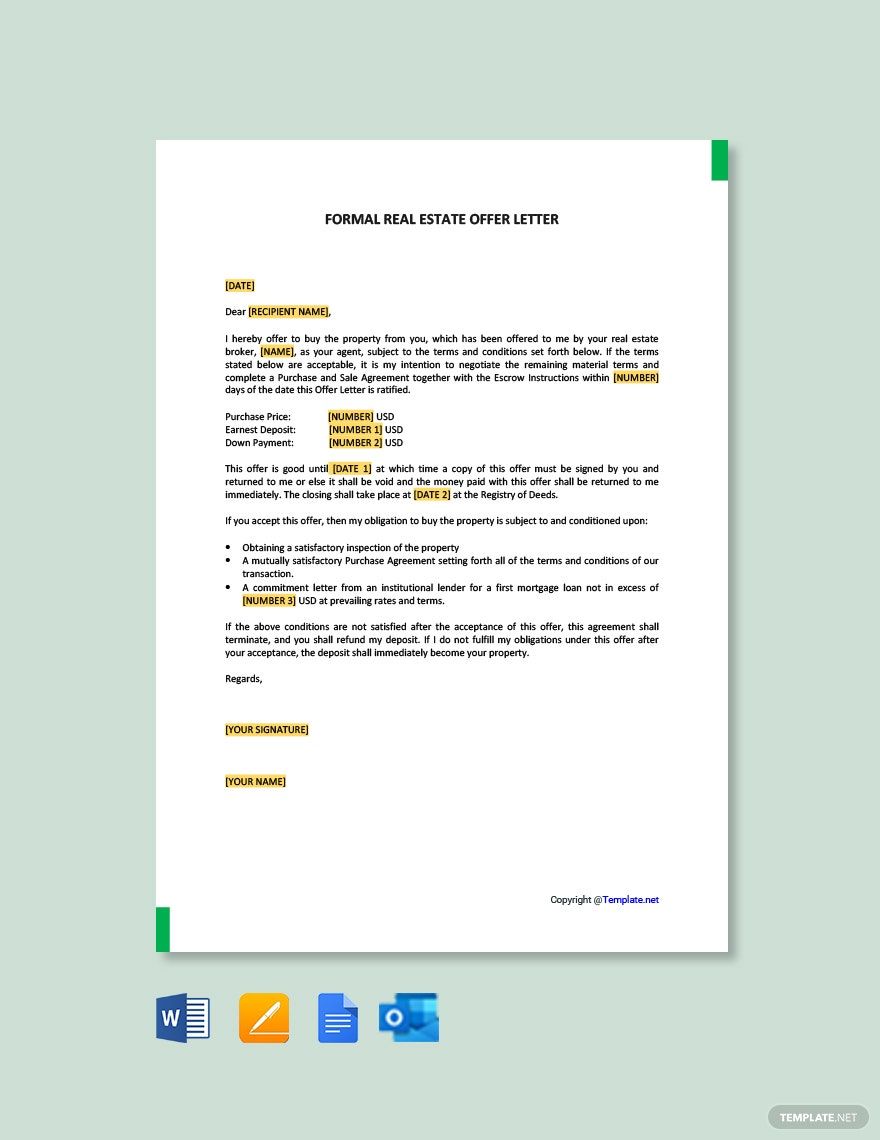
California Considerations
A search for letter for investment property template california usually signals a need for a California-oriented document rather than a generic real estate letter. A state-specific template can help the writer organize information, but the presence of a California label does not automatically make a document legally sufficient for a particular transaction.
California transactions can involve property-specific, local, financing, disclosure, leasing, tax, and contractual considerations. Those issues may depend on the transaction type and facts of the property. A general template should therefore be treated as a drafting aid rather than a statement of current legal requirements.
For a California investment property, identify the property accurately and distinguish factual information from estimates. If the letter refers to disclosures, inspections, permits, leases, tenant conditions, or other transaction matters, verify the relevant information rather than relying on generic wording from an online example.
If the document is intended to establish enforceable obligations, consult an appropriately qualified California real estate professional or attorney before relying on the language. This is especially important when a letter includes purchase terms, deadlines, deposits, contingencies, representations, or language concerning whether the document is binding.
A useful California template is therefore one that provides organization without pretending to replace transaction-specific advice. The safest workflow is to draft the business communication first, verify the property and financial facts, and then obtain professional review when the content could create legal or financial consequences.
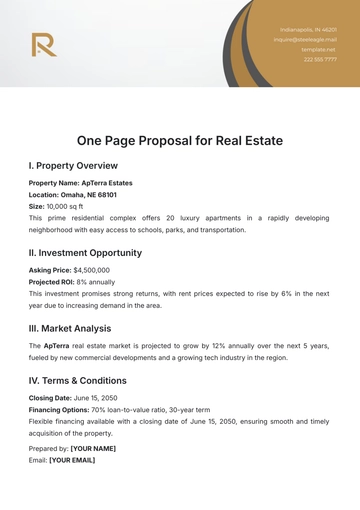
Investment Proposal Letter for Real Estate
An investment proposal letter for real estate should answer five questions quickly: What is the opportunity? Why might it be attractive? How much capital is required? What assumptions support the projected outcome? What action is being requested from the recipient?
The executive summary should be short. For example, a hypothetical proposal might describe a small multifamily acquisition, state the proposed purchase price, identify the planned renovation strategy, summarize the expected operating model, and explain that the sponsor is seeking a defined amount of equity subject to final due diligence.
The market section should support the thesis without becoming a collection of unsupported claims. Discuss relevant comparable properties, observed rental levels, competing inventory, location characteristics, and other evidence that actually affects the investment decision. Dates and sources should be retained in the underlying research file.
The financial section should connect the market evidence to the property’s expected performance. If projected rents depend on renovations, say so. If the forecast assumes a particular occupancy level, identify that assumption. If debt costs have not been locked, do not present the financing estimate as a final term.
The proposal should finish with the requested action. A recipient should know whether you are asking for an introductory meeting, permission to proceed with due diligence, an investment commitment, a term-sheet discussion, or another specific step.
Capital Investment Letter Sample Structure
A useful capital investment letter sample begins with the investment opportunity and the reason for contacting the recipient. The writer should then identify the property or project, explain the proposed use of funds, summarize the financial rationale, and describe the proposed next step.
For example, imagine a hypothetical investor seeking $300,000 in equity for a $1.2 million rental acquisition. The letter might explain that the capital would fund part of the acquisition and closing costs, while projected rental income and operating expenses are being analyzed separately.
The sample should avoid promising a specific return unless the underlying structure genuinely supports that statement. A more responsible formulation is to describe projected returns as estimates based on stated assumptions and to explain that actual results can differ.
If the capital will be contributed by multiple investors, the letter should also explain the proposed structure at a high level. It might mention ownership percentages, preferred economics, distributions, or an intended investment period, but definitive rights and obligations should be documented in appropriate agreements.
The strongest capital letter is concise enough to read quickly while directing the recipient to more detailed material. It should not attempt to place the entire financial model, legal agreement, property inspection, and business plan into one document.
Investment Proposal Letter Format
A practical investment proposal letter format generally follows the logic of a business case. Begin with sender and recipient details, add a subject line, explain the purpose, introduce the property, present the investment rationale, summarize financial information, state the request, identify due diligence, and close with contact information.
Use headings when the letter exceeds a page or contains several analytical sections. Headings such as “Property Overview,” “Investment Rationale,” “Financial Highlights,” “Proposed Structure,” and “Next Steps” allow the recipient to scan the document without sacrificing substance.
Tables can be helpful when they contain a small number of important figures. For example, a financial highlights table might show purchase price, estimated closing costs, initial cash investment, projected annual income, projected operating expenses, and estimated cash flow. Each figure should be labeled clearly.
Long tables should normally remain in the supporting financial model rather than the letter. A proposal is a communication document, not necessarily the complete underwriting workbook. The reader should be able to understand the conclusion and then inspect supporting evidence separately.
Consistency is essential. If the purchase price appears as $750,000 in the opening but $725,000 in the financial section, the recipient may question every other figure. Use one controlled set of assumptions and update the entire document whenever a material input changes.
Research and Data Collection Before Writing
The letter should be the final communication layer of the research process, not the place where research begins. Start by collecting the property’s basic facts, transaction history when relevant, current income information, operating expenses, financing assumptions, and known physical or legal considerations.
Market research should focus on evidence that can change the investment decision. Comparable rents can help evaluate income assumptions. Comparable sales can help frame valuation. Competing properties can help test leasing assumptions. Local development activity may help identify potential changes to supply or demand.
Property-level data deserves equal attention. Review available leases, rent rolls, income statements, tax information, insurance costs, maintenance history, capital expenditure needs, and other operating records that are relevant to the asset. Not every property will provide the same documentation.
Create a source log for important figures. Record where each number came from, when it was obtained, and whether it is verified, estimated, or provisional. This simple research practice makes it much easier to update the letter when assumptions change.
Finally, separate research from persuasion. The purpose of research is to determine whether the investment thesis survives scrutiny. The purpose of the letter is to communicate the resulting analysis clearly. If the research reveals weaknesses, those weaknesses should be addressed rather than hidden.

Data Analysis and Reporting
A basic investment analysis can begin with income and expenses, but sophisticated decisions require several perspectives. Review operating performance, financing, initial cash requirements, expected holding period, exit assumptions, and sensitivity to major variables.
For a hypothetical rental property, start by estimating annual effective income. Subtract operating expenses to estimate NOI. Then account for debt service and other investor-level cash requirements to estimate cash flow. Separately evaluate the initial cash invested and any anticipated future capital contributions.
For a sale-oriented investment, estimate acquisition costs, renovation costs, holding costs, financing costs, selling expenses, and the expected sale proceeds. The difference between total project costs and expected proceeds provides an initial view of the investment outcome, subject to taxes, financing details, timing, and other factors.
Return measures should never be presented without context. A high projected annual return may depend on aggressive assumptions, substantial leverage, or a short investment period. A lower projected cash yield may coexist with a different long-term appreciation or equity-building strategy.
The letter should summarize the metrics that matter to the recipient. An equity investor may care about cash distributions and total return. A lender may focus on repayment capacity and collateral. A seller may care primarily about price, certainty, timing, and transaction conditions. Reporting should reflect the audience.
Common Mistakes to Avoid
The first mistake is using the same letter for every recipient. An owner, lender, and equity investor have different concerns. A letter written for one audience should not simply be copied to another without changing the information hierarchy.
The second mistake is exaggerating projected performance. Phrases such as “guaranteed return,” “risk-free investment,” or “certain appreciation” can be inappropriate and misleading when the underlying investment is uncertain. Use measured language and support projections with documented assumptions.
The third mistake is leaving placeholders in the final version. Names, dates, property addresses, purchase prices, email addresses, and bracketed instructions should be checked systematically before delivery.
The fourth mistake is confusing a template with a legal document. A generic letter can help organize a conversation, but it may not address all transaction-specific requirements. The more a letter attempts to establish enforceable rights or obligations, the more important professional review becomes.
The fifth mistake is making the document too long. A comprehensive supporting file can be valuable, but the letter should remain focused. Put detailed calculations, extensive comparable data, inspection records, and other supporting evidence in separate materials when appropriate.

Practical Solution
The most efficient workflow is to treat the investment property letter as the front page of a larger decision package. Begin with a reusable template containing only the sections that will be used repeatedly. Keep the financial model, research notes, and supporting documents separate.
Step one is to define the audience and objective. Write down whether the recipient is a seller, lender, investor, partner, broker, or internal decision-maker. Then write one sentence describing the requested outcome. This prevents the document from drifting between unrelated purposes.
Step two is to create a verified fact sheet for the property. Record the address, property type, units or spaces, current income, major expenses, asking price or proposed price, known financing assumptions, and other essential facts. Mark each item as verified, estimated, or pending confirmation.
Step three is to build the financial case separately. Calculate the figures using consistent assumptions, test conservative and base scenarios, and identify the variables that matter most. Keep the formulas in a spreadsheet or financial model rather than relying on manual calculations inside the letter.
Step four is to draft the letter around the decision. Start with the opportunity, explain the rationale, summarize the economics, state the request, disclose important assumptions, and identify the next action. Remove any paragraph that does not help the recipient understand or act on the proposal.
Step five is to perform a factual audit. Compare every number in the letter against the source documents and financial model. Confirm names, addresses, dates, prices, percentages, investment amounts, and references to attachments. If the letter mentions a projected figure, make sure the supporting model uses the same assumption.
Step six is to perform a risk audit. Ask whether the letter makes a promise that the underlying evidence cannot support. Check whether uncertain information is labeled as an estimate. Review whether the language accidentally suggests that a preliminary document is binding, official, guaranteed, or legally sufficient when that has not been established.
Step seven is to perform an audience audit. Read the letter as the recipient would. A seller may want to know who is buying, what is being proposed, and how the transaction may proceed. An investor may want to know how capital is used and how returns are generated. A lender may require a different set of information entirely.
Step eight is to produce the requested file format. Keep the editable master in the appropriate application, create a clean PDF when a fixed version is needed, and preserve supporting spreadsheets separately. If multiple parties will edit the document, establish one current master rather than circulating several conflicting versions.
Step nine is to make the next action easy. Give the recipient a specific way to respond, such as scheduling a discussion, confirming interest, reviewing attached materials, or providing requested information. A clear call to action turns the letter from a passive description into a useful transaction tool.
Reference Examples
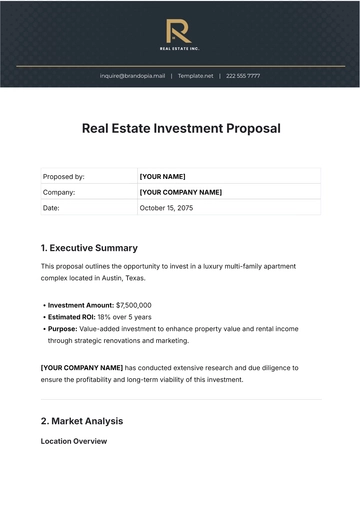
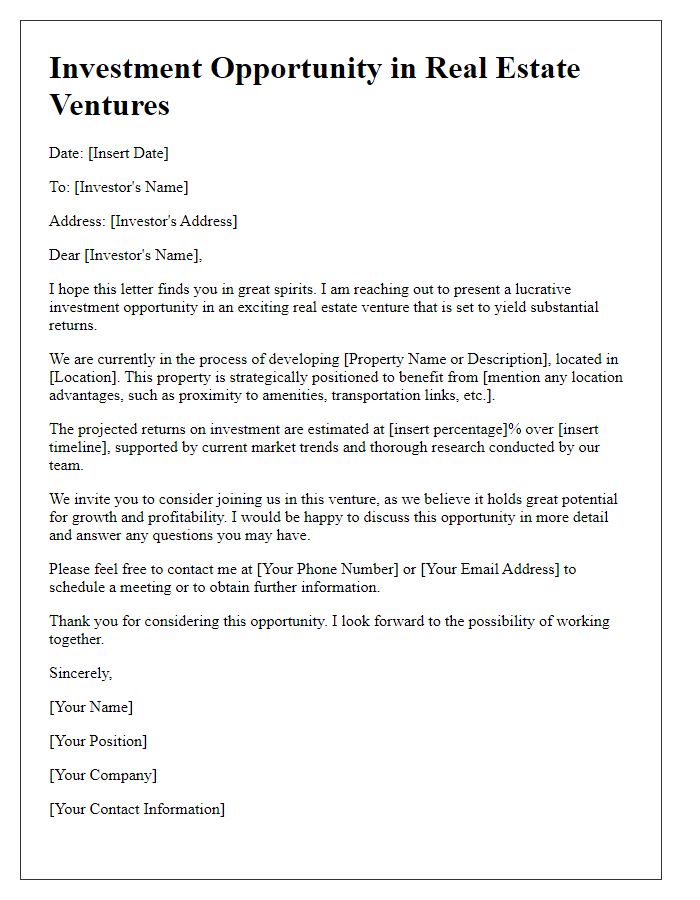
The following reference visuals show different document structures and investment-related layouts. They are examples of presentation styles and should be adapted to the facts, audience, transaction, and professional requirements of the specific situation.
letter for investment property template free

Source: Template.net
letter for investment property template pdf
Source: Template.net
letter for investment property template free download
Source: Template.net
letter for investment property template word
Source: Template.net
letter for investment property template california
Source: Template.net
letter for investment property template google docs
Source: Template.net
letter for investment property template word free
Source: Template.net
what is an investment letter
Source: Letterin
investment proposal letter for real estate
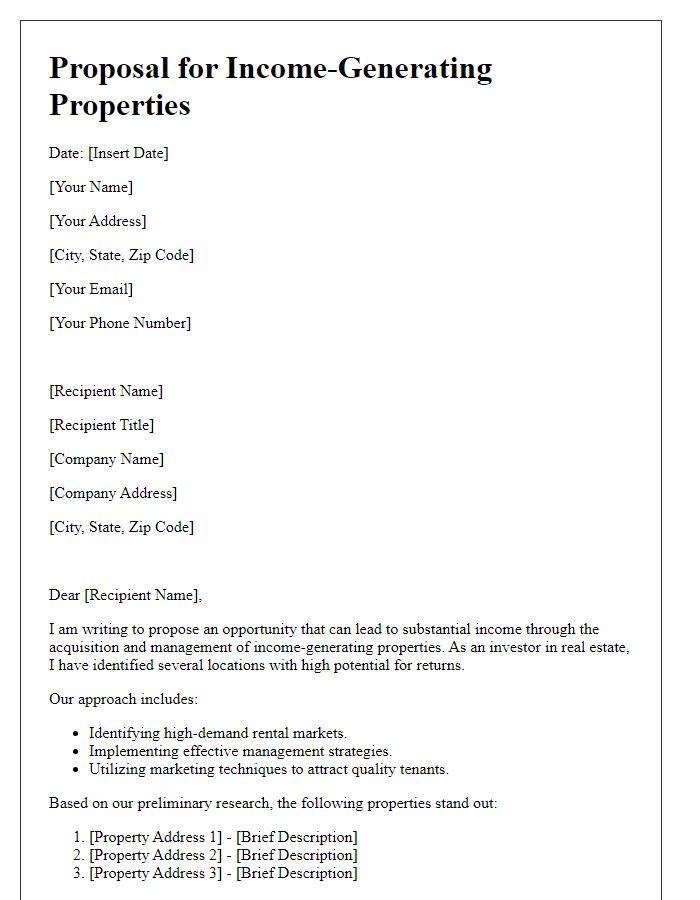
Source: Letterin
capital investment letter sample
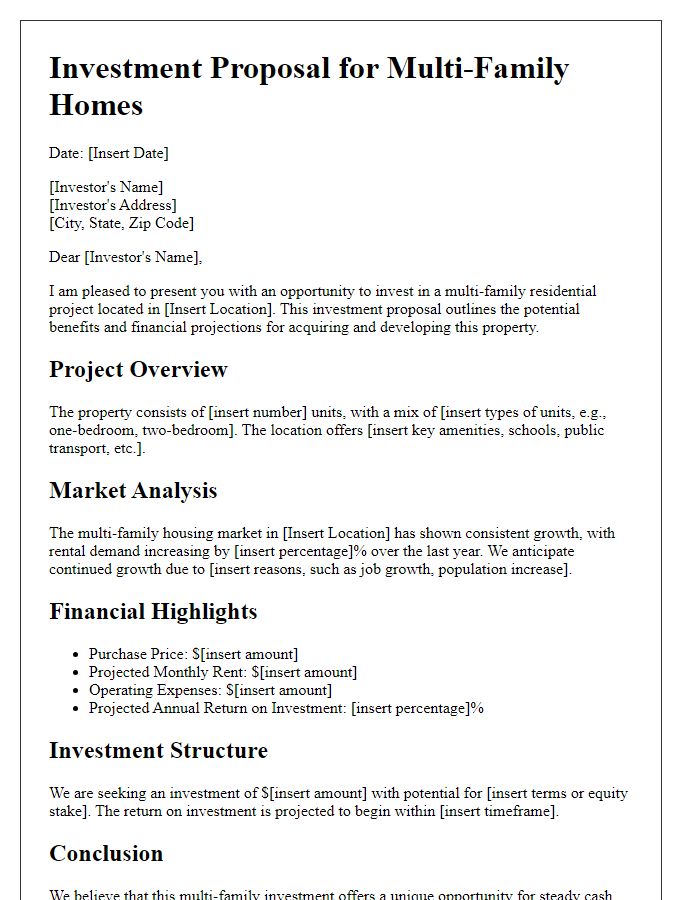
Source: Letterin
investment proposal letter format
Source: Template.net
investment proposal letter sample pdf
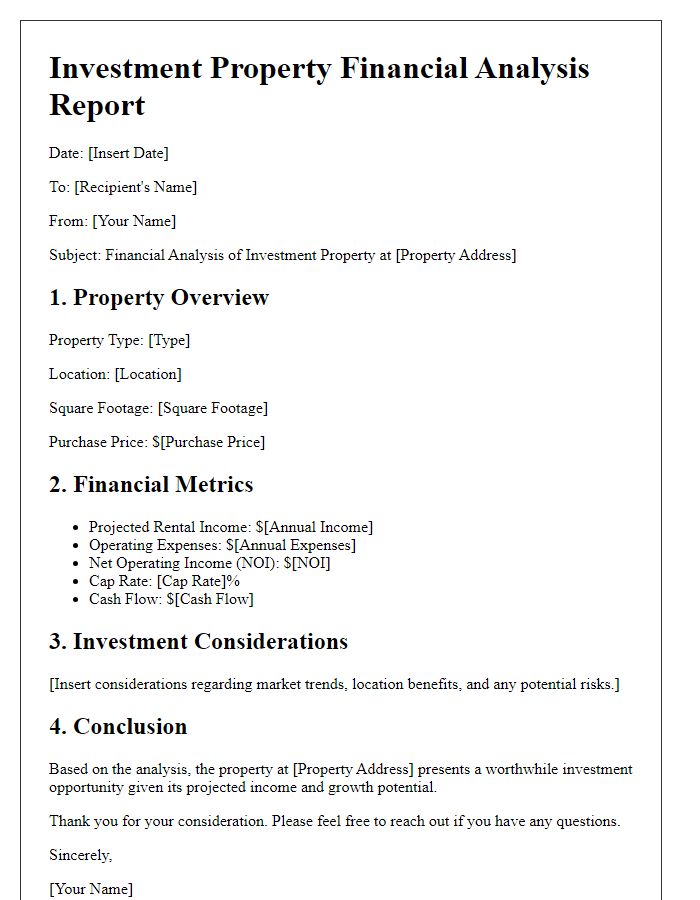
Source: Letterin
Frequently Asked Questions
What should an investment property letter include?
At minimum, identify the sender, recipient, property, purpose of the letter, investment rationale, relevant financial information, proposed request or terms, important assumptions, and next steps. Add supporting documentation when the recipient needs more detail than the letter can reasonably contain.
How long should an investment property letter be?
There is no universal page limit, but clarity should determine length. A simple expression of interest may fit on one page, while an investor proposal may require two or more pages. Detailed financial calculations are usually better placed in supporting spreadsheets or reports.
Can a free template be used for an actual transaction?
A free template can provide a useful starting structure, but it should be customized and reviewed carefully. The writer should verify all facts, remove sample language, and obtain professional advice when the document involves legal obligations, significant financing, securities, or transaction-specific requirements.
Should I send a Word document or PDF?
Use Word or another editable format when collaboration and revisions are expected. Use PDF when the document has been finalized and you want to preserve its layout. Keeping both an editable master and a final PDF can be practical for recurring investment workflows.
Can an investment property letter guarantee a return?
A template should not be used to imply that a real estate investment has a guaranteed return unless there is a legally and economically appropriate basis for such a statement. Investment outcomes depend on property performance, market conditions, financing, expenses, timing, and other risks.
Is an investment proposal the same as a purchase agreement?
No. A proposal generally communicates an opportunity and suggested approach. A purchase agreement is a formal transaction document that establishes the parties’ rights and obligations according to its terms. Do not assume that a proposal template has the legal effect of a purchase contract.
What makes a real estate investment proposal persuasive?
Persuasion comes from clarity and evidence. A strong proposal identifies a specific opportunity, explains the investment thesis, presents understandable financial assumptions, addresses meaningful risks, and makes a precise request. Credible uncertainty is generally more useful than unsupported optimism.
How should California investors approach a template?
Use a template as an organizational starting point, then confirm the transaction-specific requirements that apply to the property and parties. California real estate transactions can involve issues that a generic national template does not address, so professional review may be appropriate for consequential documents.
What should I do if the property’s numbers are incomplete?
Do not fill missing information with guesses and present those figures as facts. Mark the information as pending, use clearly identified assumptions for preliminary analysis, and explain what documentation is needed to verify the figures before making a final investment decision.
Conclusion
A strong letter for investment property Template should make a real estate opportunity easier to understand, evaluate, and discuss. The best document identifies the property clearly, explains the investment purpose, separates facts from projections, presents financial assumptions responsibly, and gives the recipient a practical next step. Whether the final document is created in Word, converted to PDF, adapted for Google Docs, or used as the foundation for a more detailed investment proposal, the template is only the starting point. The quality of the final letter comes from accurate research, disciplined financial analysis, audience-specific communication, and careful review before the document is sent.
