Financial reporting expertise is essential for businesses that need accurate financial information to support planning, compliance, performance analysis, and strategic decision-making. High-quality financial reporting goes beyond recording numbers. It involves organizing financial data clearly, interpreting important metrics, identifying trends, and presenting information in a format that stakeholders can understand and use.
Whether you are a small business owner, finance professional, accountant, manager, or student, developing financial reporting expertise can make financial information more useful and actionable. A structured reporting process also helps reduce errors and creates consistency across monthly, quarterly, and annual reports.
For professionals who regularly prepare financial statements, using a structured financial reporting template can simplify the process. A good template provides a consistent framework for presenting revenue, expenses, assets, liabilities, cash flow, financial ratios, and other important information.
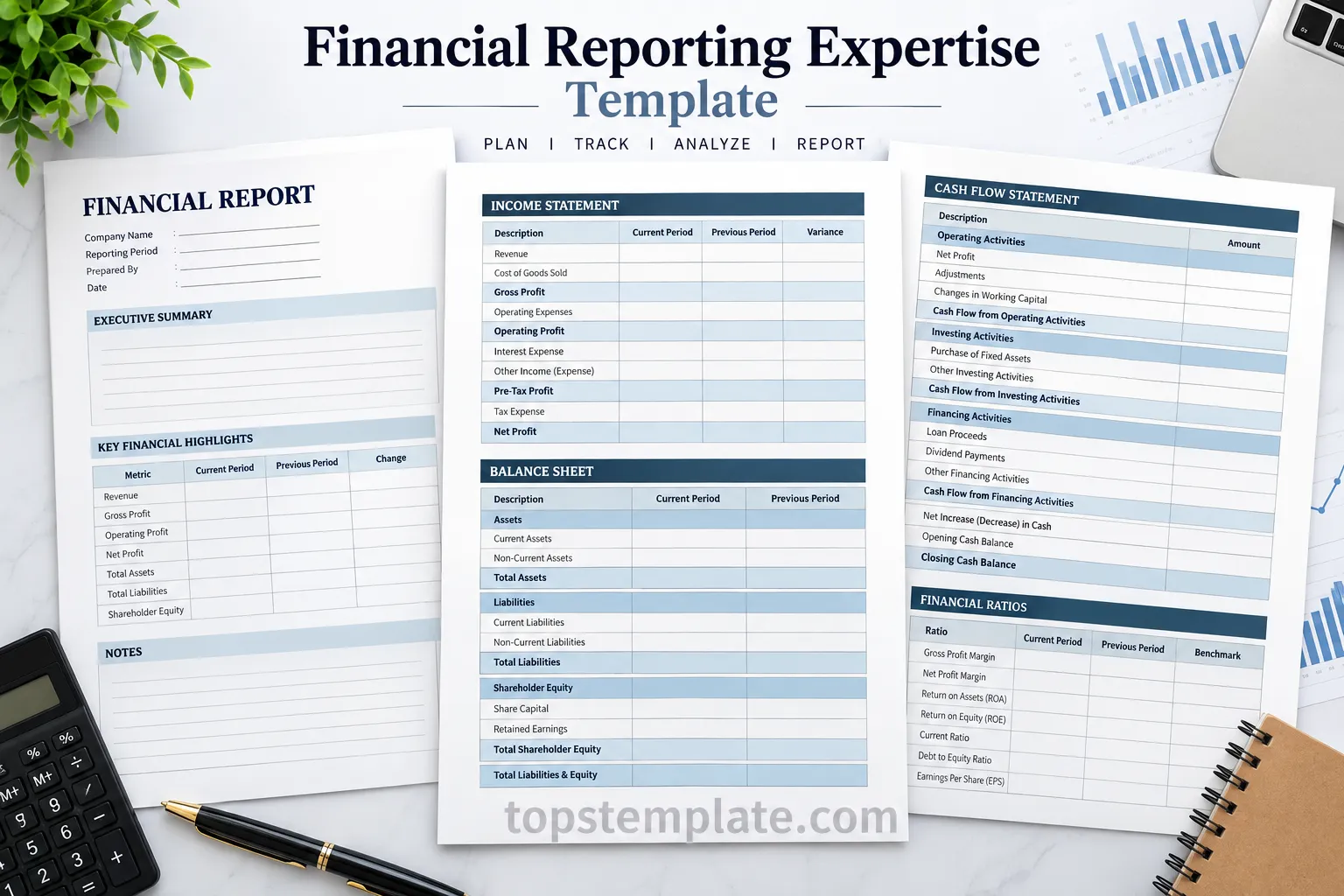
Image Title:
Alt:
Image Caption:
What Is Financial Reporting Expertise?
Financial reporting expertise refers to the ability to prepare, understand, analyze, and communicate financial information accurately and effectively. It combines technical accounting knowledge with analytical and communication skills.
A person with strong financial reporting expertise should be able to work with financial statements, understand accounting principles, recognize important financial trends, and explain what the numbers mean to different audiences.
Financial reporting commonly includes three core financial statements:
- Income statement: Shows revenue, expenses, and profit or loss over a specific period.
- Balance sheet: Presents assets, liabilities, and equity at a particular point in time.
- Cash flow statement: Explains how cash moves through operating, investing, and financing activities.
Additional reports may include statements of changes in equity, financial ratio analysis, management reports, budget comparisons, forecasts, and financial dashboards.
Why Financial Reporting Expertise Matters
Reliable financial reporting gives decision-makers a clearer view of business performance. Without organized financial information, it can be difficult to determine whether revenue is growing, expenses are under control, or cash resources are sufficient.
Better Business Decisions
Financial reports provide evidence for decisions involving pricing, hiring, investment, cost management, expansion, and resource allocation. When financial information is accurate and presented clearly, managers can evaluate options using relevant data instead of assumptions.
Improved Financial Control
Consistent reporting can help businesses identify unusual expenses, declining margins, cash flow problems, and other issues earlier. Comparing current results with previous periods or budgets makes changes easier to recognize.
Greater Transparency
Investors, lenders, business partners, managers, and other stakeholders often rely on financial information to understand an organization’s financial position. Clear reporting improves communication and makes important information easier to review.
Key Skills Behind Financial Reporting Expertise
Developing financial reporting expertise requires more than knowing accounting terminology. Several complementary skills contribute to effective financial reporting.
Understanding Financial Statements
Professionals should understand how the income statement, balance sheet, and cash flow statement work together. For example, a company may report a profit while experiencing limited cash availability. Understanding the relationship between accrual-based profit and actual cash movement is therefore important.
Data Accuracy and Attention to Detail
Small errors can affect financial analysis and management decisions. Strong reporting processes include reviewing calculations, checking account classifications, reconciling balances, and verifying source data before reports are distributed.
Financial Analysis
Reporting becomes more valuable when numbers are interpreted. Useful analysis can include period-over-period comparisons, budget variance analysis, profitability analysis, liquidity measurements, and trend analysis.
Clear Communication
Financial information should be understandable to its intended audience. A detailed report for an accounting team may contain more technical information than an executive summary prepared for senior management. Good financial reporting expertise includes knowing what information matters most to each audience.
Essential Elements of an Effective Financial Report
A professional financial report should be structured around the information readers need to understand performance and financial position quickly.
- Reporting period: Clearly state the month, quarter, year, or other period covered.
- Executive summary: Highlight the most important financial developments.
- Revenue information: Show sales or other sources of income and relevant changes.
- Expense analysis: Identify significant operating and non-operating expenses.
- Profitability: Present gross profit, operating profit, and net profit where applicable.
- Balance sheet information: Summarize assets, liabilities, and equity.
- Cash flow: Explain operating, investing, and financing cash movements.
- Financial ratios: Include relevant profitability, liquidity, efficiency, or leverage metrics.
- Notes and commentary: Explain significant changes, unusual transactions, or important assumptions.
How to Use a Financial Reporting Template
A structured template can make recurring reporting more efficient. Instead of creating every report from scratch, finance teams can follow a standardized format and focus more time on reviewing and interpreting the data.
1. Define the Reporting Period
Begin by identifying the period covered by the report. Consistent reporting periods make comparisons easier and reduce ambiguity.
2. Gather Source Data
Collect information from the accounting system, invoices, bank records, payroll records, expense documentation, and other relevant sources. Make sure the underlying data has been reviewed before entering it into the report.
3. Complete the Core Statements
Populate the income statement, balance sheet, and cash flow sections. Check that totals and subtotals are mathematically consistent and that information is classified correctly.
4. Add Comparative Information
Where useful, compare current results with a previous period, budget, forecast, or relevant benchmark. Variance information can quickly highlight areas that deserve further investigation.
5. Add Management Commentary
Numbers alone may not explain why performance changed. Add concise commentary describing important developments, such as changes in sales volume, pricing, operating costs, working capital, or investment activity.
6. Review Before Distribution
Perform a final quality check before sharing the report. Verify formulas, dates, totals, labels, supporting documentation, and significant variances. A consistent review process is an important part of financial reporting expertise.
Common Financial Reporting Metrics to Monitor
The appropriate metrics depend on the organization and its objectives. However, several financial indicators are commonly useful for understanding business performance.
- Revenue growth: Measures how sales or income change over time.
- Gross profit margin: Indicates the portion of revenue remaining after the cost of goods sold.
- Operating margin: Helps evaluate profitability from core operations.
- Net profit margin: Shows the percentage of revenue remaining after relevant expenses.
- Current ratio: Provides an indication of short-term liquidity.
- Debt-to-equity ratio: Helps assess the relationship between debt financing and equity.
- Operating cash flow: Shows cash generated or consumed by operating activities.
Metrics should not be viewed in isolation. Comparing them over time and against appropriate internal or external benchmarks can provide more meaningful context.
Practical Tips for Better Financial Reporting
Standardize the Reporting Process
Use consistent account categories, reporting periods, definitions, and layouts. Standardization reduces confusion and makes recurring reports easier to prepare and compare.
Separate Data From Interpretation
Present the underlying figures clearly, then provide concise analysis. This helps readers distinguish reported financial results from management commentary or interpretation.
Focus on Material Changes
Not every numerical movement requires extensive explanation. Prioritize significant variances, unexpected results, unusual transactions, and developments that may affect future performance.
Keep Reports Easy to Scan
Use descriptive headings, organized tables, concise notes, and clear summaries. A visually structured financial report allows readers to locate important information quickly.
Maintain Documentation
Keep supporting records for important figures and adjustments. Good documentation makes financial reporting easier to review and helps establish a reliable audit trail.
Common Financial Reporting Mistakes to Avoid
Even experienced teams can encounter reporting problems when processes are rushed or inconsistent. Common issues include incomplete source data, incorrect classifications, inconsistent accounting periods, formula errors, and insufficient explanation of significant variances.
Another common mistake is creating reports that contain too much information without identifying the most important insights. Comprehensive reporting does not necessarily mean including every available data point. Effective reports balance completeness with clarity.
It is also important to distinguish financial reporting from financial forecasting. Historical financial reports describe what has happened, while forecasts and budgets estimate what may happen in the future. Both can be valuable, but they serve different purposes and should be clearly identified.
Building Long-Term Financial Reporting Expertise
Financial reporting expertise develops through a combination of education, practical experience, consistent review, and familiarity with financial data. Professionals can strengthen their capabilities by studying financial statements, practicing financial analysis, learning relevant accounting standards, and reviewing reports from different business situations.
Technology can also improve reporting workflows. Spreadsheet templates, accounting software, reporting dashboards, and automated data processes can reduce repetitive work and improve consistency. However, automation does not replace professional review. Financial information still needs to be interpreted within the correct business context.
A useful approach is to treat every reporting cycle as an opportunity to improve. After completing a report, review which calculations required manual corrections, which information stakeholders requested, and which sections could be clearer. Over time, these improvements can create a more efficient and reliable reporting process.
Conclusion
Financial reporting expertise combines accurate financial statement preparation, analytical thinking, attention to detail, and effective communication. It helps organizations understand their financial position, evaluate performance, identify important trends, and make informed business decisions.
A well-designed financial reporting template can support this process by providing a consistent structure for income statements, balance sheets, cash flow statements, financial ratios, and management commentary. When combined with accurate source data and thoughtful analysis, standardized reporting can make financial information clearer, more useful, and easier to review.
Whether you are preparing monthly management reports or developing a more comprehensive financial reporting process, focusing on accuracy, consistency, clarity, and actionable analysis is a practical way to strengthen financial reporting expertise.
