The best template is therefore specific without becoming unnecessarily complicated. It should explain what the employee will do, what skills are genuinely required, how the role fits into the branch or contact-center structure, and what success looks like. A vague description can attract applicants who are not suited to the pace or responsibilities of rental operations, while an overloaded description can discourage qualified candidates who could learn company-specific systems after joining.
This guide explains how to build, customize, evaluate, and use a car rental customer service job description. It also provides a practical copy-ready example, guidance for Word and PDF formats, resume applications, online job boards, Google Docs workflows, and hiring platforms. The emphasis throughout is on accuracy and usability rather than simply producing a document that looks professional.
What Is a Car Rental Customer Service Job Description?
A car rental customer service job description is a structured document that defines the purpose, responsibilities, qualifications, working conditions, and expectations of a customer-facing rental position. The employee may work at a branch counter, reservation center, airport location, contact center, or another customer-service environment. Depending on the employer, the role can combine service, administrative, reservation, payment, and limited sales responsibilities.
General customer service roles commonly involve answering questions, resolving complaints, processing transactions, recording customer interactions, and escalating issues when necessary. O*NET identifies activities such as communicating with customers, keeping records, determining charges, completing forms, referring unresolved grievances, and resolving service or billing complaints as typical customer-service tasks. :contentReference[oaicite:0]{index=0}
Car rental work adds an operational layer. A representative may need to check a reservation, confirm vehicle category and availability, explain rental terms, verify required information, process a payment or deposit, document a change, coordinate with fleet staff, or explain the next step when a customer reports a problem. The precise responsibilities vary by company, location, systems, and job level, so a template should always be customized before publication.
A useful description should distinguish between duties that are essential to the position and duties that are simply possible during busy periods. For example, answering reservation questions may be essential, while assisting with vehicle movement may be an occasional branch responsibility. Separating these expectations makes the posting more transparent and gives managers a better basis for evaluating applicants.
The document can also serve beyond recruitment. Once a person is hired, the same framework can help organize onboarding, training, coaching, quality reviews, and performance conversations. The U.S. Bureau of Labor Statistics describes customer service representatives as workers who answer questions, handle complaints, process orders or payments, maintain records, and refer more difficult cases when appropriate. :contentReference[oaicite:1]{index=1}
For a rental company, the template should translate those broad activities into rental-specific language without claiming that every employee performs every task. The goal is a description that accurately represents the actual job rather than a generic list copied from another industry.
A well-designed document normally contains the job title, role summary, key responsibilities, required qualifications, preferred qualifications, skills, schedule, location, reporting relationship, compensation information where appropriate, benefits, and application instructions. Additional sections may cover performance measures, working conditions, systems used, physical requirements, or training.
Why the Template Matters in Car Rental Operations
Customer service is especially important in car rental because customers often interact with the company at moments when timing matters. A delayed pickup, unclear reservation, unexpected charge, unavailable vehicle category, extension request, or return issue can quickly become a service problem. The employee needs to communicate clearly while following policies and documenting actions correctly.
A job description helps the employer define the balance between service and procedure. A representative should be helpful, but helpfulness does not mean ignoring rental policies. The description can state that the employee is expected to explain available options, follow approved procedures, escalate exceptions, and document customer interactions accurately.
The document also helps avoid unrealistic hiring criteria. Customer service representatives commonly enter the occupation with a high school diploma or equivalent and receive short-term on-the-job training, although requirements vary by employer and industry. :contentReference[oaicite:2]{index=2} A rental company may reasonably prefer previous hospitality, travel, retail, transportation, or rental experience, but it should distinguish preferred experience from genuine prerequisites.
Another benefit is consistency. If one manager describes the job as mainly answering phones while another expects the employee to manage reservations, payments, complaints, records, and branch coordination, applicants receive conflicting information. A standardized template creates a shared baseline that can be adjusted for different locations without rebuilding the document from scratch.
The template can also support better candidate screening. When responsibilities are clearly stated, interviewers can ask questions directly connected to the work. Instead of asking generic questions about whether someone is “good with customers,” the interviewer can ask how the applicant would handle a customer whose reserved vehicle category is temporarily unavailable or how they would document a disputed charge.
Finally, the template creates a more useful employee experience. Candidates who understand the role before accepting an offer are better positioned to decide whether the schedule, environment, responsibilities, and customer-facing demands suit them. Clear expectations are valuable for both the employer and the applicant.
Core Components of a Car Rental Customer Service Job Description Template
1. Job title and reporting relationship
Use a straightforward title such as “Car Rental Customer Service Representative,” “Rental Customer Service Agent,” or another title that accurately reflects the company’s internal terminology. Avoid creative titles that make the position difficult to understand or search for.
Include the department, location, employment type, and reporting relationship when those details are known. A simple header might identify the branch, customer service department, supervisor, schedule, and whether the role is full-time, part-time, temporary, or seasonal.
2. Role summary
The summary should explain why the position exists. Two or three focused sentences are usually enough. It should mention customer assistance, reservations or rental transactions, problem resolution, and the company’s expectation for accurate and professional service.
A useful summary does not attempt to list every duty. Its purpose is to give the applicant enough context to understand the position before reading the detailed responsibilities.
3. Key responsibilities
Responsibilities should describe actual work rather than generic personality traits. Strong examples include assisting customers with reservations, explaining rental options and policies, processing rental transactions, updating customer records, responding to questions, handling complaints, documenting service actions, coordinating with branch teams, and escalating unresolved matters.
Where appropriate, responsibilities can be grouped into categories such as customer interaction, reservation management, transaction administration, problem resolution, fleet coordination, documentation, and sales support. Grouping makes the document easier to scan.
4. Qualifications and requirements
Separate required qualifications from preferred qualifications. Requirements might include communication ability, basic computer skills, availability for the stated schedule, and the ability to follow procedures. Preferred qualifications might include previous rental, travel, hospitality, retail, transportation, or contact-center experience.
If a driving license, driving record, age requirement, language ability, background screening, or other condition is genuinely necessary for the role, state it only when it is relevant and consistent with applicable law and company policy. Do not add requirements merely because they appear in another company’s job description.
5. Skills and competencies
The strongest skills section focuses on behaviors that matter in the actual role. Communication, active listening, patience, problem solving, attention to detail, organization, technology comfort, and the ability to remain professional during difficult interactions are particularly relevant to customer service work. BLS also identifies communication, customer-service, interpersonal, listening, patience, and problem-solving skills as important qualities for customer service representatives. :contentReference[oaicite:3]{index=3}
For rental operations, add accuracy with reservation information, confidence explaining charges and policies, and the ability to prioritize multiple requests when these are genuinely part of the position.
The visual examples below illustrate how job descriptions can use clear headings, role summaries, responsibilities, and qualification sections without becoming visually complicated.
A good layout makes it easy for a hiring manager to locate the information needed during screening, while a candidate can quickly understand the role and decide whether to continue reading.
The same principle applies when a company adapts a general template into a rental-specific document: preserve the useful structure, but replace generic responsibilities with realistic rental activities.
A concise visual hierarchy can also reduce the temptation to write unnecessarily long requirements. The document should remain focused on what the employee will actually be expected to accomplish.

How to Write the Template Step by Step
Step 1: Define the actual operating environment
Before writing anything, identify where the employee works. An airport rental counter may have different demands from a neighborhood branch. A reservation-center position may be primarily telephone and digital, while a branch representative may interact with customers in person and coordinate with vehicle preparation teams.
Record the location, normal operating hours, expected shifts, reporting line, employment type, and whether the employee is expected to work evenings, weekends, holidays, or peak travel periods.
Next, identify the systems the employee actually uses. These might include a reservation system, customer relationship management system, payment terminal, email platform, telephone system, document management system, or internal fleet application. Avoid naming software in the public description unless doing so provides useful information.
Then list the customer interactions that occur most frequently. Typical examples include new reservations, reservation modifications, pickup questions, extension requests, return questions, billing questions, lost-property inquiries, service complaints, and requests for clarification about rental policies.
Finally, determine which matters the employee can resolve independently and which must be escalated. This distinction is important because it prevents the job description from implying unlimited authority. A representative can be empowered to solve routine problems while still referring unusual financial, contractual, safety, or legal matters to an authorized supervisor.
Using a structured format at this stage also makes the finished document easier to maintain. A template should function as a repeatable framework rather than a one-time document.
Step 2: Write a realistic role summary
A strong summary should sound like the employer, but it should also tell the candidate what the work involves. Avoid exaggerated phrases such as “world-class superstar” unless they convey something meaningful. A better approach is to state the role’s customer-facing purpose and the main operational responsibilities.
For example, a branch-based summary could explain that the representative assists customers with reservations and rental needs, provides information about vehicles and policies, processes transactions accurately, resolves routine service concerns, and coordinates with other branch functions to support a smooth rental experience.
The summary should not promise responsibilities the employee will not have. If the employee will not negotiate contracts, approve refunds, or make pricing exceptions, do not imply that they have those powers.
Likewise, do not describe the role as purely administrative if the employee spends substantial time dealing with customers. The candidate needs an accurate picture of the pace and communication requirements.
The best test is simple: could a new employee read the summary and understand why their position exists? If not, rewrite it before moving to the responsibility list.
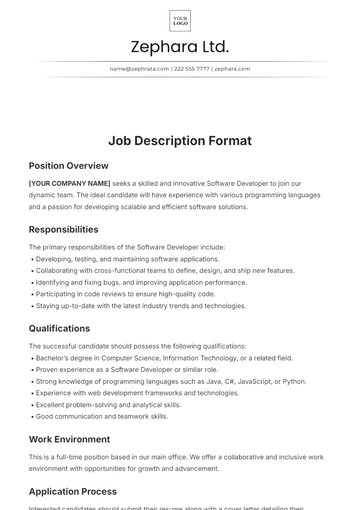
The following example shows how a clean job-description layout can separate the overview from detailed duties and qualifications.
The format can be adapted to a rental business by replacing generic duties with reservations, rental transactions, customer records, vehicle availability questions, and approved service-resolution activities.
It can also be shortened for a job-board posting or expanded into an internal position description without changing the fundamental structure.
Keeping the document modular makes later revisions easier when branch processes, systems, or responsibilities change.
This approach is especially useful for companies with multiple branches because each location can customize only the fields that genuinely differ.
Step 3: Turn daily work into measurable responsibilities
Instead of writing “provide excellent customer service,” describe the behaviors that demonstrate it. For example, the employee may be expected to respond to inquiries, explain available options accurately, process reservations, document interactions, and follow up on unresolved cases.
Use action verbs such as assist, respond, process, verify, document, coordinate, explain, resolve, escalate, update, and follow. These verbs tell candidates what they will actually do.
Be cautious with sales language. A rental representative may offer upgrades or additional products, but customer service should not be presented as aggressive selling unless sales performance is genuinely a core part of the job. A description that accurately reflects the balance between service and commercial responsibilities is more credible.
Include documentation duties when they matter. Customer-service records can help another employee understand what has happened, what was promised, and what action remains outstanding. Good records also support internal quality control and follow-up.
Include escalation duties when the employee does not have authority to resolve every problem. A strong responsibility statement might say that the representative escalates complex complaints, exceptions, or matters outside their authority while providing complete context to the responsible supervisor.
Finally, review every responsibility with the operations manager. If a manager cannot identify when or why the employee performs a listed duty, it may not belong in the final job description.
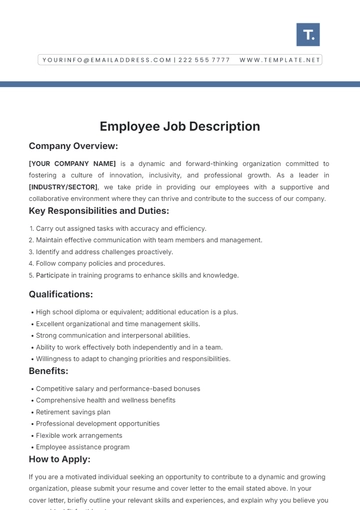
A document-oriented example is useful here because it demonstrates how duties can be organized into a hierarchy rather than presented as a wall of text.
The goal is not to copy another job description word for word. Instead, use the visual structure to decide how your own responsibilities should be grouped and prioritized.
For car rental businesses, the most useful categories are usually customer contact, reservations, transactions, documentation, issue resolution, coordination, and service quality.
A clear structure also makes later translation into an online job posting much easier because individual sections can become expandable or scannable blocks.
When responsibilities are specific and realistic, candidates can also prepare better examples for interviews.
Recommended Responsibilities for a Car Rental Customer Service Representative
The exact list should be customized, but the following categories provide a useful starting point for most rental operations.
Customer interaction
- Welcome customers and respond to inquiries through approved communication channels.
- Provide accurate information about reservations, vehicle categories, rental procedures, and available services.
- Listen carefully to customer concerns and clarify the issue before proposing a solution.
- Maintain a calm, professional, and respectful communication style during difficult interactions.
Reservation support
- Create, modify, confirm, or cancel reservations according to company procedures.
- Check reservation information for accuracy before completing a transaction.
- Explain applicable rental terms, pickup information, and required documentation within the employee’s authority.
- Coordinate with relevant teams when reservation information affects vehicle availability or preparation.
Transaction and documentation support
- Process approved rental transactions, payments, deposits, or adjustments accurately.
- Complete required forms and maintain accurate customer records.
- Document complaints, requests, changes, and actions taken.
- Protect customer information in accordance with company procedures.
Problem resolution
- Investigate routine service issues using available customer and reservation information.
- Offer solutions that fall within approved policies and authority levels.
- Escalate unresolved or exceptional matters to the appropriate supervisor.
- Follow up when a customer has been promised additional information or action.
Branch coordination
- Communicate relevant customer or reservation information to branch and fleet teams.
- Report recurring service issues or operational patterns to management.
- Support smooth handoffs between customer service, reservations, fleet, and management functions.
A general customer service template can be useful as a starting point, but a rental company should avoid copying responsibilities that do not match its actual workflow. The more accurately the list reflects the role, the more useful it becomes for recruiting and training.
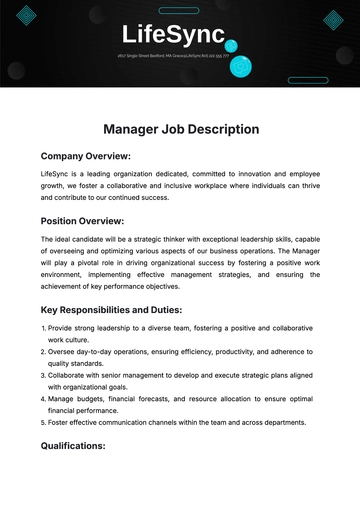
The next visual shows another document-style approach to defining a managerial or supervisory position. Its value here is structural: responsibilities, qualifications, and expectations can be visually separated without adding unnecessary complexity.
When adapting a template, use the same principle for customer service. Put the most important rental responsibilities near the top and move secondary duties into a separate section.
This makes the job description easier to scan and helps applicants understand what they will spend most of their time doing.
It also gives interviewers a logical framework for deciding which responsibilities should become interview questions or work-sample exercises.
A good job description is therefore not merely an advertisement. It is the first version of the role’s operating model.
Qualifications, Skills, and Competencies
One of the most common mistakes in job descriptions is confusing desirable qualities with mandatory requirements. A car rental customer service role may benefit from industry experience, but an employer should decide whether that experience is actually essential before making it a requirement.
Communication is usually fundamental because representatives must explain policies, gather information, document interactions, and respond appropriately to customers. Listening is equally important because a fast response is not useful if the employee misunderstands the problem.
Problem solving matters because not every customer issue fits a script. The employee needs to recognize what can be solved immediately, what requires investigation, and what should be escalated.
Attention to detail is especially relevant to rental transactions. A small error in dates, vehicle category, customer information, payment information, or reservation notes can create operational consequences.
Technology skills should normally be described at the level the job requires. If the employee must use a reservation system and standard office applications, say so. If the company provides training, do not make knowledge of a specific proprietary platform an unnecessary barrier unless experience with it is genuinely required.
Patience and professionalism should also be framed behaviorally. Rather than simply asking for a “positive attitude,” describe the ability to remain courteous when customers are frustrated, communicate next steps clearly, and follow approved escalation procedures.
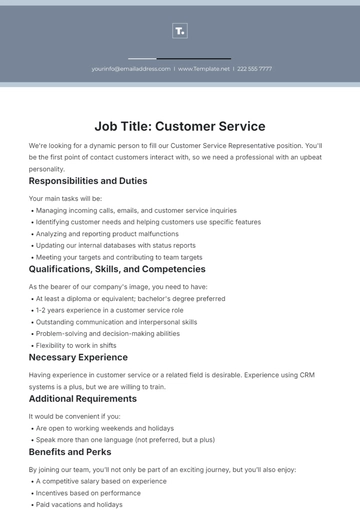
The following customer-service template demonstrates how responsibilities and qualifications can appear together on a concise document.
Its structure is useful for a rental business because it can be adapted without requiring a multi-page HR manual.
For a short vacancy announcement, the employer can keep only the most important responsibilities and requirements while retaining the same underlying framework.
For an internal job profile, the same document can be expanded with performance measures, training expectations, and detailed authority limits.
The important point is consistency: the qualifications should correspond to the work described earlier rather than forming a separate wish list.
Copy-Ready Car Rental Customer Service Job Description Example
The following example is a practical starting point rather than an official industry standard. Replace bracketed information with the employer’s actual details and remove any responsibility that does not apply.
Car Rental Customer Service Representative
Company: [Company Name]
Location: [Branch or City]
Department: Customer Service / Rental Operations
Reports To: [Customer Service Manager or Branch Manager]
Employment Type: [Full-Time / Part-Time / Seasonal]
“`
Job Summary
We are seeking a customer-focused Car Rental Customer Service Representative to assist customers throughout the rental process. The successful candidate will respond to inquiries, support reservations, explain approved rental information, process customer requests accurately, document interactions, and coordinate with relevant branch teams to help deliver a smooth rental experience.
Key Responsibilities
- Assist customers with rental inquiries, reservations, changes, cancellations, and general service questions.
- Provide accurate information about vehicle categories, rental procedures, applicable policies, and available services within approved guidelines.
- Process customer information, reservations, payments, deposits, and other transactions accurately when authorized.
- Maintain complete and accurate records of customer interactions and actions taken.
- Handle routine complaints professionally and work toward appropriate solutions.
- Escalate complex, exceptional, or unauthorized matters to the appropriate supervisor.
- Coordinate with reservation, fleet, vehicle preparation, and branch teams when necessary.
- Follow customer-service procedures, privacy requirements, transaction controls, and company policies.
- Identify recurring customer issues and communicate useful observations to management.
- Maintain professional communication across telephone, email, digital, and face-to-face channels used by the company.
Required Qualifications
- High school diploma or equivalent, unless local requirements or company policy specify otherwise.
- Strong verbal and written communication skills.
- Ability to use computers and learn reservation or customer-service systems.
- Strong attention to detail and organizational ability.
- Ability to remain professional when handling complaints or high-pressure situations.
Preferred Qualifications
- Previous customer service, hospitality, travel, retail, transportation, or rental experience.
- Experience with reservations, payment processing, CRM systems, or similar customer-facing software.
- Additional language skills where relevant to the customer base.
Success in the Role
Success means providing accurate information, completing transactions carefully, documenting customer interactions, following approved procedures, resolving routine issues effectively, escalating appropriately, and contributing to a professional customer experience.
“`
The example is intentionally written so that an employer can use it as a base without making unsupported claims about licensing, compensation, or specific software. Company-specific requirements should be added only after they have been confirmed internally.
The following internship-style job-description layout demonstrates another way of separating company information, position details, and role expectations.
For a rental business, the same visual organization can make it easier to identify branch-specific schedule information, reporting relationships, and employment conditions.
It is particularly useful when the company has seasonal hiring because the same document can be reused with updated dates, location details, and scheduling requirements.
Keeping those fields separate from the permanent responsibility section also reduces editing errors when a template is reused.
That makes a structured document much more practical than starting from a blank page every time the company hires.

Different Versions of the Template
Branch customer service version
This version emphasizes face-to-face service, reservation support, rental transactions, documentation, and coordination with branch or fleet operations. It should explain the environment honestly, including any schedule requirements that are central to the position.
Reservation center version
A reservation-center version focuses more heavily on telephone, email, chat, booking modifications, customer questions, accurate data entry, and communication across multiple locations. If sales or upgrades are included, that should be stated clearly.
Airport rental version
An airport position may involve a higher volume of time-sensitive customer interactions. The description can emphasize queue management, efficient communication, reservation verification, coordination with vehicle availability teams, and the ability to work variable shifts when applicable.
Seasonal version
A seasonal position should clearly state the expected employment period, anticipated schedule, training requirements, and whether the position may involve peak travel periods. Do not imply permanent employment if the position is seasonal.
Senior or lead version
A senior position can include coaching, quality monitoring, escalation support, reporting, and assistance with workflow coordination. These responsibilities should be separated from the duties expected of entry-level representatives so the organization does not unintentionally blur authority levels.
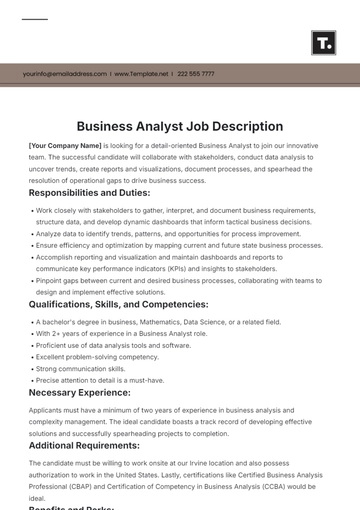
The next example is a business-analysis job-description layout. Although the role itself is different, the document demonstrates how responsibilities, qualifications, and supporting requirements can be organized in a readable format.
For customer service recruitment, this structure can be repurposed to separate operational duties from analytical or administrative expectations.
That separation is useful when a rental representative is expected to report recurring customer issues or contribute to process-improvement activities.
It also helps managers avoid mixing essential front-line responsibilities with occasional administrative assignments.
Clear categories make the resulting job description easier to review before publication.
How to Adapt the Template for a Resume
A job description and a resume are different documents, even though they use some of the same information. The employer’s job description explains what the company needs. A resume explains what the applicant has done and what evidence demonstrates their ability to perform the role.
For a resume, convert responsibilities into accomplishment-oriented statements whenever possible. “Handled customer inquiries” is acceptable, but “Handled high-volume rental inquiries and documented reservation changes across telephone and digital channels” gives a clearer picture of the work.
Do not copy a job description word for word into a resume. Instead, select duties that genuinely match previous experience and support them with evidence such as volume, scope, systems used, customer-service outcomes, process improvements, or recognition where those details are accurate.
Applicants should also avoid inserting invented performance numbers simply because a template contains them. If a candidate does not know the number of customers served or cases resolved, a qualitative description is safer than an unsupported statistic.
For employers, reviewing resumes against the job description can help identify candidates whose experience maps naturally to the role. However, the comparison should focus on relevant skills and evidence rather than requiring applicants to reproduce the employer’s exact terminology.
The visual below is specifically useful as a reminder that a customer-service resume should present role, tenure, responsibilities, and skills in a format that is easy to scan.
It can also help hiring teams understand why a candidate’s resume should be evaluated against the actual job requirements rather than against a generic ideal candidate.
For a rental role, relevant evidence might include reservation management, customer complaint resolution, payment handling, documentation accuracy, and experience working in busy service environments.
Employers should still verify the candidate’s claims through appropriate recruitment and interview processes.
The resume should be treated as evidence for discussion, not as a substitute for a structured evaluation.

Word, PDF, Google Docs, and Online Templates
Different formats serve different purposes. A Word document is useful when the employer needs to make substantial edits, maintain a reusable master copy, or collaborate internally. A PDF is useful when the final approved version needs to preserve its layout and be distributed without unintended changes.
Google Docs can be practical for teams that need simultaneous editing, comments, version history, and browser-based access. The main concern is document governance: the organization should establish which version is the approved master and who has permission to change it.
Online template libraries can be useful for inspiration and formatting, but the employer should verify what the template actually contains before publishing it. A page advertising a template does not necessarily mean every feature, file format, or download option is available without restrictions.
When using a third-party template, remove irrelevant branding, placeholder contact information, fictional company names, and responsibilities that do not match the rental business.
Also check the final document for hidden assumptions. A generic template may mention a salary structure, benefits, work schedule, licensing requirement, or software system that is not applicable to the employer.
The blank job-description example below illustrates why a reusable master can be valuable. A blank structure allows the organization to establish its own standard sections and fill them with verified information.
For multi-location operations, the master template can include fixed language for company-wide expectations and editable fields for branch-specific details.
This creates a balance between consistency and local accuracy.
It also reduces the risk that different recruiters will create materially different descriptions for substantially identical positions.
Before publication, the completed version should be reviewed by the hiring manager and, where appropriate, the relevant HR or legal team.

Research and Data Collection Before Publishing
Research does not mean copying another company’s job posting. It means collecting enough information to understand what the role actually requires and then writing original language that reflects the employer’s situation.
Start with internal research. Interview the branch manager, customer-service supervisor, or experienced employee. Ask what the person does during a typical shift, what problems occur most often, what systems are used, which responsibilities are essential, and which matters require escalation.
Review existing process documents, training materials, quality standards, and approved customer-service procedures. These sources can reveal duties that managers forget to mention because they are routine.
External occupational resources can provide a useful baseline. O*NET’s customer service profile lists tasks involving customer communication, record keeping, charges and payments, forms, escalation, and complaint resolution. :contentReference[oaicite:4]{index=4} The BLS Occupational Outlook Handbook provides additional information about duties, work environments, entry requirements, training, and important qualities. :contentReference[oaicite:5]{index=5}
Industry-specific research should then be used to refine the generic customer-service framework. Reservation management, rental agreements, vehicle availability, customer pickup and return processes, and fleet coordination are examples of topics that can make a rental position distinct.
Finally, compare the proposed description against the actual job. If an experienced employee says that a listed duty almost never occurs, either remove it or describe it as an occasional responsibility. Accuracy should take priority over making the role appear more impressive.
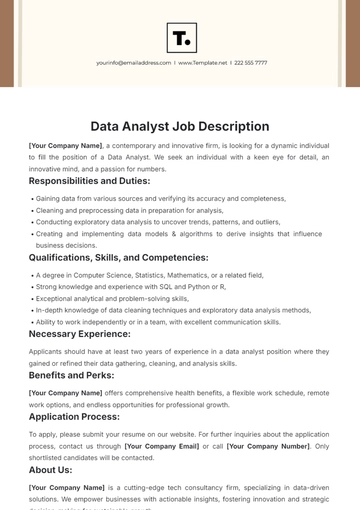
The data-analysis template below illustrates the value of separating information categories. The same concept applies when researching a position: distinguish core duties, supporting duties, required skills, preferred skills, and operational context.
That classification prevents the final document from becoming an unstructured collection of everything anyone has ever asked a customer-service employee to do.
It also makes later analysis easier if the company wants to compare similar roles across branches or identify where training needs differ.
Research is most useful when it leads to a clearer decision about what belongs in the final job description.
A strong document is the output of that decision-making process, not merely the output of a template.
Using the Job Description During Interviews
A job description becomes more valuable when interview questions are mapped to its requirements. If communication is important, ask the candidate for a specific example of explaining a complicated issue to a customer. If problem solving is important, use a realistic rental scenario rather than a vague question about strengths.
Scenario questions should reflect actual authority. For example, an interviewer might ask what the candidate would do if a customer arrives for a reservation but the expected vehicle category is unavailable. The strongest answer should demonstrate listening, verification, communication, awareness of alternatives, and appropriate escalation rather than an unsupported promise.
Role-play can also be useful for customer-facing positions. LinkedIn has discussed using role-play for customer-service hiring because it gives employers an opportunity to observe how applicants handle realistic interactions rather than relying entirely on self-description. :contentReference[oaicite:6]{index=6}
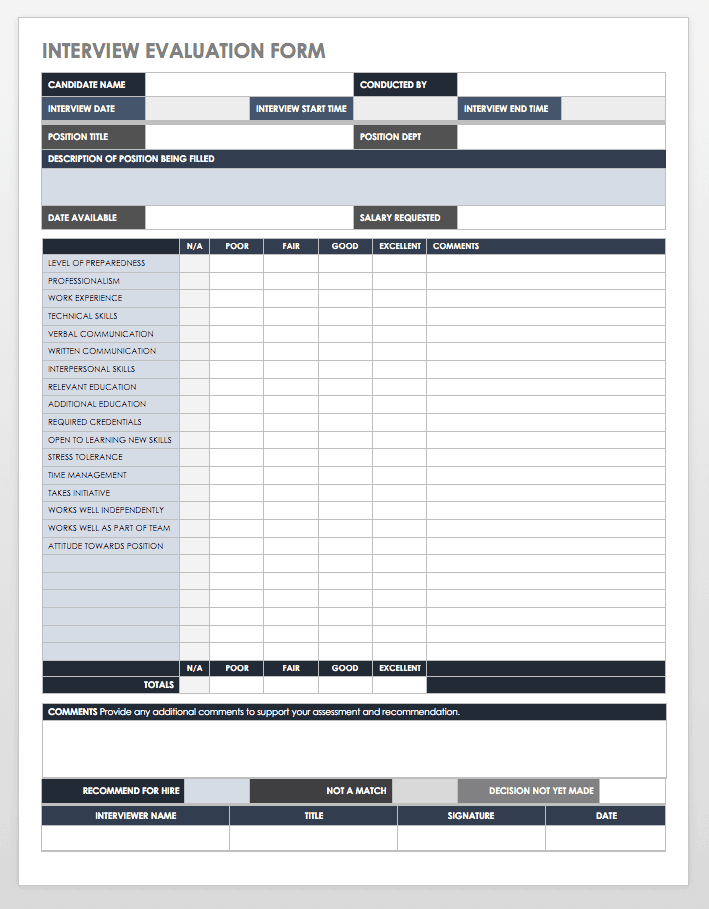
A structured scorecard can improve consistency. Interviewers can rate candidates against predefined areas such as communication, problem solving, attention to detail, customer orientation, technology comfort, and knowledge of the role.
Do not create criteria that are unrelated to the position. A scorecard should help decision makers evaluate evidence relevant to the job rather than encourage subjective impressions about personality.
The following administrative job-description visual is another example of how structured documents can separate requirements from responsibilities and make them easier to review.
For a rental company, the same principle can be applied to interview preparation by grouping questions under customer interaction, reservation handling, problem solving, documentation, and teamwork.
Interviewers can then compare evidence consistently rather than relying on memory or a general impression formed during a conversation.
This is especially helpful when several managers participate in hiring or when the company recruits repeatedly for similar seasonal positions.
The result is a hiring process that is more closely connected to the job description and less dependent on improvisation.

Performance Measures to Consider
A job description does not need a long KPI section, but it should help the organization define what good performance means. For customer service, relevant measures may include response quality, accuracy, adherence to procedures, documentation completeness, customer feedback, resolution effectiveness, and appropriate escalation.
Be careful with numerical targets. A metric such as average handling time can be useful in some environments, but if used alone it may encourage employees to end conversations too quickly. Rental customer service often requires accuracy and clear explanations, so quality measures should be balanced with productivity measures.
Customer satisfaction can be useful when interpreted alongside operational data. A high satisfaction score does not automatically mean every process was followed correctly, just as fast transaction times do not automatically mean customers received complete information.
Managers should also consider the complexity of cases. A representative handling a small number of complicated escalations may be performing as well as someone handling a larger number of simple inquiries.
The job description should therefore describe expectations at a level that remains meaningful even when daily customer volumes change.
A clear performance framework can later support coaching conversations because managers can point to the actual expectations stated in the role description.
The marketing-copywriter template below is not a rental document, but its structured use of responsibilities and qualifications illustrates how a document can keep expectations concise while still being specific.
The same design principle works for performance-related sections: use short, meaningful categories instead of a long list of loosely connected requirements.
This keeps the job description useful to candidates and managers without turning it into a full operations manual.
The detailed procedures can remain in separate training and policy documents.

Common Mistakes to Avoid
Using a generic customer service description
A generic description may mention phone calls and complaints but omit reservations, rental transactions, customer records, vehicle availability, and branch coordination. This makes it harder for applicants to understand the actual position.
Listing every possible duty
Trying to include every task that might ever occur creates an intimidating document. Focus on recurring responsibilities and clearly identify occasional duties when they genuinely matter.
Making unrealistic experience mandatory
Requiring years of rental experience for an entry-level position can unnecessarily reduce the candidate pool. Consider which skills are transferable and which knowledge can be taught.
Using vague language
Statements such as “must be a people person” or “must provide excellent service” are difficult to evaluate. Replace them with observable responsibilities and behaviors.
Ignoring schedule realities
If the branch operates early mornings, evenings, weekends, or holidays, applicants should understand that before applying. Schedule transparency helps reduce avoidable mismatches.
Copying another company’s policies
Do not copy statements about deposits, refunds, age restrictions, insurance, licenses, benefits, or employment conditions unless they are confirmed for your organization and location.
Failing to update old templates
An old document may mention discontinued systems, outdated processes, incorrect reporting lines, or responsibilities that have moved to another team. Review the template periodically.
The insurance-agency example below demonstrates another structured format for presenting a role summary, responsibilities, qualifications, and customer-service expectations.
For rental operations, this type of structure can help distinguish customer-facing duties from administrative requirements and preferred experience.
It is also a useful reminder that qualifications should be connected directly to the work described earlier.
If a qualification does not affect the employee’s ability to perform the position, it should be reconsidered before publication.
Clear, relevant requirements generally create a more credible job posting than a long list of generic preferences.

Practical Solution: Build a Reusable Hiring Workflow
The most practical solution is to create one approved master template and a simple workflow for customizing it. Start by establishing the permanent company language: employer overview, customer-service philosophy, standard qualifications, confidentiality expectations, and general employment information.
Next, create role-specific sections for branch customer service, reservation-center customer service, seasonal support, airport operations, and senior or lead positions. Each version should share a common structure so recruiters and managers know where to find the information.
For every vacancy, complete a short internal checklist before publication. Confirm the job title, location, reporting manager, employment type, schedule, compensation information where applicable, required qualifications, preferred qualifications, responsibilities, application process, and approval status.
Then validate the responsibilities with the person who manages the employee. Ask one practical question: “If we hire someone tomorrow, will they actually be expected to do these things?” Remove anything that does not pass that test.
After publication, use the same document during interviews. Convert the most important responsibilities into scenario questions, then use a structured evaluation form to record evidence. This connects the job advertisement to the selection process.
After hiring, convert the description into an onboarding checklist. Each major responsibility can become a training topic. For example, reservation procedures, transaction processing, complaint handling, escalation, documentation, and branch coordination can each have a defined learning objective.
After the employee has gained experience, review the description against the actual job again. If duties have changed, update the master template. This prevents the organization from relying on an outdated description simply because it has been used for years.
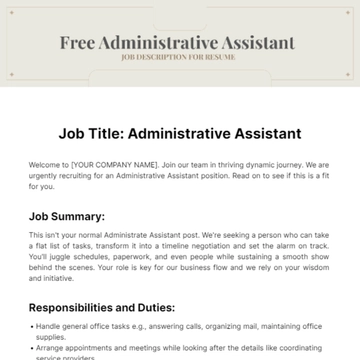
The administrative-assistant resume example below illustrates how detailed role information can be organized into a document that remains easy to scan.
For a rental organization, a similar approach can be used to organize responsibilities, systems, skills, and achievements into a consistent internal structure.
The key is to maintain one authoritative version rather than allowing multiple recruiters or branches to edit disconnected copies.
Version control is particularly important when the same role is advertised in several locations at once.
A simple naming convention and approval process can prevent outdated descriptions from remaining active after the role has changed.
Reference Examples
The following reference examples correspond to the requested search phrases and illustrate different document formats, platforms, and job-description layouts. They are examples of visual resources rather than claims that every pictured document is an official car-rental employment form.
car rental customer service job description template free

Source: Template.net
car rental customer service job description template pdf

Source: TemplateRoller
car rental customer service job description template free download

Source: Template.net
car rental customer service job description template word
Source: Smartsheet
car rental customer service job description template free pdf
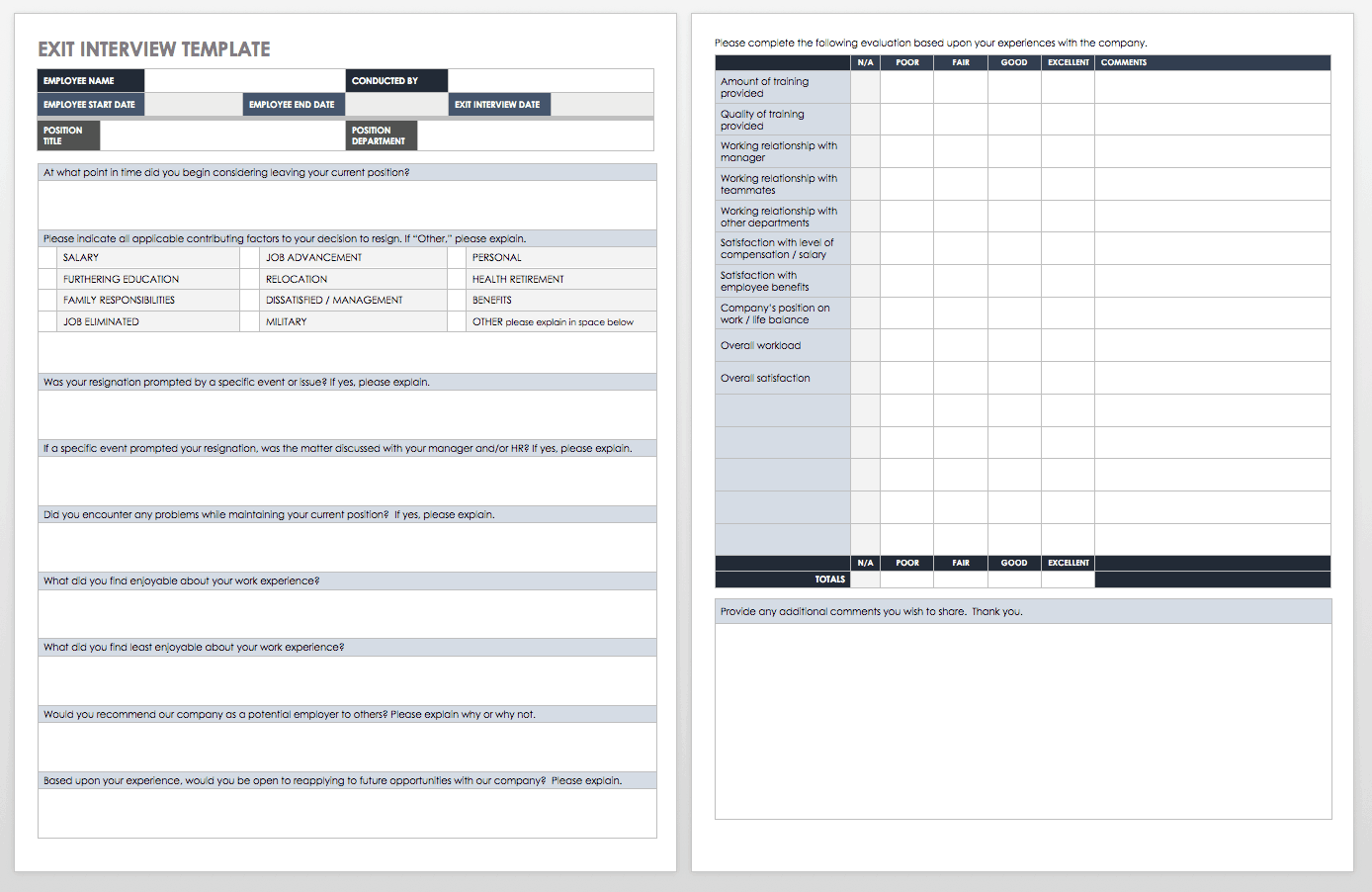
Source: Smartsheet
car rental customer service job description template for resume
Source: Template.net
car rental customer service job description template google docs

Source: Template.net
car rental customer service job description template word free
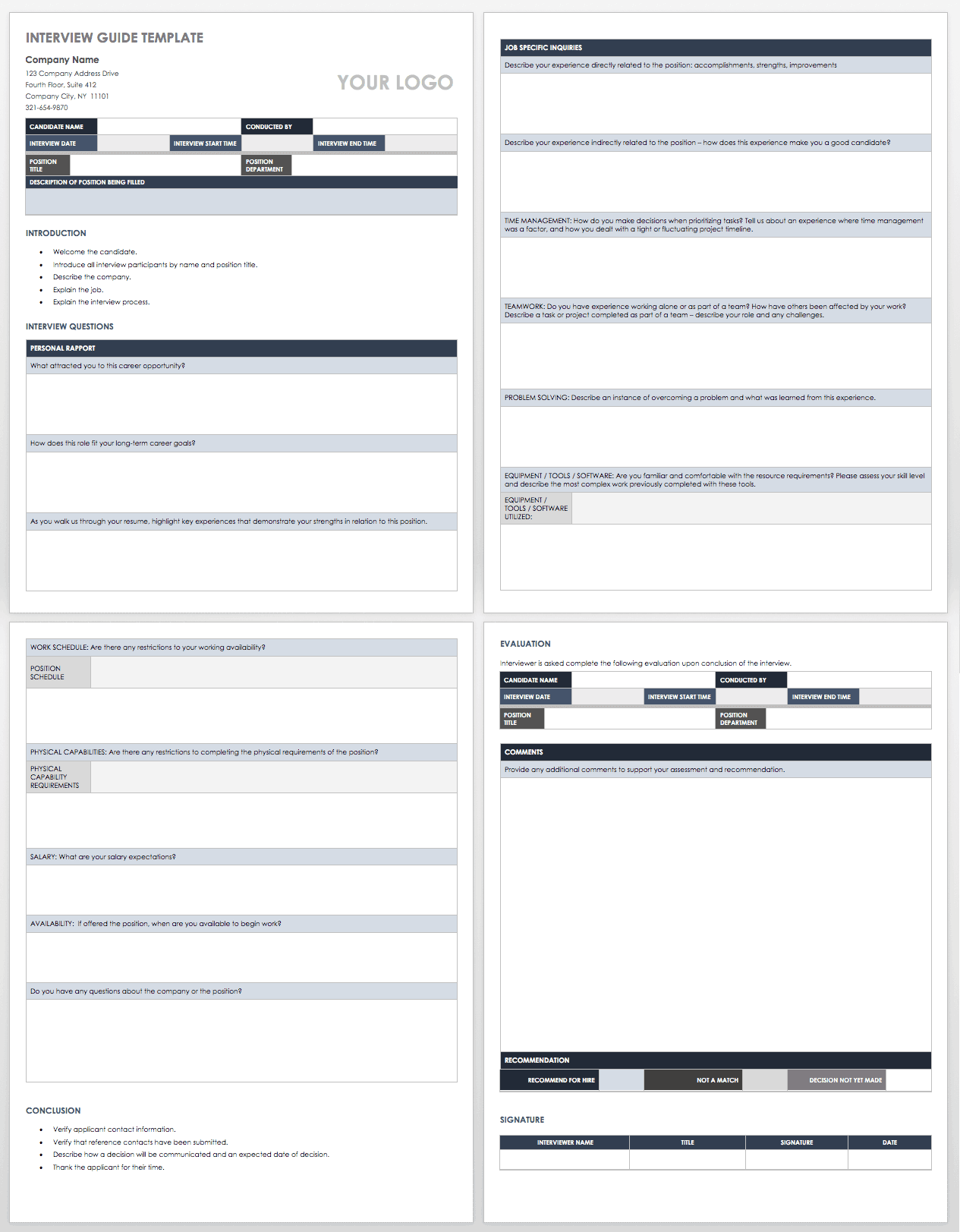
Source: Smartsheet
car rental customer service job description template workable

Source: Workable
car rental customer service job description template talentlyft

Source: TalentLyft
car rental customer service job description template sample

Source: Docs Bizkit
car rental customer service job description template linkedin

Source: SlideTeam
Frequently Asked Questions
What should a car rental customer service job description include?
It should normally include the job title, reporting relationship, role summary, responsibilities, qualifications, skills, schedule, location, employment type, and application information. Rental-specific responsibilities may include reservations, customer inquiries, rental transactions, documentation, complaints, escalation, and coordination with branch or fleet teams.
How long should the job description be?
There is no universal required length. A public job posting should be concise enough to scan quickly while containing enough information for applicants to understand the role. An internal position description can be longer because it may include additional expectations, authority limits, performance measures, or training information.
Should previous car rental experience be required?
Only if it is genuinely necessary for the position. Customer service, hospitality, travel, retail, transportation, and reservation experience can provide transferable skills. Company-specific rental systems and procedures can often be taught during onboarding.
Should the description include salary?
Include compensation information when required by applicable law or when it is part of the employer’s recruiting strategy. If a pay range is included, it should reflect the actual compensation structure for the advertised position rather than a generic range copied from another role.
What skills matter most for this role?
Communication, listening, patience, problem solving, attention to detail, organization, professionalism, and comfort with customer-service technology are strong foundations. The exact priority depends on whether the role is primarily branch-based, reservation-based, sales-oriented, or administrative.
Can one template be used for every branch?
Yes, a master template can support multiple branches, but local details should be customized. Location, schedule, reporting structure, operating hours, customer volume, and specific responsibilities may differ between branches.
Can a job description be used for onboarding?
Yes. A well-written description provides a useful outline for onboarding because each major responsibility can become a training topic. However, detailed procedures, policies, safety instructions, and system manuals should remain in their appropriate training or operational documents.
How should employers keep the template current?
Review it whenever the role, technology, workflow, reporting structure, or customer-service process changes. A scheduled review can also help identify outdated requirements or responsibilities. The goal is to keep the document aligned with the job employees actually perform.
Conclusion
A practical car rental customer service job description Template should be accurate, specific, easy to scan, and closely connected to the real work performed by the employee. The strongest versions explain the purpose of the role, identify the responsibilities that matter most, separate required qualifications from preferences, and make expectations clear enough to support recruitment, interviewing, onboarding, and performance conversations.
When building your own template, start with the actual rental workflow rather than a generic customer-service checklist. Map reservations, customer communication, transactions, documentation, complaint handling, escalation, and branch coordination to the position. Then choose the appropriate document format, verify every company-specific requirement, and keep one approved master version for future hiring.
The final document should help an applicant understand the opportunity and help the employer identify candidates who can realistically perform the work. That is what turns a basic job description into a useful hiring tool.
Before publishing, review the title, responsibilities, qualifications, schedule, reporting relationship, compensation information, and application process one final time. Remove anything inaccurate or unnecessary, confirm that the description reflects the actual position, and then use the same framework consistently throughout the hiring process.
A final document should be judged not by how many keywords or responsibilities it contains, but by whether a qualified applicant can read it and understand the job clearly. A focused, realistic, and reusable car rental customer service job description Template provides that clarity while giving the employer a dependable foundation for recruiting and managing customer-service talent.
