A B2B flow chart template is a practical way to visualize the steps involved in a business-to-business process. Whether you are mapping lead generation, sales, client onboarding, procurement, or customer retention, a clear flow chart can make complex workflows easier to understand and manage.
Unlike a simple task list, a B2B flow chart shows how activities connect, where decisions are made, and what happens when a prospect or customer moves from one stage to another. This makes it useful for sales teams, marketing departments, operations managers, consultants, and business owners who need a consistent process.
In this guide, you will learn what a B2B flow chart is, why it matters, which stages to include, and how to create an effective business process flow chart that your team can actually use.
What Is a B2B Flow Chart?
A B2B flow chart is a visual representation of a business-to-business workflow. It uses connected shapes, arrows, decision points, and process steps to explain how a business activity moves from beginning to completion.
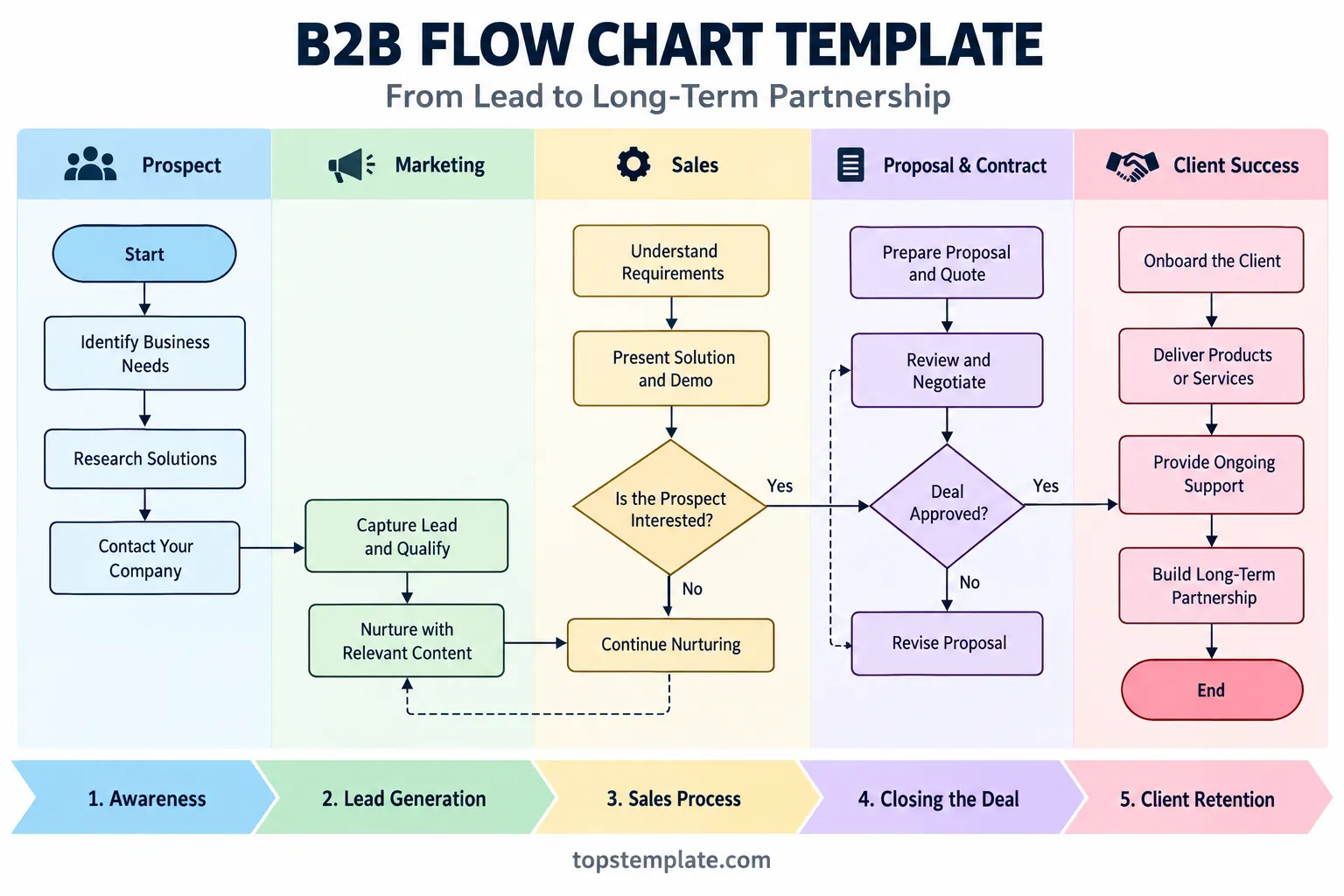
For example, a B2B sales flow chart may begin when a potential customer discovers a company and continue through lead qualification, sales discussions, proposal creation, negotiation, closing, onboarding, and customer retention.
The visual format makes it easier to identify relationships between activities. Instead of reading a long procedural document, team members can quickly follow the path and understand what action should happen next.
Why Use a B2B Flow Chart Template?
Building a workflow from a blank page can take time. A ready-made B2B flow chart template provides a structured starting point that can be adapted to different business processes.
- Improve process clarity: Team members can see the complete workflow in one place.
- Standardize procedures: A shared process helps different employees follow consistent steps.
- Identify bottlenecks: Visualizing each stage can reveal unnecessary delays or repeated tasks.
- Support employee training: New team members can use a flow chart to understand how a process works.
- Improve collaboration: Marketing, sales, operations, and customer success teams can understand how their responsibilities connect.
- Document business processes: A visual workflow can become part of a company’s internal process documentation.
Key Stages of a B2B Business Flow Chart
A B2B workflow can vary depending on the company, industry, and objective. However, many business processes share several common stages.
1. Awareness and Prospect Identification
The process often begins when a potential business customer becomes aware of a product or service. At this stage, a company may identify prospects through content marketing, search engines, referrals, events, advertising, partnerships, or outbound sales.
The flow chart can show how a prospect enters the process and what happens next. For example, an unqualified contact may be sent to a marketing workflow while a qualified prospect moves toward sales engagement.
2. Lead Generation and Qualification
After a prospect enters the business funnel, the next step is determining whether the opportunity is relevant. Lead qualification can consider factors such as company size, industry, business needs, budget, authority, timing, and potential fit.
A decision diamond in the flow chart can make this stage particularly clear. If the lead meets the qualification criteria, the process continues to sales. If not, the lead may be placed into a nurturing campaign for future engagement.
3. Sales Discovery and Requirements
Qualified prospects typically move into a discovery stage. Sales representatives may discuss the customer’s objectives, current challenges, requirements, timeline, and expected outcomes.
Documenting this stage in a B2B flow chart helps sales teams understand what information should be collected before presenting a solution.
4. Solution Presentation and Proposal
Once requirements are understood, the company can prepare a suitable solution. Depending on the business model, this may involve a product demonstration, proposal, quotation, statement of work, or customized presentation.
The flow chart should make clear what happens if the prospect requests changes. For example, a proposal may return to the sales or solution-design stage before moving forward.
5. Negotiation and Deal Approval
Many B2B transactions involve several stakeholders. Pricing, contract terms, implementation requirements, timelines, and service levels may need to be reviewed before an agreement is finalized.
A decision point such as “Is the proposal approved?” can clearly separate successful deals from proposals that require revision or further negotiation.
6. Client Onboarding and Delivery
After the agreement is signed, the workflow should continue into onboarding. This may include account setup, implementation, training, product delivery, project kickoff, or assigning a customer success manager.
Including post-sale activities is important because the B2B customer journey does not end when a contract is signed.
7. Customer Retention and Long-Term Partnership
The final stage can include ongoing support, performance reviews, renewals, upselling, cross-selling, and relationship management. A well-designed B2B process flow therefore represents the full customer lifecycle rather than only the sales funnel.
For organizations focused on recurring revenue, this stage can be especially useful for showing how successful onboarding and customer support contribute to long-term business relationships.
How to Create an Effective B2B Flow Chart
Creating a useful flow chart is not simply about adding boxes and arrows. The structure should make the business process easier to understand and follow.
Start With a Clear Objective
First, determine what the flow chart needs to explain. A sales process, procurement workflow, customer onboarding process, and lead management process will each require different steps.
A specific objective prevents the diagram from becoming unnecessarily complicated.
List Every Major Process Step
Write down the major activities before designing the visual diagram. Focus on meaningful stages rather than documenting every minor action.
For a B2B sales process, the list might include prospect identification, lead qualification, discovery, product demonstration, proposal, negotiation, approval, contract signing, and onboarding.
Identify Decision Points
Decision points are one of the most useful elements in a business flow chart. Questions such as “Is the lead qualified?” or “Is the proposal approved?” create clear paths for different outcomes.
Each decision should lead to an understandable next action. Avoid decision points that create confusing loops or unclear responsibilities.
Assign Responsibilities
Consider identifying which team owns each stage. A B2B process may involve marketing, sales, finance, legal, operations, and customer success.
Using swimlanes or clearly labeled sections can help employees understand where their responsibilities begin and end.
Keep the Visual Design Simple
A professional B2B flow chart should be easy to scan. Use consistent shapes, short labels, logical spacing, and directional arrows.
- Use rectangles for standard process steps.
- Use diamonds for decisions.
- Use arrows to show process direction.
- Use short action-oriented labels.
- Group related activities into logical sections.
- Avoid unnecessary decorative elements.
Common B2B Flow Chart Examples
A B2B flow chart template can be adapted to many business scenarios.
B2B Sales Flow Chart
This workflow can cover the complete sales journey from prospecting to closing. It is useful for sales teams that want a consistent qualification and conversion process.
Lead Management Flow Chart
A lead management flow chart can show how new leads are captured, scored, assigned, contacted, nurtured, and converted into sales opportunities.
Client Onboarding Flow Chart
This type of workflow helps customer-facing teams organize activities after a contract has been signed, including documentation, account setup, implementation, training, and initial support.
B2B Customer Service Flow Chart
A customer service workflow can illustrate how support requests are received, categorized, assigned, resolved, escalated, and closed.
Procurement Flow Chart
Procurement workflows can map purchase requests, approvals, supplier selection, purchase orders, delivery, invoice processing, and payment.
Tips for Making Your B2B Flow Chart More Useful
A flow chart becomes more valuable when it reflects the way your organization actually works. Review the diagram with the people who perform each stage rather than creating it entirely from a management perspective.
- Use real terminology: Label steps using language your employees already understand.
- Remove unnecessary steps: If an activity does not affect the process, consider removing it.
- Highlight critical decisions: Make approval, qualification, and escalation points easy to identify.
- Review regularly: Update the flow chart when software, responsibilities, policies, or customer requirements change.
- Measure important stages: Where possible, connect process stages to metrics such as conversion rate, response time, cycle time, or retention.
- Keep one source of truth: Store the approved version where the relevant teams can easily access it.
Benefits of Visualizing the B2B Customer Journey
Mapping the customer journey can reveal gaps that are difficult to see when processes exist only in written instructions. For example, a company may discover that qualified leads wait too long before receiving a sales response or that customers receive inconsistent onboarding experiences.
A visual process also encourages teams to think about handoffs. In B2B organizations, problems often occur when responsibility moves from one department to another. A clear flow chart makes those transitions visible.
Over time, the diagram can become a useful foundation for process improvement, automation, employee training, and performance management.
Final Thoughts on B2B Flow Chart Templates
A B2B flow chart template gives businesses a simple framework for turning complex processes into clear visual workflows. From lead generation and qualification to sales, proposal approval, onboarding, and customer retention, a well-structured diagram helps teams understand what should happen and when.
The most effective flow charts are specific, easy to scan, and connected to real business responsibilities. Start with the process objective, identify the major stages and decision points, assign ownership, and remove unnecessary complexity. Then review the workflow regularly as your business evolves.
Whether you are documenting a B2B sales funnel, customer onboarding process, procurement workflow, or service journey, a practical flow chart can make the process easier to communicate, improve, and scale.
