A well-structured contract for property management Template gives a property owner and manager a shared written framework for operating a rental property. It should identify the parties, describe the property, define management authority, establish compensation, explain maintenance procedures, set reporting expectations, address insurance and liability, and establish a clear process for ending the relationship. The best template is not necessarily the longest document. It is the one that makes important decisions explicit before disagreements arise.
Searchers looking for a property management agreement usually want more than a blank form. They want to understand what belongs in the document, which clauses deserve special attention, how residential and commercial arrangements differ, and how local rules can affect the final wording. A useful template therefore works as both a drafting framework and a review checklist. It helps the owner decide what authority to delegate and helps the manager understand exactly what services are expected.
Property management agreements can also involve money held on behalf of the owner, tenant deposits, repair spending, leasing authority, records, and contractual relationships with vendors. Those issues make precision especially important. Arizona law, for example, expressly addresses material duties, contract dates, cancellation terms, treatment of collected money, reporting, reserves, compensation, and certain termination procedures in property management agreements.
What a Property Management Agreement Actually Does
A property management agreement is a services and agency contract between the property owner and the manager. The owner remains the property owner, while the manager receives specified authority to perform agreed tasks. Depending on the arrangement, those tasks can include marketing vacancies, screening prospective tenants, preparing or signing leases, collecting rent, coordinating repairs, arranging inspections, communicating with tenants, paying authorized expenses, and preparing financial reports.
The distinction between a management agreement and a lease is important. A lease normally governs the relationship between the landlord side and a tenant occupying a particular property. A management agreement governs the relationship between the owner and the manager. The manager’s authority to act toward tenants and vendors comes from the management relationship and should not be assumed merely because the manager handles day-to-day operations.
Written authority is particularly important when the manager can make commitments that affect the owner. Examples include signing a lease, hiring a contractor, authorizing an emergency repair, negotiating a tenant dispute, ordering utilities, or initiating legal action where permitted. The agreement should state which actions are included in ordinary management and which require prior owner approval. This reduces uncertainty and creates a practical boundary around delegated authority.
Essential Information to Put at the Beginning
The opening portion should identify the owner and manager precisely. For an individual, this normally means the legal name and contact information. For a company, the agreement should identify the legal entity and the person authorized to sign. If a licensed professional is acting under a brokerage structure, the relevant license or brokerage information may also need to be recorded depending on local requirements.
The property description should be equally specific. Include the street address, unit numbers when relevant, property type, and any additional identifying information needed to distinguish the managed premises from another property owned by the same client. For a portfolio, list each property or attach a schedule that can be updated according to the agreement’s modification procedure.
It is also useful to identify what is included in management. A residential agreement might cover one house, a duplex, or a multi-unit building. A commercial agreement may cover office, retail, industrial, or mixed-use premises. The document should state whether common areas, parking areas, storage spaces, equipment, landscaping, furnishings, or other associated assets fall within the manager’s responsibilities.
Define the Manager’s Services in Specific Terms
The services clause is often the most important operational section. Instead of saying that the manager will “manage the property,” identify the actual work included. Leasing services might include advertising, showing coordination, tenant screening, lease preparation, renewal administration, and move-in procedures. Management services might include rent collection, tenant communication, inspections, maintenance coordination, accounting, and vendor supervision.
Tenant-related authority should be carefully described. If the manager may approve tenants, specify whether the manager follows owner-set criteria, written screening standards, or legally compliant policies. If the manager may sign leases or renewals on the owner’s behalf, state that authority directly. If certain lease terms require owner approval, such as unusually long terms, concessions, substantial alterations, or commercial lease provisions, those exceptions should be identified.
Maintenance language should be equally practical. A manager might be authorized to arrange routine repairs up to a stated spending threshold without separate approval, while larger projects require written consent. Emergency work may be treated differently when immediate action is reasonably necessary to protect people or prevent serious property damage. The contract should explain how the manager documents the emergency, communicates with the owner, and records the resulting expense.
Management Fees, Leasing Charges, and Other Costs
Compensation should never depend on an implied industry custom. The agreement should state the management fee, the calculation method, when the fee becomes payable, and how the manager receives it. Possible structures include a percentage of collected rent, a fixed recurring amount, a per-unit amount, or another negotiated arrangement. The contract should make clear whether the fee is calculated from rent actually received, scheduled rent, or another defined amount.
Additional charges should be listed separately. A manager may charge a leasing fee for placing a new tenant, a renewal fee, a project-management fee for major repairs, or reimbursement for authorized third-party expenses. The owner should be able to distinguish compensation paid to the manager from money that merely passes through the manager to contractors, utilities, authorities, or other vendors.
A useful contract also explains what happens when rent is unpaid. For example, it can specify whether the management fee is calculated only from collected rent, whether legal services are included, and whether extraordinary collection work carries a separate charge. Clear fee language protects both sides because neither party has to infer the financial arrangement from an invoice after services have already begun.
Rent, Deposits, Reserves, and Financial Reporting
Financial provisions deserve special attention because the manager may receive money belonging to the owner or tenants. The agreement should explain how rent is collected, where funds are held, which expenses can be paid from those funds, when the owner receives the balance, and how management fees are deducted. Local trust-account and deposit rules can impose additional requirements, so a general template should not be treated as a substitute for jurisdiction-specific review.
Tenant security deposits should be addressed separately from ordinary operating funds. The contract can identify who is responsible for receiving, safeguarding, accounting for, and returning deposits, while recognizing that statutory requirements may control the actual procedure. The agreement should also explain how an owner provides the manager with reserve funds for routine or emergency expenses and what happens if the reserve becomes insufficient.
Reporting provisions should specify the information the owner receives and how frequently it is delivered. A useful owner statement can show rent collected, unpaid balances, management charges, maintenance costs, vendor payments, reserves, and the amount remitted to the owner. More detailed arrangements can include bank records, invoices, reconciliations, rent rolls, inspection reports, and year-end summaries.
Insurance, Liability, and Indemnification
Insurance provisions should identify which party is responsible for maintaining property insurance, liability coverage, and any other required policies. The agreement can also state whether the manager must be named as an additional insured where appropriate. These terms should be coordinated with the actual insurance policies because contract wording does not automatically change the coverage provided by an insurer.
Liability clauses should be written carefully rather than treated as a blanket release. A typical agreement may allocate responsibility for the owner’s property, the manager’s services, vendor actions, tenant claims, and losses caused by negligence or misconduct. The language should distinguish ordinary contractual risk from conduct that cannot appropriately be excluded or shifted.
Indemnification provisions can be particularly important when the manager is authorized to hire vendors or act on the owner’s behalf. The agreement should explain when one party must defend or reimburse the other and whether that obligation applies to claims arising from authorized management activities. Because indemnification law varies by jurisdiction, this section is one of the areas where professional legal review can be especially valuable.

Term, Renewal, and Ending the Relationship
A management agreement should state when it begins and when it ends. Some agreements use a fixed initial term followed by renewal periods, while others use an ongoing arrangement subject to written notice. Whatever structure is chosen, the contract should explain how renewal works and when notice must be delivered.
Termination provisions should cover ordinary termination and termination for cause. Ordinary termination might require advance written notice, while a material breach could create a right to terminate after a defined opportunity to cure. The agreement should also address what happens if the property is sold, transferred, foreclosed upon, substantially damaged, or otherwise becomes unsuitable for the management arrangement.
The exit procedure matters as much as the termination date. The manager may need to transfer keys, leases, tenant records, inspection reports, vendor contracts, security-deposit information, accounting records, and funds. Arizona law provides a particularly detailed example of post-termination record delivery and final accounting requirements for covered property management firms.


Residential and Commercial Agreements Are Not Identical
A residential agreement generally focuses on recurring rent collection, tenant relations, inspections, maintenance, turnover, leasing, and compliance with residential tenancy rules. The manager may need clear procedures for maintenance calls, tenant notices, renewals, security deposits, inspections, and routine vendor coordination.
Commercial property management can require a broader operational framework. Depending on the property, the manager may handle common-area expenses, service contracts, operating budgets, tenant improvements, insurance coordination, utility arrangements, commercial lease administration, and more complex vendor relationships. A commercial agreement should therefore identify the specific assets, services, and financial responsibilities involved rather than simply adapting a short residential form.
Mixed-use properties require still more care because different areas may be governed by different leases, operating rules, and maintenance obligations. The agreement should distinguish residential units, commercial spaces, common areas, parking, mechanical systems, and other shared facilities when the manager’s responsibilities differ among them.


Property Management Contract Considerations in Canada
There is no single nationwide property management contract that automatically fits every Canadian property. Rental and landlord-tenant rules can differ by province and territory, so an owner should identify the governing jurisdiction before relying on a general form. The federal Office of Consumer Affairs also emphasizes that landlord and tenant regulations depend on where the property is located. :contentReference[oaicite:2]{index=2}
Canadian arrangements can also raise agency questions. The Canada Revenue Agency describes agency as a relationship in which one person is authorized to act for another, with the agent potentially affecting the principal’s legal position within the authority granted. That concept is useful when reviewing a management contract because the document should make clear which actions the manager can take on the owner’s behalf. :contentReference[oaicite:3]{index=3}
A property management contract template Canada searcher should therefore treat any general template as a starting structure rather than a jurisdiction-neutral legal instrument. The agreement should identify the province or territory, the applicable rental rules, treatment of deposits and owner funds, management fees, reporting duties, maintenance authority, insurance, privacy obligations, and termination procedure. A local lawyer or qualified real estate professional can help confirm whether the wording fits the particular property and management relationship.


Florida-Specific Issues to Check Carefully
A property management contract template florida search should not be treated as interchangeable with a generic form from another jurisdiction. Florida property management can involve real estate licensing considerations, and the details depend on the services performed and the relationship between the owner, manager, broker, and tenants. The agreement should therefore be reviewed against current Florida requirements before it is signed.
Condominium management creates an additional distinction. Florida Statute 718.3025 addresses contracts for operation, maintenance, or management of condominium associations and requires covered contracts to specify services, responsibilities, reimbursable costs, service frequency, certain personnel information, and specified financial-interest disclosures. It also provides that services or obligations not stated in the contract may be unenforceable under the section. :contentReference[oaicite:4]{index=4}
That illustrates a broader drafting lesson: the right template depends on the property and legal relationship, not merely the state name. A rental house, apartment community, condominium association, and commercial building may require very different provisions. The safest approach is to identify the exact property type first, then adapt the agreement to the applicable legal framework and business arrangement.
Common Mistakes to Avoid
One common mistake is using broad language such as “manager will handle all property matters.” That wording may seem convenient, but it can create uncertainty over leasing authority, spending limits, litigation decisions, vendor contracts, and owner approvals. A better agreement identifies authority by category and gives specific approval thresholds where money or significant commitments are involved.
Another mistake is focusing only on the headline management fee. Owners should review leasing charges, renewal charges, maintenance coordination fees, vendor markups, administrative charges, legal costs, reserve requirements, and reimbursable expenses. Managers should likewise confirm that the compensation structure reflects the actual workload and that unusual services are not silently included in an ordinary monthly fee.
A third mistake is neglecting the end of the relationship. An agreement that explains how management begins but says little about transition can create problems involving keys, tenant records, deposits, unpaid bills, vendor contracts, pending repairs, and final accounting. A well-designed contract treats transition as a planned process rather than an afterthought.
How to Review a Property Management Agreement Before Signing
Start by reading the agreement from the owner’s perspective. Ask what the manager is authorized to do without permission, what requires written approval, how much can be spent on repairs, how often reports arrive, how funds are handled, and what happens when tenants stop paying. Every material business expectation should appear somewhere in the written agreement or an expressly incorporated addendum.
Then review the document from the manager’s perspective. Confirm that the service scope is realistic, that owner responsibilities are clear, that required reserves are adequately described, and that the fee structure accounts for extraordinary work. Check whether the manager has authority to communicate with vendors, enter contracts, respond to emergencies, and enforce the owner’s policies within lawful limits.
Finally, review the document for consistency. The fee clause should match the accounting provisions. The maintenance clause should match the spending authority. The termination clause should match the transfer-of-records procedure. Insurance provisions should align with actual policies. Property descriptions should match schedules and attachments. Signatures should be completed by parties with authority to bind the owner and manager.
Practical Solution
The most practical way to build a reliable contract for property management Template is to work through the document in a fixed sequence. First identify the parties and the exact property. Second define every service the manager will provide. Third establish the manager’s authority and approval thresholds. Fourth specify fees and reimbursable expenses. Fifth document the handling of rent, deposits, reserves, and reporting. Sixth address maintenance, insurance, liability, records, and compliance. Finally establish the term, renewal, termination, and transition process.
For a typical residential arrangement, the working draft can begin with a property schedule, a detailed service list, a fee schedule, a repair authorization limit, an owner-reserve provision, reporting requirements, insurance language, and an exit checklist. Keep operational details in schedules or addenda when that makes the main agreement easier to read. The goal is not to create unnecessary complexity; it is to make important decisions easy to find and difficult to misunderstand.
Before signing, compare the completed document with the laws and professional requirements governing the property’s location. State and provincial rules can affect licensing, trust accounts, deposits, notices, reporting, condominium management, and other subjects. The agreement should then be reviewed by qualified local counsel when the property value, portfolio size, commercial complexity, or legal risk justifies professional review. A carefully reviewed template is much more useful than a generic form that leaves critical decisions unstated.


Reference Examples
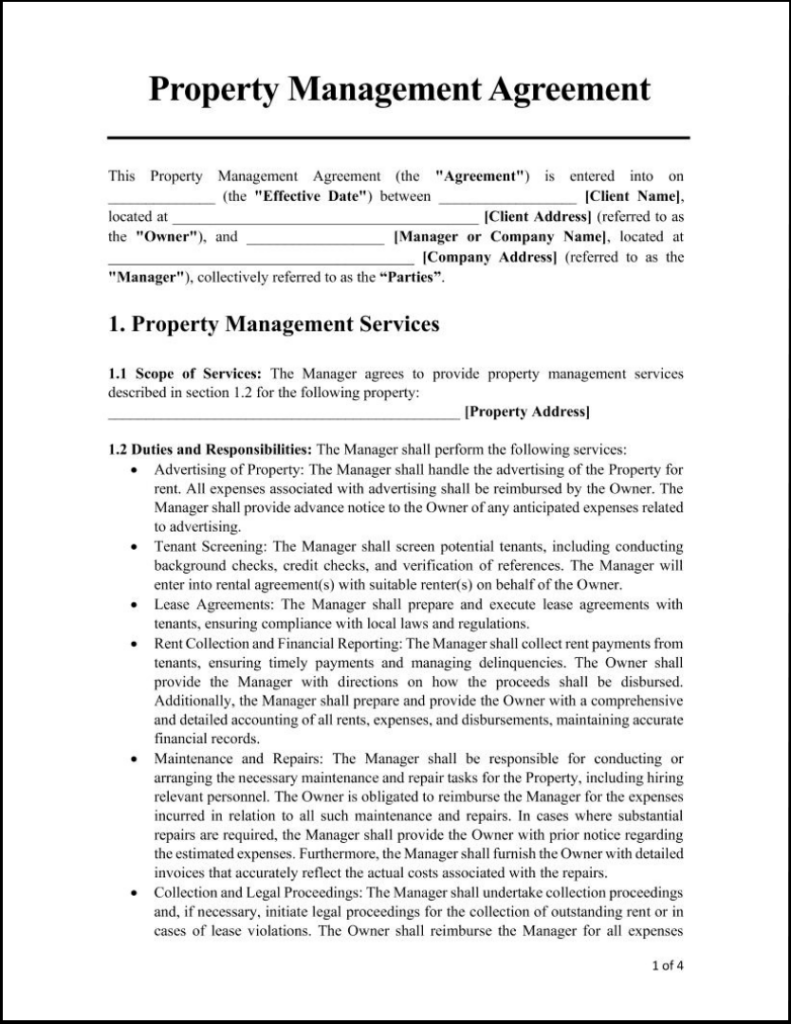
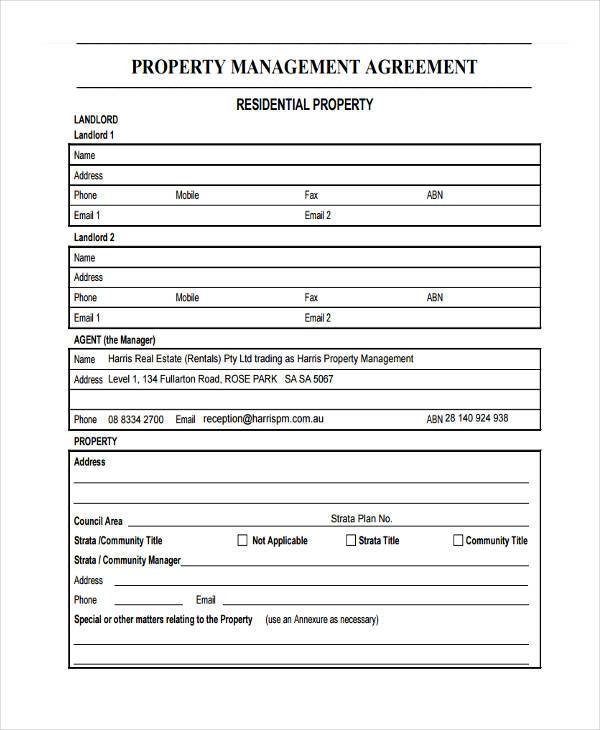
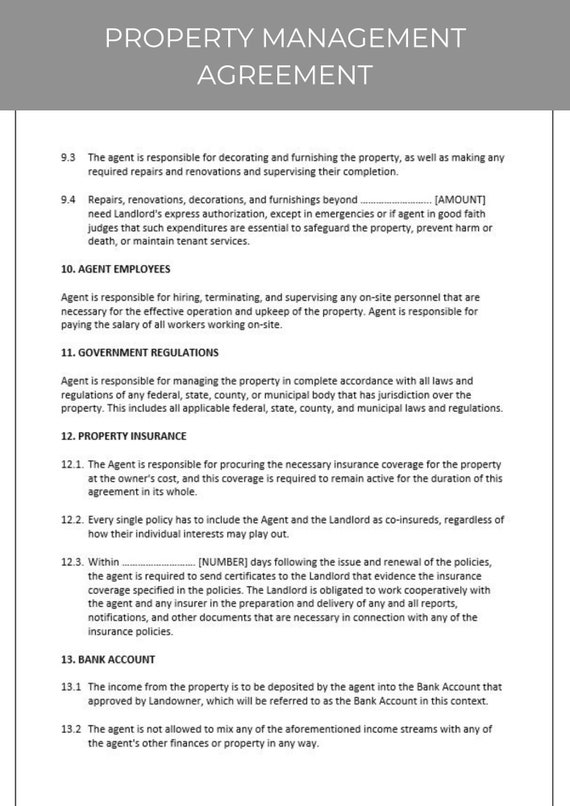
A contract for property management Template is easiest to evaluate when its structure can be compared with real document layouts. Useful examples typically show how the parties and property are identified, where the manager’s authority is stated, how compensation is presented, and how signatures or termination provisions are organized. The examples below are visual references rather than universal forms. Their wording, jurisdictional assumptions, and business terms should not automatically be copied into another management relationship.
The following references also demonstrate why a good contract for property management Template should be assessed as a complete document rather than by looking only at its first page. Some examples emphasize leasing and property identification, while others show maintenance, insurance, termination, or signature provisions. Comparing these layouts can help an owner or manager recognize missing sections, understand how detailed the agreement may need to be, and create a more deliberate review process before signing.
Residential Property Management Agreement Template
Source: SampleForms
Vermont Property Management Agreement Form
Source: Property Management Forms
Rhode Island Property Management Agreement
Source: Property Management Forms
Property Management Agreement Template Excerpt
Source: Etsy
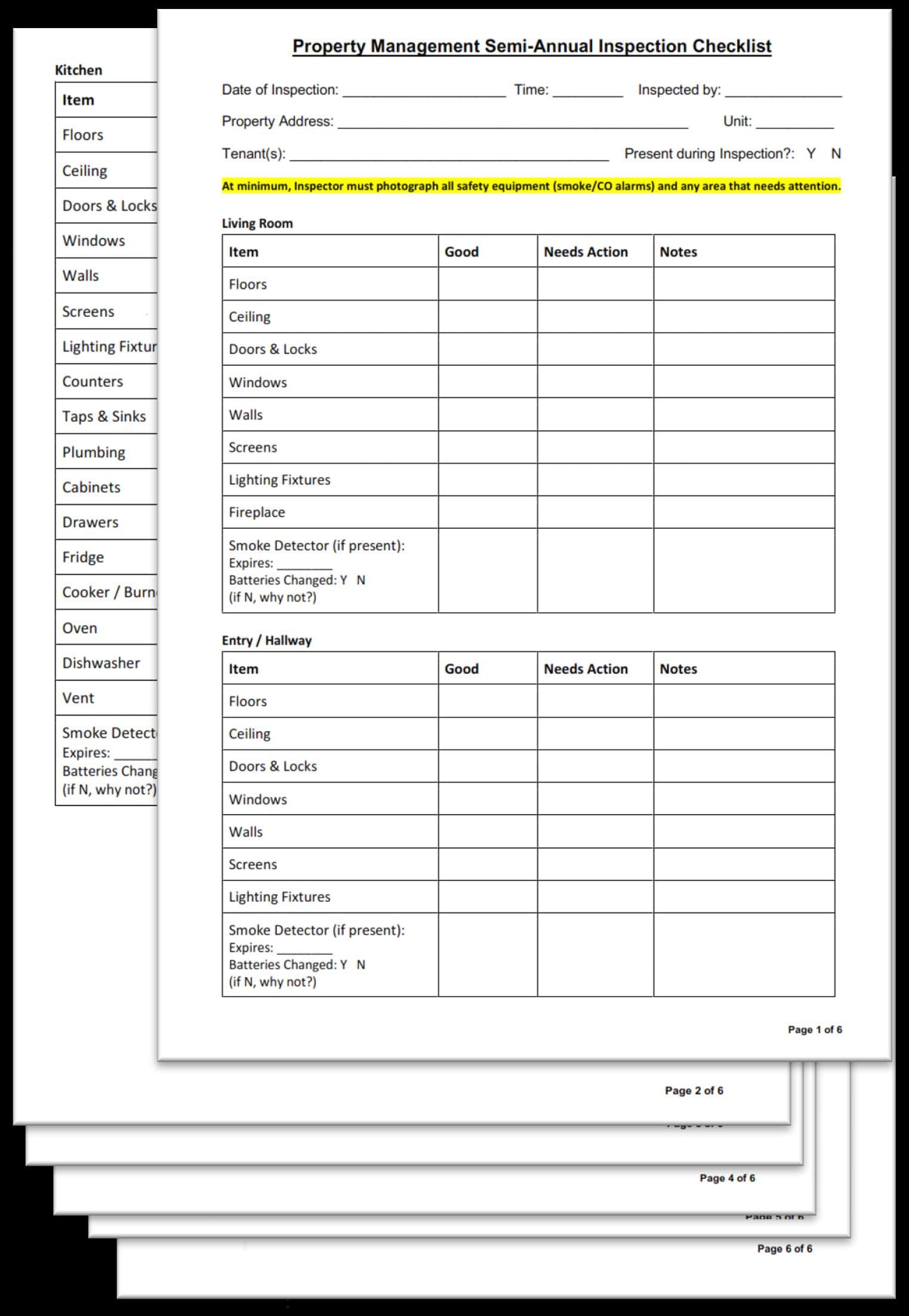
Semi-Annual Rental Inspection Checklist
Source: Etsy
Colorado Property Management Agreement Template
Source: eForms
Owner’s Notice to Terminate Management Agreement
Source: eForms

Sample Property Manager/Owner Letter
Source: StudyLib
New York Property Management Agreement for Leasing — Page 1
Source: Lumin PDF
New York Property Management Agreement for Leasing — Page 2
Source: Lumin PDF
