A strong marketing content distribution plan template Template is more than a calendar with dates and channel names. It is a working framework that connects each piece of content to a target audience, a business goal, a distribution route, an owner, a publishing moment, and a measurable result. The central question is not simply what the team will publish. It is where each asset should travel, why that route fits the audience, what version belongs on each channel, and how the team will judge whether the effort was worthwhile.
That distinction matters because content creation and content distribution solve different problems. Creation produces the asset; distribution creates the path by which the asset can reach people. A useful plan therefore records the original asset, the audience segment, the funnel stage, the channel, the format, the message, the timing, the call to action, and the metric that will be reviewed. This structure can work for a solo marketer, an agency, a small business, or a larger editorial team with several campaigns running at once.
Current content planning guidance from organizations such as the American Marketing Association, Content Marketing Institute, Smartsheet, and Semrush consistently points toward the same operational idea: planning works best when goals, audiences, formats, channels, owners, dates, and measurement are connected rather than kept in separate notes. A distribution plan makes that connection visible. It also creates a record that can be refined when performance data shows that one channel or format is stronger than another.
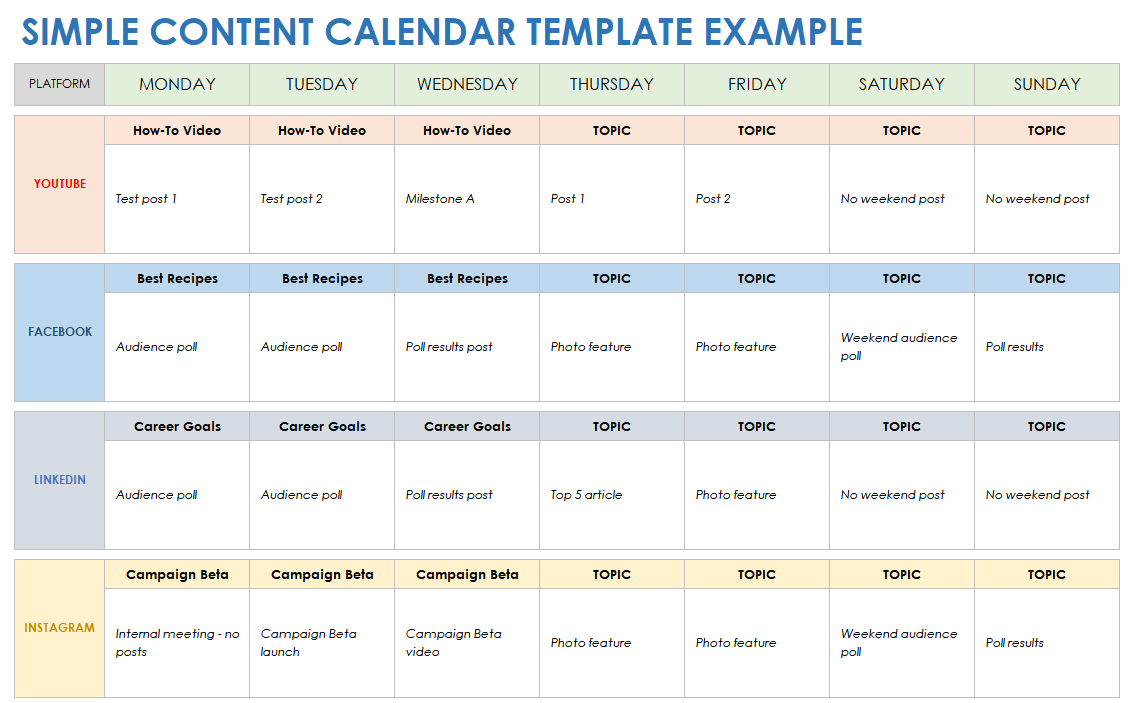
The visual structure of a calendar is useful because timing is one of the easiest parts of distribution to overlook. A plan can show which channel receives the first release, which channels receive supporting versions, and which follow-up messages occur later. This prevents a common operational problem in which every channel receives the same asset at the same time without considering how people use that channel.
A distribution plan also gives the team a place to record dependencies. A blog article may need a search-focused title, an email version, a social excerpt, a visual asset, and a measurement tag. A webinar may need an invitation sequence, reminder messages, a registration page, a live-session promotion, and a post-event recap. When these pieces sit inside one structure, the team can see the campaign as a connected system rather than as isolated publishing tasks.
The best template is therefore neither the longest nor the most decorative. It is the one that captures the decisions needed to execute the campaign without creating needless administration. A compact plan with strong fields is usually more useful than a giant worksheet that nobody keeps current.
What a marketing content distribution plan should contain
The first layer is strategic. Record the business objective, campaign objective, audience, funnel stage, core message, and desired action. The objective might be awareness, qualified traffic, lead generation, product education, retention, or support for a launch. The audience field should be specific enough to guide channel selection. A broad label such as “customers” is less useful than a segment defined by role, need, buying stage, or content interest.
The second layer is operational. Record the asset title, content type, channel, owner, draft status, publish date, promotion window, and required supporting materials. If one source asset becomes several channel versions, keep the relationship visible. For example, a research article might produce a newsletter summary, a short social post, a carousel, a presentation slide, and a sales-enablement excerpt. Each version should still point back to the same campaign objective.
The third layer is measurement. A good plan does not stop at publication. It states what signal will indicate success. Reach may matter for awareness, qualified visits for consideration, form completions for lead generation, and revenue or retained customers for lower-funnel work. Metrics should be chosen before publishing when possible, because a metric chosen after results arrive can encourage selective interpretation.
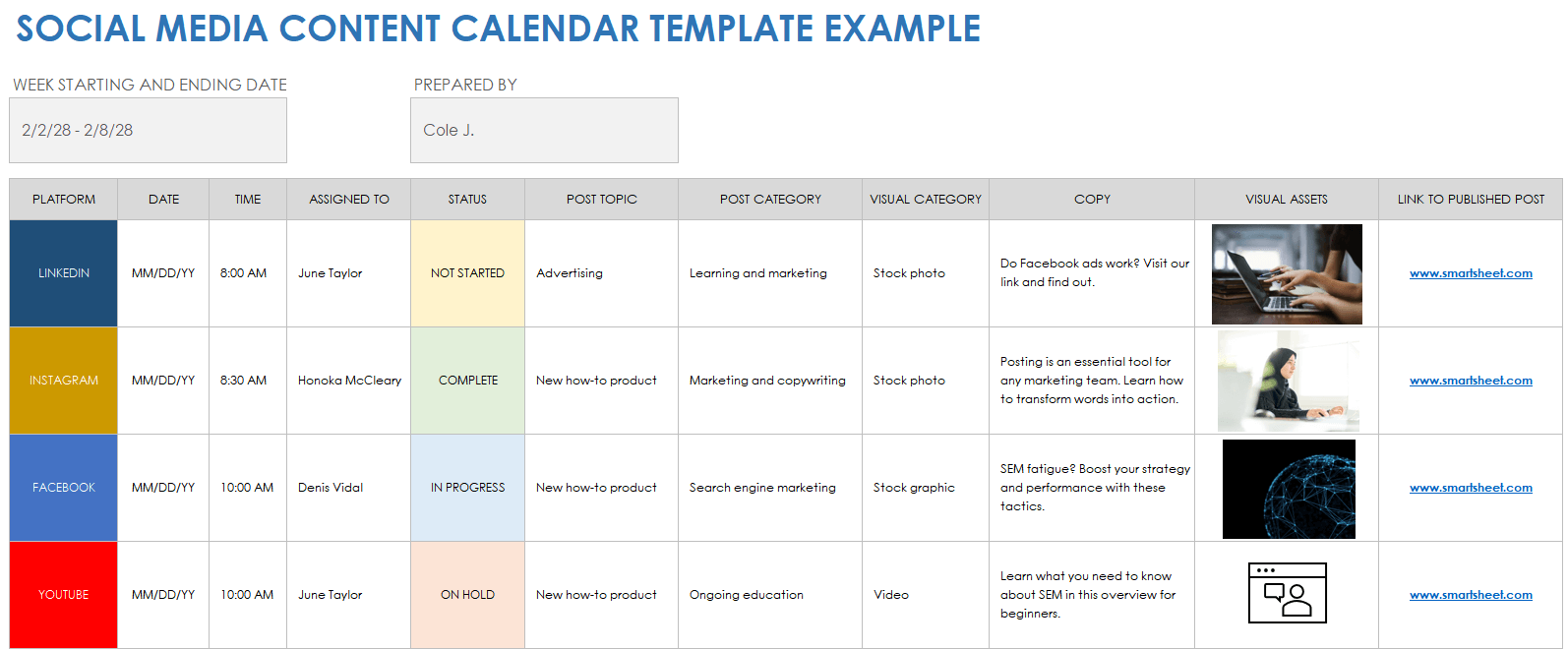
A social distribution view benefits from channel-specific fields. The same campaign may use a professional network for thought leadership, a visual network for a condensed graphic, and email for a deeper explanation. The plan should record these differences instead of treating every network as interchangeable.
For a useful worksheet, consider fields such as: campaign, asset, audience, funnel stage, channel, content format, owner, publish date, promotion date, destination, call to action, status, primary metric, result, and next action. Teams can add budget, partner, paid placement, geographic market, language, or compliance review when those factors matter.
Do not force every field into every row. A recurring newsletter may need a subject line and segment field, while a video series may need a production status and thumbnail field. The template should be modular enough to serve different content types while keeping a shared core of strategic information.
Owned, earned, and paid distribution
A practical plan normally separates distribution into three broad groups: owned, earned, and paid. Owned routes are channels the organization controls, such as its website, email list, resource center, or brand publishing space. Earned routes include organic sharing, mentions, editorial coverage, community discussion, and other exposure that is not directly purchased. Paid routes include sponsored placements, paid search, paid social, display, and other media bought for reach or action.
This classification is useful because each group behaves differently. Owned channels give the team more control over timing and presentation. Earned exposure can extend credibility and reach but is less predictable. Paid distribution can provide controlled targeting and scale while introducing a direct media cost. A balanced plan can use one route to strengthen another rather than treating the three groups as isolated silos.
For example, a new research report could first live on the company site, then receive an email announcement, then be summarized in social posts, then be pitched to relevant publishers, and finally receive paid promotion if the report supports a high-value campaign. The plan can show the sequence and the purpose of each stage. That is more useful than simply listing every possible channel.

Channel choice should follow audience behavior and content fit. A detailed article may work well on a company site and in search, while a visual summary may be better suited to social sharing. A concise update may work in email, while a longer instructional format may suit a webinar or resource center. The template should document the reason for each channel, not only the channel name.
Frequency also needs context. Publishing more often is not automatically better. A team should choose a cadence it can sustain while preserving quality, relevance, and measurement. A smaller number of strong assets with deliberate distribution can be easier to manage and easier to evaluate than a high-volume schedule with weak follow-through.
Geography can matter as well. If a plan serves multiple markets, record country or region, language, time zone, and any channel differences. This is particularly useful when evaluating the phrase marketing content distribution plan template template uk, because a regional plan may require local timing, audience assumptions, and editorial conventions even when the core campaign remains the same.

How to turn the template into a working campaign system
Start with the campaign objective. Write one sentence that states the business outcome and the audience action. Then define the primary audience and the problem or need the content addresses. This prevents the distribution plan from becoming a list of channels without a clear reason for using them.
Next, define the source asset and the content variants. A source asset might be a report, article, webinar, guide, case study, video, or product education piece. List the versions required for each selected channel. This is where a template becomes a workflow: each row or field should tell someone what must occur next.
After that, assign dates and owners. Distinguish the asset publication date from the promotion date. A launch may have a pre-release phase, a release day, a follow-up phase, and a later reuse phase. Ownership should be explicit so that a missing caption, review, link, or visual does not block the whole campaign.

Build the measurement layer before the campaign begins. Choose a primary metric for each channel and define the decision that follows the result. For example, a high reach with weak qualified traffic may lead to a message or audience review. Strong engagement with weak conversions may suggest a destination or call-to-action issue. Low reach may suggest a channel, timing, or distribution problem.
Then create a review rhythm. A short weekly check can focus on execution status and immediate changes. A monthly review can compare channels and formats. A quarterly review can decide which themes, assets, and distribution routes deserve more attention. This rhythm keeps the template alive rather than turning it into a static planning document.
Finally, preserve lessons learned. Add a short field for what worked, what did not, and what should change next time. Over several campaigns, the plan becomes a knowledge base for channel selection, format decisions, timing, and measurement.

Choosing the right format for the planning document
A spreadsheet-style format is useful when the team needs filtering, sorting, dates, owners, and metrics. A document format can work well when the plan needs more narrative context, such as audience definitions, messaging rules, or campaign rationale. A presentation format is useful when the plan must be reviewed by stakeholders who need a visual summary rather than a detailed working sheet.
Search behavior often produces format-specific phrases. For example, someone may search for marketing content distribution plan template template word, marketing content distribution plan template template pdf, marketing content distribution plan template template doc, marketing content distribution plan template template ppt, or marketing content distribution plan template template powerpoint. These phrases describe desired output formats rather than different strategic subjects. The underlying planning logic can remain the same while the presentation layer changes.
The phrase marketing content distribution plan template template sandbox is different. In a technical context, “sandbox” can mean an isolated environment for testing. If that phrase emerges in search data, it should not automatically become a content-planning category. Treat it as a signal about query intent, then decide whether it belongs in the editorial scope.

Likewise, marketing content distribution plan template template function overload and marketing content distribution plan template template parameters are technical-looking phrases that do not describe ordinary marketing planning. A sensible SEO workflow records them as query data, checks their context, and avoids distorting the main article around them. This is an important editorial lesson: not every adjacent search phrase deserves a dedicated topic.
That method protects topical clarity. The page should answer the intent behind the primary keyword first. Supporting terms can help clarify format, region, or related planning concepts, but they should not pull the article into programming documentation or unrelated technical subjects.
The practical rule is simple: preserve useful search language when it fits the reader’s task, but keep the page centered on marketing content distribution planning. A template should help someone decide what to publish, where to place it, when to release it, who owns the task, and how the result will be judged.

Building a reusable distribution workflow
Once the core template is defined, create a repeatable sequence. A useful sequence is strategy, audience, source asset, channel selection, adaptation, scheduling, publication, measurement, review, and reuse. Each step should have a clear owner and a visible status. The exact sequence can vary, but the important point is that distribution becomes part of production rather than an afterthought.
Repurposing deserves its own field. One strong source asset can support several related formats when the message remains coherent. A report can become a summary article, a visual chart, a newsletter segment, a short video, and a sales talking point. The plan should show which derivatives are planned and which are optional, so the team does not create unnecessary work.
Quality control is another useful field. Before publication, verify the destination link, message consistency, format, accessibility, brand language, tracking method, and audience fit. The checklist should be short enough to use consistently. A complex review process that slows every release may reduce the value of the distribution plan.

Channel overlap can also be intentional. An owned article may support search visibility, an email message may bring existing subscribers back to it, and social discussion may generate additional exposure. Paid media may then amplify a proven message. The template should record these relationships so the team can see how channels reinforce one another.
Use a priority field to separate essential distribution from optional distribution. A small team might designate the website, email, and one social channel as core routes, while a larger campaign may add communities, partners, paid media, video, or events. Prioritization keeps the plan manageable and makes resource limits visible.
A mature workflow also includes an archive. Keep past campaigns with their results and notes. Historical records help teams avoid repeating weak tactics, identify durable themes, and recognize assets that continue to perform after the original campaign ends.

Metrics that make the plan useful
Metrics should answer business questions. Reach and impressions can describe exposure, but they do not explain whether the right audience acted. Engagement can show interest, while qualified visits can show stronger intent. Lead actions can indicate demand creation, and revenue or retention measures can connect content work to business outcomes when reliable attribution is available.
Do not treat one metric as the universal score. A top-of-funnel educational article may have a different success signal from a product comparison page. A newsletter may emphasize clicks and downstream actions, while a video may emphasize completion or qualified site visits. The planning template should let each content type use the metric that best matches its role.
Trend analysis is often more useful than a single result. Compare similar formats over several periods, note changes in audience response, and record what changed in the campaign. A simple results field can include the observed outcome, the interpretation, and the next action.

For reporting, keep the summary close to the original plan. Show the objective, selected channels, major assets, timing, results, and lessons. This makes stakeholder review easier because the report answers the same questions that guided the campaign.
Measurement should also guide future planning. If a channel repeatedly produces useful outcomes with reasonable effort, give it a clear place in the next plan. If a channel creates activity but little business value, test a new message, format, audience, or timing before deciding whether to reduce its role.
The strongest templates therefore connect planning and learning. They do not merely record what occurred. They make the next distribution decision easier.

Common mistakes to avoid
One common mistake is treating every channel as a duplicate publishing outlet. A strong distribution plan recognizes that channel audiences, formats, and expectations differ. The same core idea can remain consistent while the hook, length, visual treatment, and call to action change.
Another mistake is planning publication without planning promotion. A high-value asset may need several supporting touches before and after publication. If the template records only the launch date, the team may lose the chance to extend the asset’s useful life.
A third mistake is measuring activity instead of outcomes. Counting posts, emails, or campaign tasks can show production volume, but it does not show whether the work moved the intended audience toward the desired action. Include outcome fields and a place for the next decision.

Another issue is overloading the worksheet. If every row demands dozens of fields, the team may stop maintaining it. Keep the shared core small and add specialist fields only when they support a real decision or workflow.
It is also risky to copy a template without adapting it to the business. A B2B campaign, an ecommerce campaign, a publisher, and a nonprofit may use different channels and metrics. The structure should be consistent enough for governance but flexible enough for real operating conditions.
Finally, avoid confusing search-query research with editorial direction. Search data can reveal useful language, but the presence of an odd query does not mean the article should become a page about that unrelated subject. Relevance remains the strongest editorial filter.

Practical Solution
Start by creating one master worksheet with these core fields: campaign, business goal, audience, funnel stage, source asset, channel, content variant, owner, publish date, promotion date, destination, call to action, status, primary metric, result, and next action. Keep the fields in that order so the plan moves from strategy to execution and then to learning.
Next, create a short channel guide beside the worksheet. For each selected channel, record the audience, role in the campaign, preferred formats, normal cadence, message style, and primary metric. This guide prevents repeated debate about why a channel was chosen and gives new team members a clear operating reference.
Then build a campaign sequence. Mark the source asset as the anchor, place the first release date, add supporting distribution, and schedule follow-up activity. Give each task an owner. If a task depends on another task, record that dependency in notes so the team can see what might delay the sequence.

Before launch, review every destination, message, format, tracking method, and audience selection. After launch, record the first meaningful signals and resist making major judgments from a single short period. At the planned review point, compare results with the original objective and record one or two changes for the next cycle.
For a small team, this can remain a simple spreadsheet. For a larger team, the same structure can sit inside a shared planning system with views for campaigns, channels, owners, and status. The format can change without changing the underlying logic. That is the key benefit of a durable marketing content distribution plan template Template: it gives the team a consistent decision structure while allowing the execution details to evolve.
Use the template as a living operating document. Review it when campaigns change, update it when channel conditions shift, and archive results after each major cycle. Over time, the plan becomes more than a schedule. It becomes a practical record of which content, audiences, channels, messages, and timing choices produce useful outcomes.

How to keep the template useful over time
Set a review cadence that matches the pace of your marketing work. A weekly check should focus on dates, owners, blockers, and immediate publishing needs. A monthly review can examine channel performance and content mix. A quarterly review can reconsider the audience, business objectives, channel portfolio, and measurement model.
Keep naming conventions consistent. Use stable campaign names, clear asset titles, and standardized status labels. This makes filtering and reporting easier and reduces ambiguity when several people work on the same plan. Consistency also helps when old campaigns are reviewed for lessons.
Finally, keep strategic decisions visible. If the team stops using a channel, changes a publishing cadence, or shifts a content format, record why. The reason matters because it turns the template into organizational memory rather than a simple task list.




Reference Examples
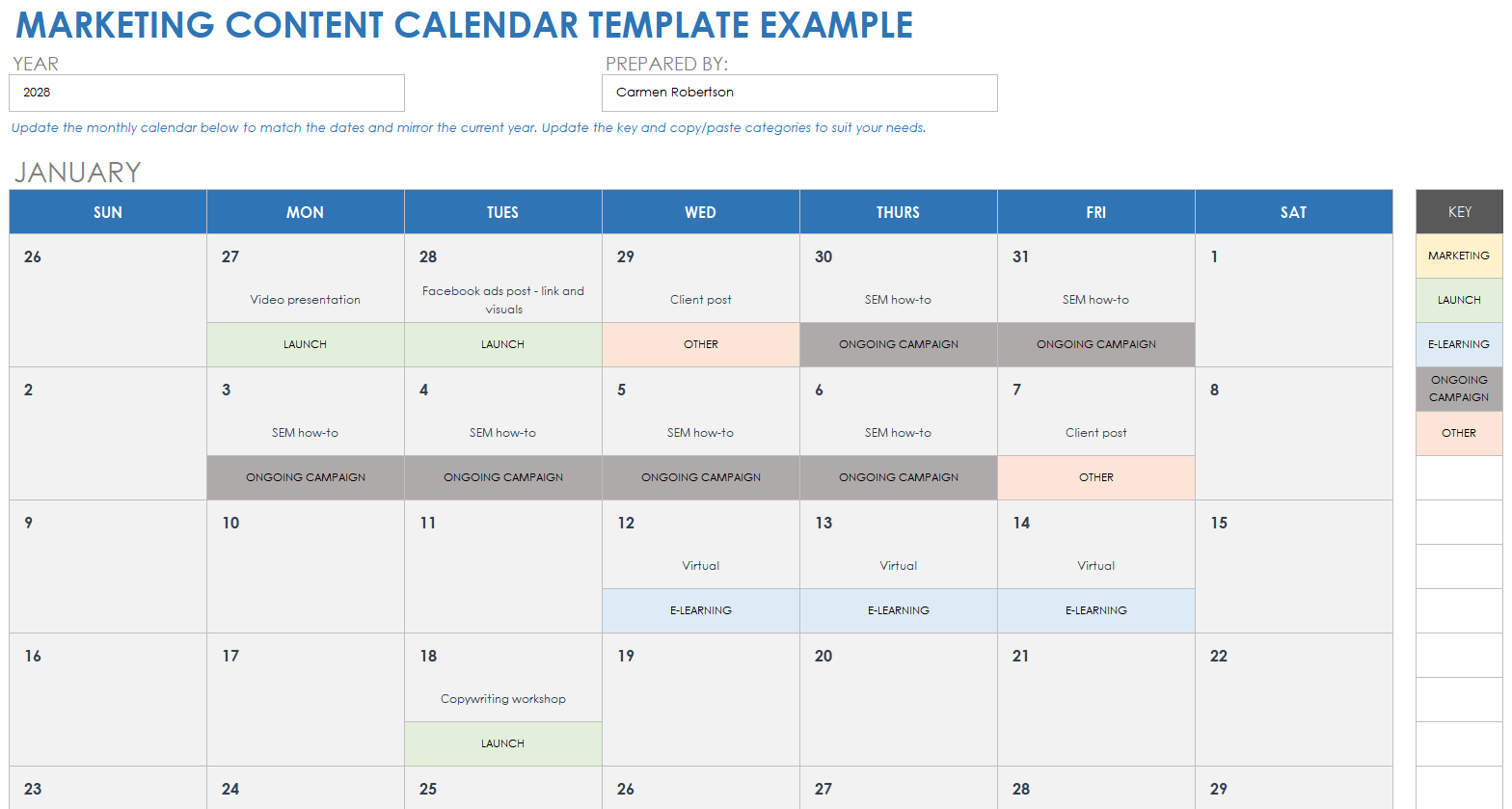
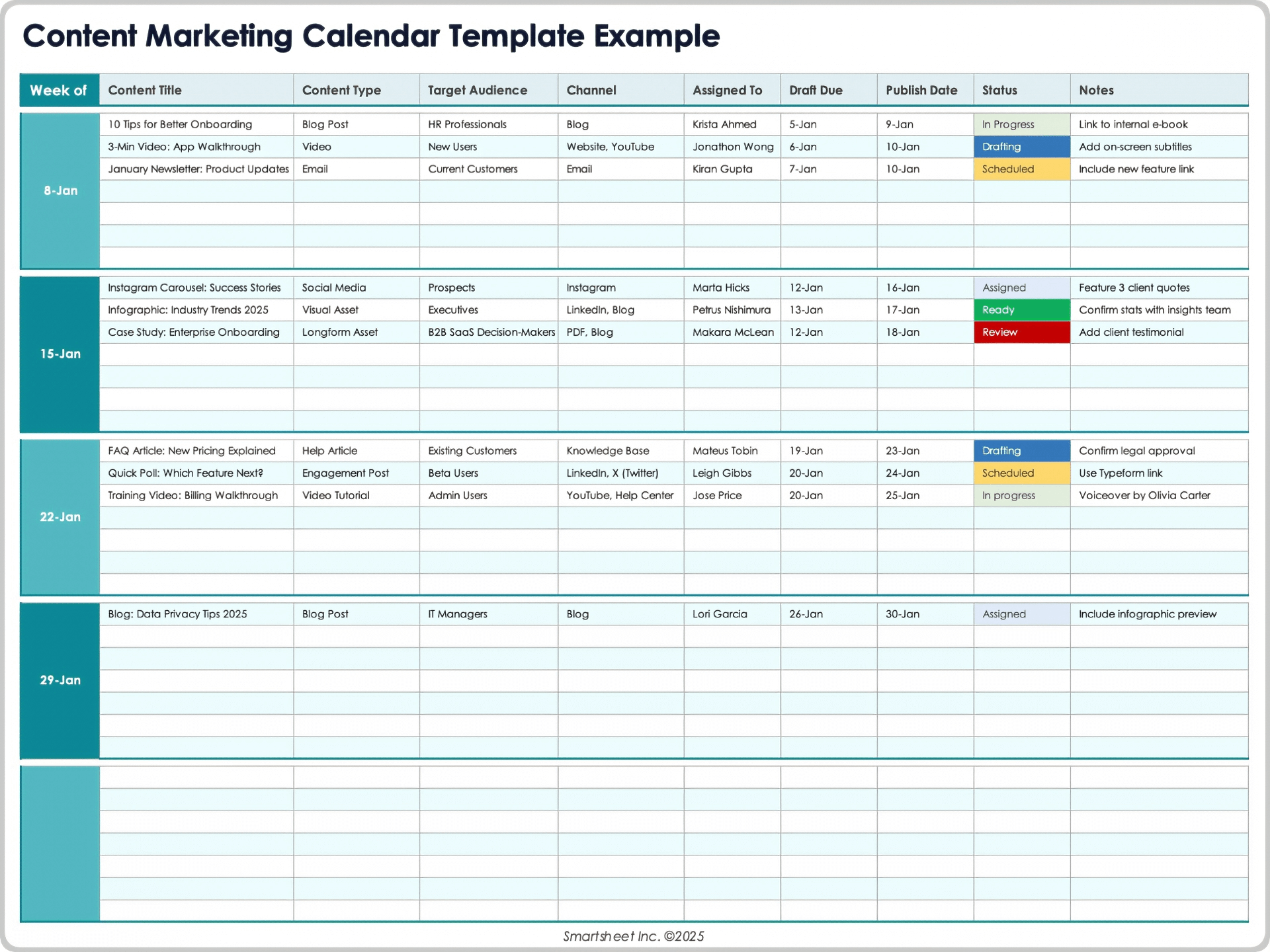
A marketing content distribution plan template Template is easiest to understand when you can see how calendars, campaign schedules, channel matrices, roadmaps, and goal worksheets organize related decisions. The strongest visual references tend to place strategy and execution in the same view: an audience or campaign goal sits alongside timing, content type, channel, ownership, and measurement. That arrangement makes the planning logic visible and helps teams decide which fields belong in their own working document. The examples below cover several useful structures, from editorial calendars and campaign plans to content roadmaps and goal frameworks.
These references also show why one layout cannot serve every team in exactly the same way. Some plans emphasize dates and publishing cadence, while others emphasize channel selection, campaign stages, content variants, or performance review. Use the visuals to compare structure rather than copy a design without thought. A strong marketing content distribution plan template Template should reflect the audience, content mix, channels, operating rhythm, and measurement needs of the organization using it.
Social Media Content Calendar View

Source: Asana

Blue Content Marketing Plan Presentation Template
Source: Venngage

Content Marketing Presentation Cover
Source: Venngage

Content Marketing Campaign Insights Presentation
Source: Venngage

SMART Content Goals Infographic
Source: Planly

SMART Goals Framework for Social Media Marketing
Source: Semrush

SMART Goals for Email Lead Generation
Source: Tiny Coast Digital

SMART Goals for Content Planning
Source: SlideTeam

Example SMART Marketing Goals Template
Source: Smartsheet

Example Marketing and Sales Goals Template
Source: Smartsheet
